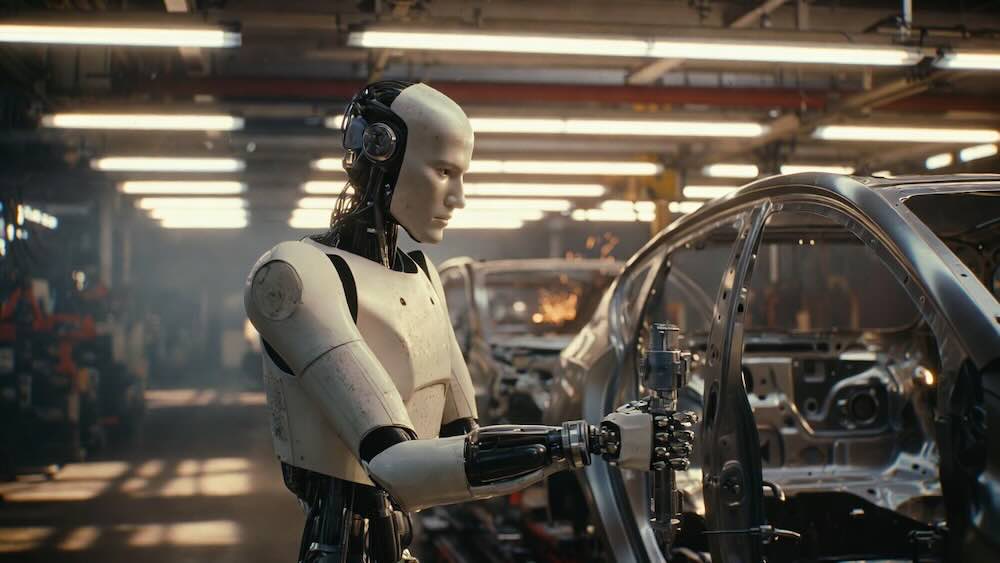
What happened: Interesting Engineering reports a new high-capacity humanoid robot production line in Guangdong began operating on March 29, 2026, backed by Leju Robotics and Dongfang Precision Science and Technology. It is pitched as China’s first line built for truly industrial output, not just demo-day theatre.
Why it matters: The claimed capacity is up to 10,000 humanoids a year, with one robot finishing about every 30 minutes, a stated 50% efficiency boost versus traditional methods. That kind of throughput turns “humanoid startup” into “humanoid supply chain,” which is where hype either becomes a business or quietly evaporates.
Wider context: The piece frames volume as the new scoreboard in a global race: Agibot says it has rolled out its 10,000th humanoid, Unitree is reportedly pursuing $580 million in funding tied to a 75,000-units-per-year target, and UBTECH is aiming for 5,000 units annually while pushing costs below $20,000 per robot. Humans love a moonshot; factories love a bill of materials.
Background: The factory’s line reportedly uses 24 precision assembly stages and 77 inspection checkpoints, plus a flexible setup with automated guided vehicles and digital control so it can switch between models without a full overhaul. Each robot is also said to face 41 simulated work-condition tests before it escapes into the wild (or, more likely, another controlled pilot).
New humanoid robot factory in China claims it can make one unit every 30 minutes — Interesting Engineering
Droid Brief Take: Congrats, we have entered the era of “humanoids per hour” metrics, which is both thrilling and deeply cursed. If the hardware line is real, the next bottleneck is software that survives unpredictable environments, because factories can ship robots faster than autonomy can stop embarrassing itself.
Key Takeaways:
- Throughput Claims: The launch details cite a robot rolling off the line roughly every 30 minutes and an efficiency gain of about 50% versus traditional assembly methods, paired with an annual capacity claim of up to 10,000 humanoids.
- Factory-Grade QA: The production line is described as having 24 precision assembly stages and 77 inspection checkpoints, with robots undergoing 41 simulated work-condition tests before leaving, an attempt to make “reliability” more than a PowerPoint noun.
- Contract Manufacturing Model: The partnership splits responsibilities with Leju focused on design and software while Dongfang Precision handles large-scale production, system integration, and after-sales support, plus a reported 2.8% equity stake to align incentives.
- Software Still Hurts: The article argues that even if factories can produce thousands of humanoids, meaningful deployment remains constrained by software maturity in real-world, unpredictable environments, shifting pressure onto AI developers to make robots useful workers rather than showcases.
Related News
China Puts Humanoid Interns on the Factory Floor — Another China factory-floor angle, but focused on deployment theatre versus reality rather than raw production capacity.
China Humanoid Robot Industry Takes the Lead — A broader look at China’s momentum, useful context for why manufacturing scale is becoming the headline, not just the demo clips.
Relevant Resources
Manufacturing & Warehousing: Humanoid Robots on the Factory Floor — The practical constraints and use-case reality that determine whether “10,000 units a year” becomes deployed work or warehouse decor.
Robot Operating Systems & Software Stacks — The unglamorous layer that has to work reliably if mass-produced humanoids are going to do anything besides stand there looking expensive.