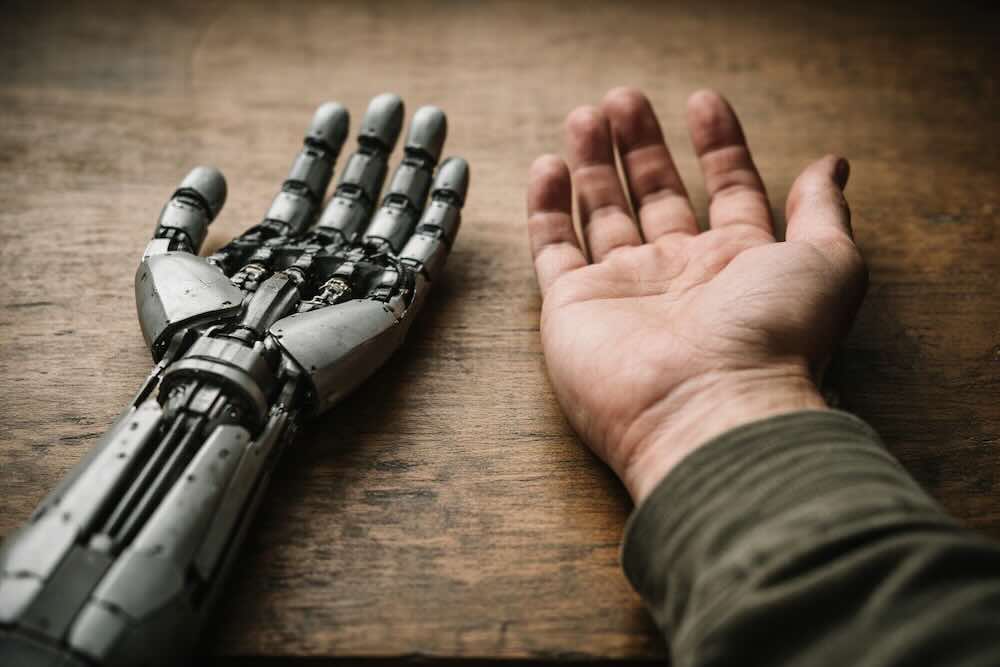
The human body is not the fastest, strongest, or most efficient design in nature. So why are some of the world's most ambitious technology companies spending billions to build robots in our image? The answer is more practical — and more interesting — than you might think.
The Question That Won't Go Away
If you've spent any time reading about humanoid robots, you've probably had this thought: why bother making them look like people? We already have incredibly capable robots that look nothing like humans. Industrial robot arms assemble cars with superhuman speed and precision. Warehouse robots on wheels can shift thousands of kilograms of goods around the clock without tiring. Drones survey terrain that no human could reach. Surgical robots operate with steady hands that no surgeon can match — and they have four or six arms, not two.
So why would anyone choose the human form — a shape that is unstable on two legs, limited to two arms, constrained by a high centre of gravity, and fiendishly difficult to engineer — when purpose-built alternatives already outperform us at almost every specific task?
The answer lies in a word that rarely appears in robot marketing materials but underpins the entire industry: generality.
The World Is Built for Human Bodies
This is the single most important argument for humanoid robots, and it is overwhelmingly practical.
Over the course of human history, we have constructed an entire civilisation around the dimensions and capabilities of the human body. Door handles sit at arm height. Stairs are sized for human legs. Light switches, taps, tools, vehicles, keyboards, countertops, shelves, drawers, corridors, lifts — all of it is designed on the assumption that the user is roughly 150 to 190 centimetres tall, has two hands with opposable thumbs, walks upright, and can reach, bend, twist, carry, and climb in the ways that human bodies can.
This isn't a minor detail. It's the entire built environment. And it means that any robot designed to operate in human spaces — homes, offices, hospitals, factories, shops, construction sites — has two options:
- Option A: Redesign the environment to suit the robot. Flatten the stairs. Widen the doorways. Replace the handles with automated systems. Install specialised docking stations and conveyor belts. This works, and it's exactly what we do in highly controlled settings like car factories and Amazon warehouses. But it's extraordinarily expensive, and it's simply impossible in most of the places where we actually need robots — existing buildings, homes, disaster zones, hospitals mid-shift.
- Option B: Build the robot to fit the environment as it already is. Give it a body that can navigate stairs, reach shelves, open doors, use tools, sit in chairs, and move through spaces designed for people. In other words, give it a human-shaped body.
The humanoid form factor is, in this sense, not an aesthetic choice. It's an engineering strategy. A human-shaped robot is a general-purpose machine that can operate as a drop-in replacement in any environment already designed for humans, without requiring that environment to change.
As NVIDIA CEO Jensen Huang put it when explaining his company's massive investment in humanoid robotics: the easiest robot to adapt into the world is a humanoid robot, because we built the world for us.
The Generalist Advantage
This is where the argument gets deeper. Specialised robots beat humans — and would beat humanoid robots — at almost any individual task. A SCARA arm is faster at pick-and-place than any humanoid hand will ever be. A wheeled robot is more energy-efficient than any pair of legs. A six-armed surgical system has capabilities no two-armed body can match.
But here's the catch: each of those robots can only do one thing, or a narrow range of things. The SCARA arm can't walk to the next room. The wheeled robot can't climb stairs. The surgical system can't open a door.
The human body is not optimised for any single task. It's optimised for range. We can walk, run, climb, crawl, swim, carry, throw, catch, push, pull, twist, squeeze, and manipulate objects from the size of a needle to the size of a suitcase. We can do all of this in environments ranging from a kitchen to a construction site to a mountainside. No other body plan — biological or mechanical — offers this breadth of capability in a single package.
The bet that humanoid robotics companies are making is that a robot with this kind of general-purpose versatility is ultimately more valuable than a fleet of specialists. Not because it's better at any one thing, but because it can do many things, in many environments, without requiring a different machine for each task. In the language of the industry, the humanoid form is the most general-purpose form factor — meaning that given any unknown task in a human environment, it has the highest probability of being physically capable of performing it.
The Training Data Argument
There's a second, more recent argument for the human form that has become increasingly important as AI transforms the field: data.
Modern humanoid robots are not programmed motion by motion. They're trained — using machine learning techniques like reinforcement learning and imitation learning — to acquire skills by observing and practising. And this is where the human form offers a massive practical advantage.
The world is saturated with data about how human bodies move. Every video ever filmed, every motion capture session ever recorded, every biomechanics study ever conducted — all of it describes how a human-shaped body performs tasks in human environments. If your robot has roughly the same body plan as a human, you can use this enormous library of human movement data to teach it. A human can demonstrate a task — picking up a box, opening a valve, folding laundry — and the robot can learn from that demonstration directly, because its body maps onto the demonstrator's body.
This is called "learning from demonstration," and it's one of the most powerful techniques in modern robotics. It works far better when the teacher and the student share a similar body plan. If your robot has wheels instead of legs, or four arms instead of two, or a radically different shape, the translation from human demonstration to robot action becomes dramatically harder.
The human form, in short, gives you access to the richest training dataset in existence: human life itself.
The Psychological Case
The practical arguments are strong. But there's another dimension to the question that's less about engineering and more about psychology: how do humans react to robots that look like them?
Intuitive Interaction
Humans find it easier to communicate with, instruct, and work alongside machines that move the way they do. If a humanoid robot reaches for an object, you intuitively understand what it's about to do. If it turns its head toward you, you know it's "looking" at you. If it gestures, you can read the gesture. This shared body language creates a natural interface between human and machine that requires no training, no manual, and no specialised knowledge.
This is particularly important in collaborative settings — factories where humans and robots work side by side, hospitals where robots assist patients and staff, or homes where a robot needs to interact with people who have no technical background. The human form makes the robot's intentions legible in a way that a box on wheels or a disembodied arm cannot match.
Empathy and Trust
Research in human-robot interaction consistently shows that people are more willing to engage with, trust, and accept assistance from robots that have human-like features. This isn't about making robots look convincingly human — in fact, trying too hard to look human can backfire spectacularly (more on that below). It's about having a recognisably human shape: a head, a face-like structure, arms that gesture, a body that moves in ways we instinctively understand.
For applications like elder care, customer service, rehabilitation, and education — all areas where humanoid robots are being seriously developed — this psychological compatibility isn't a nice-to-have. It's central to whether people will actually use and benefit from the technology.
The Uncanny Valley
Of course, the psychological relationship between humans and human-shaped machines isn't all positive. In 1970, Japanese roboticist Masahiro Mori proposed a concept he called the "uncanny valley" — the idea that as a robot becomes more human-like in appearance, people's emotional response becomes more positive, up to a point. But when the robot is almost but not quite convincingly human, the response suddenly flips to revulsion, unease, or eeriness. Only when the robot becomes indistinguishable from a real person does comfort return.
The uncanny valley is not a myth. Research over the past five decades has repeatedly confirmed that robots which are nearly but not quite human in appearance or movement can provoke significant discomfort. The effect appears to be driven by conflicting perceptual signals — our brains detect something that looks human but doesn't move or express itself quite right, and the mismatch triggers an instinctive alarm.
This is one reason that most current humanoid robots are deliberately designed to look like machines. They have human proportions but metallic or plastic surfaces, visible joints, camera eyes rather than realistic faces, and movements that are smooth but clearly mechanical. They sit on the safe side of the uncanny valley — human enough to be intuitive, robotic enough to avoid triggering unease. This is a conscious design choice, not a limitation, and it's likely to remain the dominant approach for commercial humanoid robots for years to come.
The Case Against: Why Critics Push Back
The arguments for the humanoid form are strong, but they aren't unchallenged. Serious critics — including experienced roboticists — raise important counterpoints that deserve honest consideration.
Two Legs Are an Engineering Nightmare
Bipedal walking is one of the most difficult problems in all of robotics. A two-legged robot has a high centre of gravity, a narrow base of support, and must constantly balance through a process that amounts to controlled falling. This requires enormous computational resources, sophisticated sensor systems, and actuators working at the limits of their capability. It also consumes far more energy than wheels or tracks. Several prominent robotics engineers have openly questioned why so many humanoid companies insist on legs when the vast majority of commercial environments — warehouses, factories, offices — have flat floors where wheels would be faster, more efficient, and vastly more reliable.
Hands Are Heroically Hard
The human hand has 27 degrees of freedom and approximately 17,000 tactile sensors packed into a compact, dexterous package. Replicating anything close to this in a robotic hand that is also affordable, durable, and reliable enough for commercial use remains one of the field's greatest unsolved challenges. Many current humanoid robots use simplified grippers or hands with limited finger articulation — which raises the question of whether the full humanoid form is justified if the hands can't actually match human capability.
Specialisation Usually Wins
History strongly suggests that specialised tools outperform general-purpose ones at specific jobs. We don't use Swiss Army knives in professional kitchens. The robots that have actually transformed industries — welding arms, pick-and-place systems, autonomous mobile robots — are all specialists, optimised for narrow tasks. Critics argue that the humanoid form is a compromise that will always be outperformed by purpose-built machines in any given application, and that the dream of a single general-purpose robot is exactly that: a dream.
Cost and Complexity
A humanoid robot is, by definition, one of the most mechanically complex machines you can build. More joints, more actuators, more sensors, more points of failure. A robot with 30 or 40 degrees of freedom cannot match the operational reliability of a 6-degree-of-freedom industrial arm, simply because the more components you have, the more things can go wrong. Critics point to the fact that we already have highly effective, highly reliable non-humanoid robots in many industries, and ask whether the added complexity of a human form actually delivers enough value to justify the cost and risk.
So Who's Right?
Both sides make valid points, and the honest answer is that nobody knows for certain yet. The case for humanoid robots is fundamentally a bet on generality — the idea that a single, versatile platform capable of operating across many environments and tasks will ultimately prove more valuable than a collection of specialists.
The case against is a bet on specialisation — the proven track record of purpose-built machines outperforming general-purpose ones at specific, well-defined tasks.
The most likely reality, as with most technology debates, is that both will coexist. The future of robotics will almost certainly include humanoid robots working alongside specialised machines, with each deployed where its form factor makes the most sense. Humanoid robots in environments where the human form provides genuine advantages — unstructured spaces, collaborative work with people, tasks requiring versatility and adaptability. Specialised robots where task-specific optimisation matters more than flexibility.
What's driving the current wave of humanoid robot development is the conviction — backed by billions of dollars in investment — that the generalist niche is enormous and currently unserved. There is no existing robot that can walk into a warehouse, pick up a box, carry it upstairs, open a door, and place it on a shelf. There is no existing robot that can operate a human vehicle, use human tools, and navigate a human building without the building being redesigned. The humanoid form is the only form factor that can plausibly do all of these things, and the market for a machine that can is potentially measured in trillions.
Beyond Practicality: The Deeper Question
There's one final dimension to the question of why we build robots that look like us, and it has nothing to do with engineering or economics.
Humans have been imagining artificial versions of themselves for thousands of years — from the bronze Talos of Greek myth to Karel Čapek's robots to the androids of modern science fiction. This isn't a recent obsession driven by technology companies. It's a deep and ancient impulse to create something in our own image, to explore what it means to be human by building something that resembles us but isn't us.
The humanoid robot sits at the intersection of engineering, commerce, and this much older question. We build them because the human form is practical. We build them because the economics may work. But we also build them because something in us has always wanted to — because the project of creating an artificial human tells us something about ourselves.
Whether that impulse is wisdom or hubris is a question that humanity has been debating since the myth of Prometheus. The current generation of humanoid robots won't settle it. But they will, for the first time, give us real-world evidence to work with.
We don't build humanoid robots because the human form is the best possible design. We build them because it's the best possible design for a world we already built for ourselves — and because something deep in human nature has always wanted to try.
Stay with Droid Brief to follow every step of that journey.