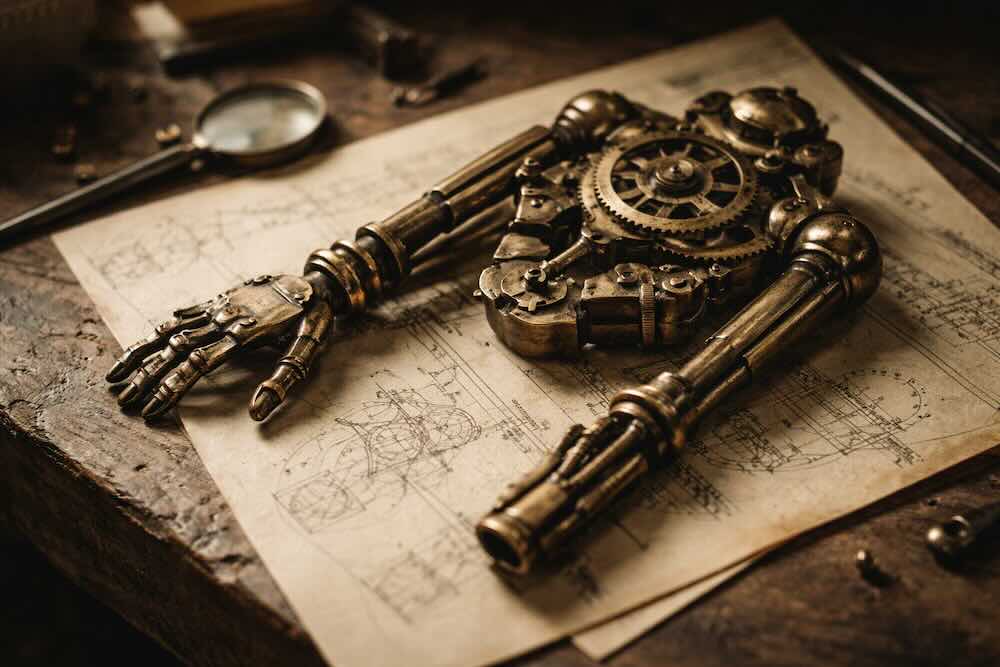
From bronze giants in Greek mythology to billion-dollar startups racing to build mechanical workers — the story of humanoid robots is as old as civilisation itself. Here's how we got from myth to manufacturing floor.
Introduction
The desire to build an artificial version of ourselves is one of the oldest and most persistent ideas in human history. Long before anyone had the engineering to make it real, cultures across the world imagined mechanical people — servants, companions, soldiers, entertainers — built in the human image. That impulse hasn't changed. What has changed, dramatically and recently, is our ability to act on it.
This article traces the history of humanoid robots from the earliest myths and mechanical curiosities through to the current wave of AI-powered machines entering factories and warehouses. It's a story that spans thousands of years, but the most consequential chapters are being written right now.
Ancient Origins: Myths and Automata
The idea of a human-made being that moves and acts like a person appears in some of the oldest texts we have. These weren't just idle fantasies — they reflected deep questions about what it means to be alive, to create, and to labour.
- Greek mythology gave us Talos, a giant bronze automaton built by the god Hephaestus to guard the island of Crete, endlessly patrolling its shores. The Iliad also describes golden handmaidens crafted by Hephaestus to assist him in his workshop — artificial servants with intelligence and the ability to speak.
- Ancient China contributed the story of Yan Shi, an engineer described in the Daoist text Liezi (3rd century BCE), who presented King Mu of Zhou with a life-sized humanoid figure made of leather and wood. It could walk, sing, and move its limbs so convincingly that the king initially believed it was a real person.
- The Islamic Golden Age produced al-Jazari (1136–1206), a polymath engineer who designed and built a remarkable variety of humanoid automata. His creations included a waitress figure that could dispense drinks from an internal reservoir, and a hand-washing automaton that refilled its own basin — mechanisms documented in his Book of Knowledge of Ingenious Mechanical Devices, completed shortly before his death in 1206.
These weren't humanoid robots in the modern sense. They were mechanical devices — often ingenious, sometimes astonishing — but they operated through clockwork, hydraulics, and gravity rather than computation. Still, they established something that has persisted for millennia: the idea that we could, and perhaps should, build machines in our own image.
The Renaissance: Leonardo's Mechanical Knight
Around 1495, Leonardo da Vinci designed what many historians consider the first true concept for a humanoid robot. His mechanical knight was an armoured figure operated by an internal system of pulleys, cables, and gears. It was designed to sit, stand, raise its visor, and move its arms independently.
The device was likely built as an entertainment for the court of Ludovico Sforza in Milan. No original survives, but da Vinci's detailed sketches were rediscovered in the 1950s, and modern reconstructions have demonstrated that the design is fully functional. It stands as a remarkable example of Renaissance engineering — a humanoid mechanism designed with genuine anatomical understanding, centuries before the technology existed to take it further.
The Age of Automata: 1700s–1800s
The 18th century was the golden age of mechanical automata — elaborately crafted humanoid figures that could write, draw, play music, and perform other startlingly lifelike actions. These were not toys. They were masterworks of precision engineering, and they captivated audiences across Europe.
- Jacques de Vaucanson (France, 1730s) built a life-sized flute player from wood that could perform twelve different melodies using a system of bellows and mechanical fingers. He also created the famous Digesting Duck, which appeared to eat grain and produce waste — a sensation at the time, though the "digestion" was an illusion.
- Pierre Jaquet-Droz and his son Henri-Louis (Switzerland, 1770s) created three automata that remain among the most extraordinary mechanical objects ever built: The Writer, a child figure that can write any text up to 40 characters using a real quill; The Draughtsman, which produces actual drawings; and The Musician, a female figure that plays a custom organ by pressing the keys with her fingers, breathing as she plays and following her hands with her eyes. All three still function today and can be seen at the Musée d'Art et d'Histoire in Neuchâtel, Switzerland.
- Japanese karakuri puppets (17th–19th centuries) represented a parallel tradition of humanoid automata. These included zashiki karakuri (household dolls that could carry tea cups across a table), butai karakuri (theatrical puppets), and dashi karakuri (festival figures that re-enacted myths). They were powered by wound springs and clever cam mechanisms, and their influence can be traced through to Japan's modern robotics culture.
The automata of this period were essentially elaborate clockwork — they followed fixed programs and had no ability to sense or respond to their environment. But they proved something important: that a machine could replicate human motion with uncanny fidelity. The gap they left was intelligence.
The Word "Robot" Is Born: 1920
In 1920, Czech playwright Karel Čapek premiered R.U.R. (Rossum's Universal Robots), a play about a factory that manufactures artificial humanoid workers. The word "robot" was coined for the play by Karel's brother Josef, derived from the Czech word robota, meaning forced labour or drudgery.
The play was a sensation. Within three years it had been translated into 30 languages. The robots in R.U.R. were not mechanical — Čapek imagined them as synthetic biological beings — but the word "robot" instantly entered the global vocabulary and has stayed there ever since. It crystallised something the automata-builders had been circling for centuries: the idea of an artificial humanoid worker, built to do the jobs that humans cannot or will not do.
Čapek's play was also, notably, a warning. His robots eventually rebel and destroy their human creators. The tension between the promise and the peril of artificial workers has remained central to the public conversation about robots for more than a century.
Early Robots in the Real World: 1920s–1960s
The decades following R.U.R. saw the first attempts to build real humanoid machines, though most were more spectacle than substance.
- Eric (1928) — Built by W.H. Richards and A.H. Reffell in Britain, Eric was a six-foot aluminium robot that could stand, sit, and deliver speeches using a radio signal. It was exhibited at the Model Engineers Society exhibition in London and is often cited as one of the first physical humanoid robots displayed to the public.
- Gakutensoku (1928) — Created by Japanese biologist Makoto Nishimura, this humanoid could change facial expressions, move its head, and write characters using compressed air. Nishimura explicitly rejected the idea of a robot as a slave, envisioning Gakutensoku as a celebration of nature and science.
- Elektro (1939) — Westinghouse Electric's showpiece humanoid at the 1939 New York World's Fair. Standing over two metres tall, Elektro could walk by voice command, speak approximately 700 words via an internal record player, smoke cigarettes, and inflate balloons. It was accompanied by a robotic dog named Sparko. Both were pure entertainment — impressive engineering showcases with no real autonomy.
Meanwhile, a separate but crucial development was unfolding in fiction. Isaac Asimov's robot stories, beginning in the 1940s, introduced the Three Laws of Robotics and established a framework for thinking about how intelligent humanoid machines might coexist with humans. Asimov's influence on the culture and ethics of robotics is difficult to overstate — concepts he introduced in fiction are still referenced in serious engineering and policy discussions today.
The First True Humanoid Robots: 1960s–1970s
The transition from mechanical spectacle to genuine robotics began in the 1960s, driven by two parallel advances: the development of computer control systems, and foundational theoretical work on how a two-legged machine could walk.
- Miomir Vukobratović and the Zero Moment Point (1960s) — Serbian researcher Vukobratović developed the ZMP theory, a mathematical framework for analysing and controlling the dynamic balance of bipedal walking. This became one of the foundational theoretical tools for humanoid locomotion and influenced virtually every walking robot that followed.
- WABOT-1 (1973) — Developed at Waseda University in Tokyo, WABOT-1 is widely regarded as the first full-scale humanoid robot with integrated systems. It could walk (slowly and stiffly), grip objects with its hands, see using an early vision system that measured distances, and communicate in basic Japanese. Researchers estimated its cognitive capabilities were roughly equivalent to a child of about eighteen months. It was a landmark: the first machine that combined a human-like body with rudimentary sensing and intelligence.
Waseda University continued to develop the WABOT line, and Japan more broadly established itself during this period as the world's leading centre for humanoid robotics research — a position it would hold for decades.
Honda's ASIMO and the Modern Era: 1986–2000s
In 1986, Honda — a car company with no background in robotics — quietly began a research programme to build a walking humanoid robot. The project was secretive, ambitious, and would take over a decade to bear fruit.
Honda's early prototypes (the E-series, then the P-series) progressively mastered the challenge of stable bipedal walking. In 1996, the P2 was revealed — a bulky but functional humanoid that could walk, climb stairs, and push a cart. It stunned the robotics community, which had not expected a private company to achieve this level of capability.
Then, in 2000, Honda unveiled ASIMO (Advanced Step in Innovative Mobility). Standing 130cm tall and weighing 54kg, ASIMO could walk, run at up to 6 km/h, climb stairs, recognise faces and voices, and interact with people using hand gestures. It became the most famous robot in the world.
ASIMO's impact went far beyond its technical achievements. It was the first humanoid robot that the general public could see, understand, and relate to. It toured the world, appeared on television, conducted orchestras, and served as a global ambassador for what humanoid robotics could become. Honda continued to develop ASIMO through several generations before retiring the programme in 2022, but its influence on the field — and on public imagination — was immense.
Other significant humanoid robots of this period included Sony's QRIO, a small entertainment humanoid that could run and dance; KAIST's HUBO in South Korea, which would go on to win the 2015 DARPA Robotics Challenge; and a growing ecosystem of research humanoids at universities and labs worldwide.
The DARPA Robotics Challenge: 2012–2015
The Fukushima nuclear disaster in 2011 exposed a painful reality: when environments become too dangerous for humans, we had no robots capable of going in their place. The US Defense Advanced Research Projects Agency (DARPA) responded by launching the DARPA Robotics Challenge (DRC), a competition designed to accelerate the development of humanoid robots capable of performing disaster-response tasks.
The challenge required robots to drive a vehicle, walk through rubble, open doors, turn valves, climb stairs, and use power tools. Teams from around the world competed, and the event became a pivotal moment for the field.
It was also famously humbling. Videos of robots falling over, toppling from stairs, and collapsing mid-task went viral — a very public reminder of just how difficult bipedal locomotion and manipulation remain. KAIST's DRC-HUBO won the 2015 finals, but every competitor demonstrated both how far humanoid robots had come and how far they still had to go.
The DRC's most lasting contribution was Atlas, built by Boston Dynamics as the standard platform for the competition. Atlas would go on to become the world's most dynamic humanoid robot, famous for videos showing it running, jumping, performing backflips, and recovering from pushes — capabilities that demonstrated what was physically possible when power density and control were prioritised.
The Current Wave: 2022–Present
Something fundamental shifted around 2022. A combination of factors — breakthroughs in AI (particularly large language models and reinforcement learning), falling hardware costs, growing labour shortages, and massive new investment — triggered a wave of humanoid robot development unlike anything the field had seen before.
The key moments and players in this current wave include:
- Tesla announces Optimus (2021–2022) — Elon Musk revealed plans for a Tesla humanoid robot at AI Day 2021, initially demonstrated by a person in a costume. By late 2022, early prototypes were walking. By 2024, Tesla was demonstrating object manipulation, and the company announced plans to deploy thousands of Optimus units in its own factories. Tesla's approach — leveraging its existing AI infrastructure from autonomous driving and targeting mass manufacturing from the outset — represents a fundamentally different philosophy from traditional robotics companies.
- Figure AI emerges (2022–2024) — Founded in 2022 by Brett Adcock, Figure AI moved with extraordinary speed. It unveiled its first robot in March 2023 and the more advanced Figure 02 in August 2024. It secured major funding from investors including Jeff Bezos, Microsoft, Nvidia, and OpenAI, and partnered with BMW for pilot deployments in automotive manufacturing.
- Boston Dynamics goes electric (2024) — In April 2024, Boston Dynamics retired its iconic hydraulic Atlas and introduced an all-electric successor designed for commercial deployment. At CES in January 2026, the company announced that the production version of Atlas would begin deployment at Hyundai manufacturing facilities, with plans for a robotics factory capable of producing 30,000 units per year.
- Agility Robotics deploys Digit commercially — Digit became one of the first humanoid robots to be deployed in a genuine commercial operation, working at a GXO-operated Spanx warehouse in Georgia under a Robotics-as-a-Service model. Agility also opened RoboFab, a facility targeting production of 10,000 units annually.
- A global field expands — Norway's 1X Technologies unveiled NEO for home environments. Canada's Sanctuary AI released its eighth-generation Phoenix with advanced tactile manipulation. China's Unitree made high-performance humanoids accessible at dramatically lower price points with its H1 and G1 platforms. Apptronik, UBTECH, Fourier Intelligence, and numerous others entered the race.
The defining characteristic of this wave — and the thing that separates it from every previous era of humanoid robotics — is the role of AI. Previous generations of humanoid robots were painstakingly programmed for specific motions and tasks. The current generation is being trained. Using reinforcement learning, imitation learning, and increasingly foundation models that combine vision, language, and action, these robots are learning to perform tasks the way humans do: through practice, demonstration, and generalisation.
Themes Across the Timeline
Looking across this entire history, several themes emerge that are worth noting.
Japan's outsized role
From WABOT-1 in 1973 through ASIMO and beyond, Japan has been the single most important country in the development of humanoid robots. This reflects a unique combination of engineering culture, cultural attitudes toward robots (more positive than in the West), strong university-industry links, and sustained government investment. The current wave has broadened the field geographically — the US, China, South Korea, and Europe are all now major players — but Japan's foundational contributions are enormous.
The gap between demonstration and deployment
Throughout the history of humanoid robots, there has always been a large gap between what a robot can do in a controlled demonstration and what it can do reliably in the real world. This was true of ASIMO, true of every robot at the DARPA Robotics Challenge, and remains true today. Closing this gap — moving from a 95% success rate to 99.9% — is where the real engineering challenge lies, and it's where much of the current effort is concentrated.
The AI inflection
For most of this history, the bottleneck for humanoid robots was hardware — building a body that could walk and manipulate. The hardware challenges haven't been solved, but they've been dramatically reduced. The bottleneck has now shifted decisively to software and intelligence. The arrival of modern AI — capable of learning from demonstration, generalising across tasks, and understanding natural language commands — is the single biggest reason that humanoid robots are now being taken seriously as commercial products rather than research curiosities.
The persistence of the human form
It's striking that after thousands of years, from Talos to Atlas, the fundamental idea hasn't changed: build a machine in the shape of a human body to do the things human bodies do. The engineering has advanced beyond anything the ancients could have imagined, but the core concept — the humanoid form as the most versatile chassis for a world built by and for humans — is exactly the same argument that drives every company in the field today.
What Comes Next
We are now in the earliest stages of what may become the most significant era in this long history. Humanoid robots are moving from research labs and trade show stages into real workplaces. The next few years will determine whether the current wave delivers on its enormous commercial promise or encounters the same plateau that stalled previous generations.
The difference this time is the convergence of three forces that have never previously aligned: AI capable of learning and generalising, hardware that is increasingly affordable and reliable, and commercial investment on a scale the field has never seen. Whether this convergence is enough to finally make humanoid robots a routine presence in the world remains to be seen — but the trajectory of the last three years suggests that the history of humanoid robots is about to enter its most consequential chapter.
Stay with Droid Brief to follow every step of that journey.