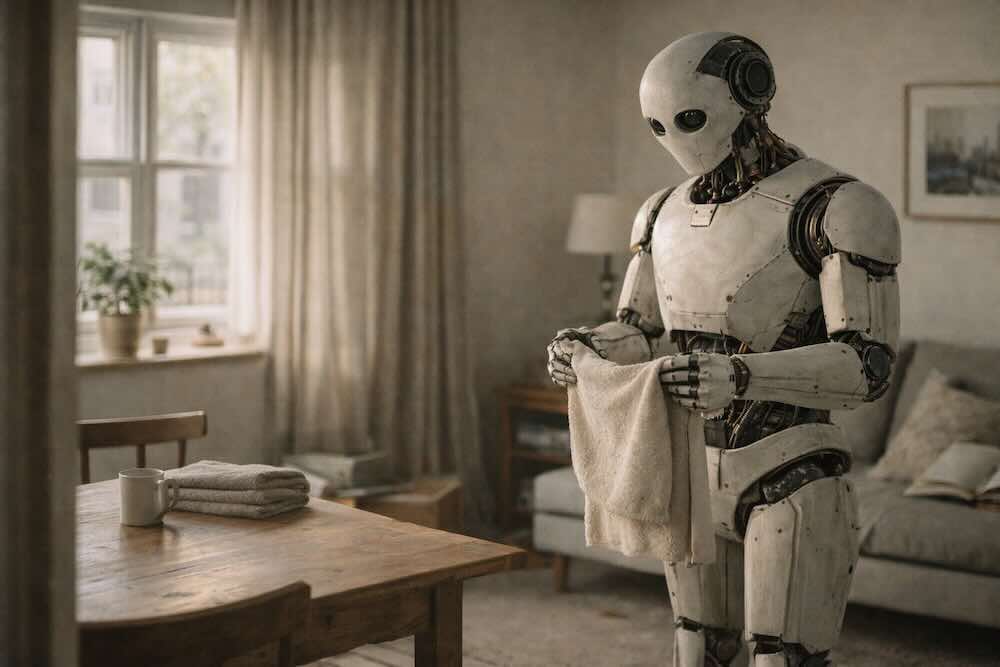
Where do humanoid robots for the home actually stand — and how close are we to the future we were promised?
Few ideas in robotics capture the imagination quite like a humanoid that can help around the house. Fold the laundry, unload the dishwasher, tidy the kitchen, carry the shopping in. For decades, the domestic robot has been a fixture of science fiction — and a source of persistent disappointment in reality. But after years of false starts, the gap between promise and product is finally narrowing. The first humanoid robots designed specifically for the home are now entering pre-orders, and major companies are racing to make the household humanoid a commercial reality.
This article looks at where things stand today, what these machines can actually do, and what still needs to happen before a humanoid assistant becomes a practical fixture in everyday homes.
A History of Almost Getting There
The dream of a domestic robot is older than the word "robot" itself. Mechanical automata that could serve tea or play music date back centuries. But modern attempts to build a consumer home robot have a strikingly consistent pattern: intense hype, impressive demonstrations, and eventual commercial failure.
Sony's Aibo, launched in 1999, was one of the first consumer robots to generate genuine emotional attachment. Owners named their robotic dogs, treated them as family members, and — when Sony discontinued the line in 2006 — even held funerals for them at a Buddhist temple in Japan. Aibo was charming, but it was an entertainment product, not a domestic helper.
SoftBank's Pepper, introduced in 2014, was a humanoid designed for social interaction. It found a niche in retail and hospitality — greeting customers in shops and hotel lobbies — but never made the transition to a useful household assistant. Its capabilities were too limited, and the novelty wore off quickly.
Jibo, launched via crowdfunding in 2014 and hailed by TIME as one of the best inventions of 2017, was specifically designed as a social home robot. It could recognise faces, hold conversations, and remind family members of their schedules. But it shipped years late, cost close to $1,000, and was quickly outperformed by cheaper voice assistants from Amazon and Google. The company burned through $73 million in funding before shutting down. When Jibo's servers were finally switched off in 2019, the little robot delivered a final, poignant farewell to its owners.
Other casualties include Anki's Cozmo, Mayfield Robotics' Kuri, and Amazon's Astro — each of which demonstrated that building a useful, affordable, and emotionally resonant home robot is among the hardest challenges in consumer technology.
The lesson from these failures is consistent: people don't just want a companion or a novelty. They want a robot that can do things — physical things, in the messy, unstructured environment of a real home.
Why the Home Is the Hardest Environment
It may seem counterintuitive, but a family kitchen is a far more challenging operating environment than a factory floor. In a warehouse, the layout is known, the lighting is controlled, and the objects are standardised. In a home, almost nothing is predictable.
Domestic environments present a unique combination of challenges for humanoid robots:
- Unstructured spaces. Every home is different. Furniture moves, objects get left in unexpected places, and the robot must navigate around pets, children, and clutter without a pre-mapped route.
- Object variety. A robot in a warehouse handles identical boxes. A robot in a kitchen handles glasses, plates, cutlery, food packaging, wet surfaces, hot pans, and crumpled tea towels — each requiring different grasping strategies and levels of force.
- Fine manipulation. Tasks like folding laundry, loading a dishwasher, or cracking an egg demand a level of dexterity that most robotic hands still struggle with. Soft, deformable objects like fabric are particularly difficult.
- Safety around people. A home robot operates alongside vulnerable people — children, elderly family members, pets. There is no safety cage, no exclusion zone. The robot must be fundamentally incapable of causing harm through normal operation.
- Edge cases everywhere. In a factory, exceptions are rare. In a home, exceptions are the rule. The cat is on the counter. The toddler has left toys on the stairs. The dishwasher is loaded differently every time. Handling these situations gracefully requires a level of common-sense reasoning that robots are only beginning to develop.
This is why, despite impressive demonstrations, no company has yet shipped a humanoid robot that can reliably manage a full day of unsupervised household work. The technology is getting there — but the home remains the final boss of robotics.
The Current Generation: What's Actually Available
As of early 2026, the landscape is shifting rapidly. Several companies are now specifically targeting the home as a primary market for their humanoid platforms. Here's where the leading contenders stand.
1X Technologies — NEO
NEO is arguably the most significant product launch in domestic humanoid robotics to date. Announced in October 2025, it is the first consumer humanoid robot to open pre-orders with a clear price, specifications, and delivery timeline.
Standing 5'6" and weighing just 30 kg (66 lbs), NEO is designed from the ground up for the home. Its body is covered in a soft knit suit with organic, neutral tones — deliberately designed to complement living spaces rather than look like a piece of industrial equipment. It operates at just 22 dB, quieter than a typical refrigerator.
NEO's target tasks include folding laundry, tidying rooms, organising shelves, and providing conversational assistance through a built-in large language model. It can recognise objects, remember conversations over time, and suggest actions based on what it sees — such as identifying ingredients on a counter and suggesting recipes.
Crucially, 1X is transparent about NEO's limitations. Early units come with restrictions: no handling of sharp or hot objects, and no homes with young children in the initial phase. The system blends on-board autonomy with remote human operators ("1X Experts") who can guide the robot through unfamiliar tasks via its cameras. Each of these teleoperated sessions generates training data, so NEO's capabilities are designed to expand over time.
Early access units are priced at $20,000, with first deliveries planned for 2026 in the United States. A subscription model at $499 per month will follow. International expansion is expected from 2027.
Figure AI — Figure 03
Figure AI's third-generation humanoid, launched in October 2025 and named one of TIME's Best Inventions of 2025, represents a ground-up redesign aimed at both industrial and domestic use.
At 168 cm and 60 kg, Figure 03 features a soft, washable textile exterior, wireless inductive charging through its feet, and a custom battery providing roughly five hours of operation. Its hands feature 20 degrees of freedom and tactile sensors capable of detecting forces as small as 3 grams — sensitive enough to handle a delicate egg without explicit programming.
The robot is powered by Helix, Figure's proprietary vision-language-action AI, which enables it to reason about multi-step tasks, process natural language commands, and remember where objects have been placed. In demonstrations, Figure 03 has folded towels, loaded laundry into a washing machine, and navigated household spaces.
However, Figure AI's CEO Brett Adcock has been candid about the timeline. At launch, Figure 03 is not yet ready for unsupervised domestic deployment. The company's goal is to achieve reliable all-day home autonomy during 2026, but this remains a significant engineering push. Initial deployment is with commercial partners, and broader consumer availability is expected in the mid-2026 timeframe. At high production volumes, Figure is targeting a price point under $20,000.
Tesla — Optimus
Tesla's Optimus is perhaps the most high-profile humanoid robot programme in the world, backed by the company's manufacturing scale and AI expertise. Elon Musk has positioned Optimus as a general-purpose robot for both factory and domestic use, with ambitious production targets of 50,000 units in 2026 and aspirations of one million by 2027.
Musk has specifically cited elderly care, household chores, and personal companionship as target applications, and has suggested an eventual price point between $20,000 and $30,000.
However, as of early 2026, a reality check is warranted. On Tesla's Q4 2025 earnings call, Musk acknowledged that Optimus is still in the R&D phase and that deployed units are not yet performing useful work in factories, let alone homes. Several demo events have revealed that some Optimus robots shown interacting with the public were partially teleoperated by humans. The company's track record of ambitious timelines that slip — from Full Self-Driving to the Cybercab — has led many industry observers to treat the 2027 home deployment target with scepticism.
Optimus remains a programme to watch closely, but the gap between Tesla's public ambitions and demonstrated domestic capability is currently the widest of any major player.
Other Players
Several other companies are developing humanoid or semi-humanoid platforms with domestic applications in mind:
- LG — CLOiD. Unveiled at CES 2026, CLOiD is a dual-armed home assistant with humanoid upper body and a wheeled base, building on LG's existing CLOi line of commercial service robots. LG is marketing it under the tagline "Zero-Labour Home" and is leveraging its manufacturing scale and appliance ecosystem.
- NEURA Robotics — 4NE-1. The German company's humanoid, designed in collaboration with Studio F.A. Porsche, features artificial skin for proximity detection and a 100 kg lifting capacity. A smaller Mini variant is priced at €19,999, with pre-orders open and deliveries expected in 2026.
- Unitree — R1. At just $5,900, the ultra-lightweight R1 is the cheapest full humanoid ever offered, targeting the consumer and education markets. While its capabilities are more limited than higher-end competitors, it represents a psychological price breakthrough for the category.
What Can Home Humanoids Actually Do Today?
Across all current platforms, domestic humanoid robots can perform a handful of specific household tasks in controlled or semi-controlled conditions:
- Folding laundry (towels, simple garments)
- Loading and unloading a dishwasher
- Tidying rooms — picking up objects and returning them to designated locations
- Carrying items between rooms
- Watering plants
- Light food preparation (stirring, retrieving ingredients)
- Holding conversations, setting reminders, and answering questions via integrated AI
What they cannot yet do reliably without human oversight:
- Handle the full range of objects found in a typical home, including fragile, hot, wet, or irregularly shaped items
- Recover gracefully from unexpected failures or novel situations
- Operate safely and continuously for a full day in a home with children or pets
- Perform complex multi-step tasks (such as cooking a full meal) end to end
- Navigate stairs reliably in all domestic configurations
The honest assessment: today's home humanoids are impressive technology demonstrations that can perform specific tasks, but they are not yet substitutes for human domestic labour. Think of them as capable but early — more first-generation smartphone than mature product category.
The Elderly Care Opportunity
If domestic humanoids have a "killer app," it may well be elder care. Ageing populations in Japan, South Korea, Europe, and North America are creating acute demand for physical assistance that existing care systems cannot meet. The arithmetic is stark: the number of people requiring daily living support is rising far faster than the number of available caregivers.
A humanoid robot that could reliably help an elderly person with basic tasks — fetching items, assisting with mobility, reminding them to take medication, providing companionship, and alerting family members or medical professionals in an emergency — would address a genuine and growing need.
Several companies are explicitly targeting this use case. Tesla has cited elderly care as a primary domestic application for Optimus. 1X's NEO is designed to provide conversational companionship and light physical assistance. Research into teleoperated care — where a trained human controls the robot remotely via VR — is also attracting serious interest, as it could allow a single caregiver to assist multiple patients in different locations throughout a day.
The appeal is obvious, but the challenges are significant. Elderly care demands the highest possible standards of reliability and safety. A robot that drops a glass is inconvenient in a typical household; for a frail person living alone, it could be dangerous. Trust is paramount, and it will need to be earned through extensive real-world deployment before this market can scale.
Key Challenges Still to Solve
For domestic humanoids to move from early-adopter curiosity to mainstream household presence, several fundamental challenges need to be addressed:
Dexterity and Manipulation
Human hands are extraordinarily capable. We adjust grip force instinctively, handle deformable objects like fabric without thinking, and switch between hundreds of different grasping strategies throughout a single day. Robotic hands are improving rapidly — tactile sensors can now detect forces as small as a few grams — but the gap between human and robotic dexterity remains the single biggest technical barrier to useful domestic work.
Battery Life and Power
Current humanoid robots offer roughly three to five hours of operation on a single charge. For a robot expected to be useful throughout a working day, this is insufficient. Wireless charging (as implemented by Figure 03) helps by allowing the robot to top up automatically, but energy density remains a limiting factor for continuous domestic operation.
Price
At $20,000 for early-access units, today's domestic humanoids are firmly in early-adopter territory. For mass adoption, prices will need to fall significantly — likely below $10,000 or into viable subscription models. Companies like Tesla and Figure are banking on high-volume manufacturing to drive costs down, but achieving this at scale with a product as complex as a humanoid robot is an enormous industrial challenge.
Safety and Certification
There is no established regulatory framework for humanoid robots operating in private homes. Existing industrial safety standards (such as ISO standards for collaborative robots) are designed for controlled environments, not for machines sharing space with children and pets. Developing appropriate safety standards and certification processes will be essential for consumer adoption — and for securing the insurance and liability frameworks that commercial deployment will require.
Privacy
A humanoid robot in your home is, by necessity, equipped with cameras, microphones, and sensors that continuously observe the domestic environment. This raises profound privacy concerns — particularly when data is uploaded to cloud servers for AI training. Companies will need to demonstrate transparent, robust data policies to earn consumer trust. The question of who owns the data generated inside your home by a robot will become increasingly urgent.
Emotional and Social Dynamics
People form emotional bonds with robots — even simple ones. The history of Aibo and Jibo demonstrates this clearly. A humanoid robot that lives in your home, remembers your conversations, and helps with daily tasks will inevitably become more than a tool in the minds of its users. Managing these emotional dynamics — without exploiting them — is both a design responsibility and an ethical imperative.
What Comes Next
The period from 2026 to 2028 will be decisive for domestic humanoid robotics. For the first time, actual products are reaching actual homes, and the gap between demonstration and deployment is closing.
Several trends will shape how this unfolds:
- The teleoperation bridge. Rather than waiting for full autonomy, companies like 1X are using human operators to handle edge cases while the AI learns from every interaction. This hybrid model may prove to be the most practical path to useful domestic robots in the near term.
- AI as the unlock. Advances in foundation models, vision-language-action systems, and sim-to-real transfer are accelerating faster than hardware improvements. The robots that succeed domestically may be distinguished more by the quality of their AI than by their physical specifications.
- Subscription economics. The Robots-as-a-Service model — paying a monthly fee rather than a large upfront cost — may be the key to consumer adoption. At $499 per month, 1X's NEO subscription is in the range of many household services. If the robot proves genuinely useful, the economics could work for a surprisingly broad market.
- Learning by doing. Every domestic humanoid deployed in a real home generates training data for the next generation. This creates a powerful flywheel: the companies that get robots into homes first will accumulate data advantages that are difficult for latecomers to match.
The home robot is no longer a science fiction premise. It's an emerging product category — messy, imperfect, and expensive, but real. The machines arriving in 2026 will not transform domestic life overnight. But they represent a genuine starting point, and the pace of improvement in both hardware and AI suggests that the gap between what these robots can do and what we need them to do will close faster than most people expect.
The question is no longer whether humanoid robots will enter our homes. It's when they'll be good enough — and affordable enough — for most of us to want one.
Related articles: Manufacturing & Warehousing · Healthcare & Assisted Living · Manipulation & Dexterous Hands · AI & The Robot Brain · The Business Case for Humanoid Workers · Humanoid Robots as a Service · Privacy & Surveillance Concerns