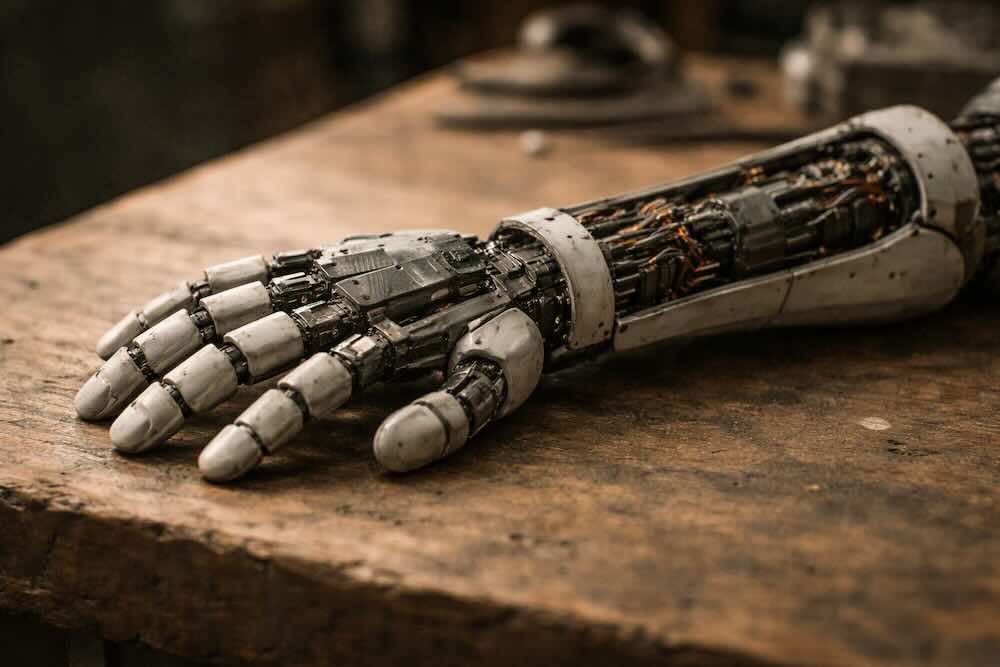
The materials inside a humanoid robot determine almost everything about how it performs — how fast it moves, how long it runs, how hard it can fall without breaking, and how safely it can work alongside people. Building a machine that moves like a human turns out to be as much a materials science challenge as an engineering one.
This article breaks down the key materials and structural approaches used in today’s humanoid robots, from the metals and composites that form their skeletons to the emerging soft materials that may one day give them something resembling skin.
The Core Challenge: Strong, Light, and Tough
A humanoid robot has to support its own weight, carry payloads, absorb impacts from falls and collisions, and do all of this while being light enough to move efficiently on battery power. Every extra kilogram in the frame means less payload capacity, shorter battery life, and greater forces on joints and actuators during movement.
This creates a fundamental tension that drives every material choice: the structure needs to be as rigid and strong as possible where it bears load, and as light as possible everywhere else. Getting this balance right is one of the biggest differentiators between humanoid platforms.
Metals: The Structural Backbone
Aluminium Alloys
Aluminium alloys are the workhorse structural material in most humanoid robots today. They offer a good balance of strength, stiffness, and low weight, and they’re relatively easy to machine into complex shapes. Aerospace-grade aluminium alloys (such as 7075 and 6061) are common choices, offering high strength-to-weight ratios at a fraction of the cost of more exotic materials.
Most humanoid robot torsos, limb segments, and mounting brackets are machined or cast from aluminium. It’s well-understood, widely available, and straightforward to work with — qualities that matter enormously when you’re iterating on prototype designs.
Titanium
Where maximum strength is needed at minimum weight — particularly in high-stress joints and load-bearing connectors — titanium steps in. Boston Dynamics’ Atlas robot, for example, uses titanium alongside aluminium in its frame, contributing to a strength-to-weight ratio that enables the acrobatic feats the platform is known for.
Titanium is significantly more expensive and harder to machine than aluminium, so its use tends to be selective: targeted at the specific structural points where nothing else will do.
Steel
Steel still appears in humanoid robots, particularly in gears, bearings, shafts, and other drivetrain components where extreme hardness and wear resistance matter more than weight. You won’t typically find steel in the main structural frame of a modern humanoid, but it remains essential inside the actuators and transmission systems that make the robot move.
Composites: Borrowing from Aerospace
Carbon Fibre Reinforced Polymer (CFRP)
Carbon fibre composites have become increasingly important in humanoid robotics, drawn directly from their success in aerospace and motorsport. CFRP offers a remarkable combination: a density of roughly 1.6 g/cm³ (compared to about 2.7 for aluminium and 4.5 for titanium), yet with tensile strength that can dramatically exceed both metals on a weight-for-weight basis.
Boston Dynamics uses CFRP in the leg structures of Atlas, where the material’s stiffness and light weight directly contribute to the robot’s ability to run, jump, and perform dynamic manoeuvres. Other platforms use carbon fibre for outer casings and protective panels, where impact resistance matters but every gram counts.
The main drawbacks of CFRP are cost and manufacturing complexity. Carbon fibre parts typically require moulds, layup processes, and curing cycles that are slower and more expensive than machining metal. As humanoid robots move toward volume production, the industry is actively working on faster, cheaper composite manufacturing methods.
Engineering Plastics: The Quiet Revolution
PEEK (Polyether Ether Ketone)
PEEK has emerged as one of the most important materials in humanoid robotics. This high-performance engineering thermoplastic offers an unusual combination of properties: it’s lightweight, extremely strong for a plastic, resistant to heat and chemicals, and can be precisely machined or injection moulded.
Tesla’s Optimus Gen 2 robot achieved a 10 kg weight reduction compared to its predecessor — without sacrificing structural performance — largely by adopting PEEK for key structural components. The material is particularly valuable for joint housings, spine segments, and internal structural elements where its combination of strength, light weight, and thermal stability outperforms both metals and conventional plastics.
Polyamide (Nylon) and Other Technical Polymers
Various grades of polyamide and other engineering polymers are used throughout humanoid robots for housings, covers, brackets, and non-structural components. These materials are cheap, light, and easy to produce at scale, making them important for keeping overall costs down as the industry moves from prototype quantities toward mass production.
Unitree’s G1 robot, for example, uses lightweight PEEK materials in its optimised joint structures as part of a broader modular design approach aimed at dramatically reducing manufacturing costs.
3D Printing: Rethinking How Robots Are Built
Additive manufacturing — 3D printing — is changing not just which materials are used in humanoid robots, but how those materials are shaped and combined.
Boston Dynamics pioneered the use of 3D-printed metal components in Atlas. Rather than assembling legs from dozens of separate machined parts connected with nuts and bolts, the company used metal additive manufacturing to print leg structures with hydraulic channels, actuator housings, and fluid pathways integrated directly into the part. This approach dramatically reduces part count, eliminates potential leak points, and creates structures that would be impossible to make with conventional machining.
The company’s hydraulic power unit — the central power plant of Atlas — integrates sensing, filtration, valves, and fluid management into a single 3D-printed component. As Boston Dynamics’ VP of Engineering Aaron Saunders has noted, this integrated approach delivers power density approaching a kilowatt per kilogram.
At the other end of the spectrum, open-source and research platforms like Poppy (developed by Ensta ParisTech and Flowers Lab) use polymer 3D printing — specifically selective laser sintering with polyamide — to produce entire robot bodies. Every structural part of Poppy aside from motors and electronics is 3D printed, demonstrating how additive manufacturing can make humanoid robotics accessible to researchers and educators.
As the humanoid robot industry scales up, 3D printing is likely to play a dual role: enabling rapid prototyping and complex geometries during development, while also increasingly finding a place in production manufacturing for parts where its design freedom justifies the cost.
Soft Materials: Towards Safer, More Human-Like Robots
The newest frontier in humanoid robot materials isn’t about making structures harder or stiffer — it’s about making them softer.
Silicone Elastomers
Silicone rubbers are becoming standard for any part of a humanoid robot that might contact people or delicate objects. They’re used for grip surfaces on hands, protective padding on limbs, and increasingly for cosmetic skin-like coverings that make robots less intimidating to interact with.
Advanced silicone formulations like Ecoflex and Dragon Skin can stretch to several times their original length and return to shape, closely mimicking the mechanical behaviour of human skin and tissue. Researchers in Japan and China are pushing this further, developing silicone-based skins with embedded sensors that give robots a sense of touch, pressure, and even temperature.
Thermoplastic Elastomers (TPE) and Polyurethanes
TPE materials combine rubber-like flexibility with the processability of plastics, making them attractive for joint cushioning, impact absorption, and bio-inspired surface coverings. They can be injection moulded at scale, which gives them a manufacturing advantage over silicone in many applications.
Electronic Skin (E-Skin)
A particularly active area of research involves embedding sensing capabilities directly into soft surface materials. Electronic skin typically uses thin films of materials like polydimethylsiloxane (PDMS) or polyimide, layered with conductive traces and pressure-sensitive elements, to create surfaces that detect touch, pressure, texture, and temperature.
E-skin is still largely in the research and early prototype stage for full humanoid robots, but it represents a fundamental shift: turning the robot’s outer surface from a passive protective shell into an active sensory organ.
Bio-Inspired Structural Design
Beyond individual materials, humanoid robot designers are increasingly borrowing structural principles from biology.
Skeletal hierarchy: Just as human bones are dense and strong at the surface but lighter and more porous inside, robot structural members are being designed with variable-density internal structures — often enabled by 3D printing — that put material exactly where it’s needed and remove it where it isn’t.
Compliant mechanisms: Instead of building every joint from rigid parts connected by bearings, some designs use the controlled flexibility of materials themselves to create hinge-like behaviour. This reduces part count, eliminates friction, and can make structures more resilient to impacts.
Multi-material integration: Biological organisms don’t have sharp boundaries between hard bone and soft tissue — there are gradual transitions. Advanced manufacturing is starting to enable similar gradient structures in robots, blending rigid and flexible materials within a single component to reduce stress concentrations and improve durability.
The Manufacturing Scalability Challenge
Perhaps the biggest material challenge facing humanoid robotics today isn’t technical — it’s economic. Many of the most promising materials and manufacturing approaches (CFRP layups, metal 3D printing, custom PEEK components) work brilliantly at prototype volumes but become prohibitively expensive or slow when you need to produce thousands or tens of thousands of units.
This is why the humanoid robot industry is watching automotive manufacturing so closely. The car industry long ago solved the problem of producing lightweight, strong, multi-material structures at enormous scale. Techniques like high-pressure die casting (Tesla’s “gigacasting” approach for car bodies), automated composite layup, and high-volume injection moulding of engineering plastics will likely play an increasing role as humanoid robots transition from hand-built research platforms to mass-produced commercial products.
The bill of materials for a typical humanoid robot is currently estimated at around $35,000, with structural materials and actuator components accounting for a major share. Bringing this down to levels that enable widespread commercial deployment is one of the industry’s defining challenges.
What’s Coming Next
Several emerging material technologies could reshape humanoid robot design in the coming years:
- Shape memory alloys: Materials like Nitinol that can change shape when heated and return to their original form on cooling, potentially replacing conventional actuators in some applications with simpler, lighter alternatives.
- Self-healing materials: Polymers and composites that can repair minor damage autonomously, extending robot lifespans and reducing maintenance — particularly important for robots working in harsh environments.
- Dielectric elastomer actuators: Soft, flexible materials that change shape in response to electrical fields, functioning as artificial muscles. These are still largely in the research phase but offer the tantalising possibility of robots that move with truly muscle-like smoothness and compliance.
- Liquid crystal polymers: Already appearing in high-frequency connectors and precision electronic components within humanoid robots, these materials offer exceptional dimensional stability and signal performance.
- AI-driven material design: Machine learning is increasingly being used to discover and optimise new material compositions and structures specifically for robotics applications, potentially accelerating the pace of materials innovation dramatically.
Why Materials Matter for the Humanoid Future
It’s easy to focus on the AI, the sensors, and the software when discussing humanoid robots. But the physical materials that make up the robot’s body are just as fundamental to its capabilities as the code running on its processors.
A humanoid robot that is too heavy will burn through its battery in minutes. One that is too rigid will shatter when it falls. One that is too expensive to build at scale will never leave the laboratory. The companies that solve the materials challenge — finding the right combinations of metals, composites, plastics, and soft materials, and learning to manufacture them affordably at volume — will be the ones that turn humanoid robots from impressive demonstrations into practical, everyday machines.
The evolution of humanoid robotics is, at its core, an evolution in materials science. And that story is still in its very early chapters.
Further reading: For more on the systems that use these materials, see our deep dives on Actuators & Motors: The Muscles and Locomotion & Balance in this section. For how individual companies approach the design challenge, visit our Company Profiles in the Companies & Platforms section.