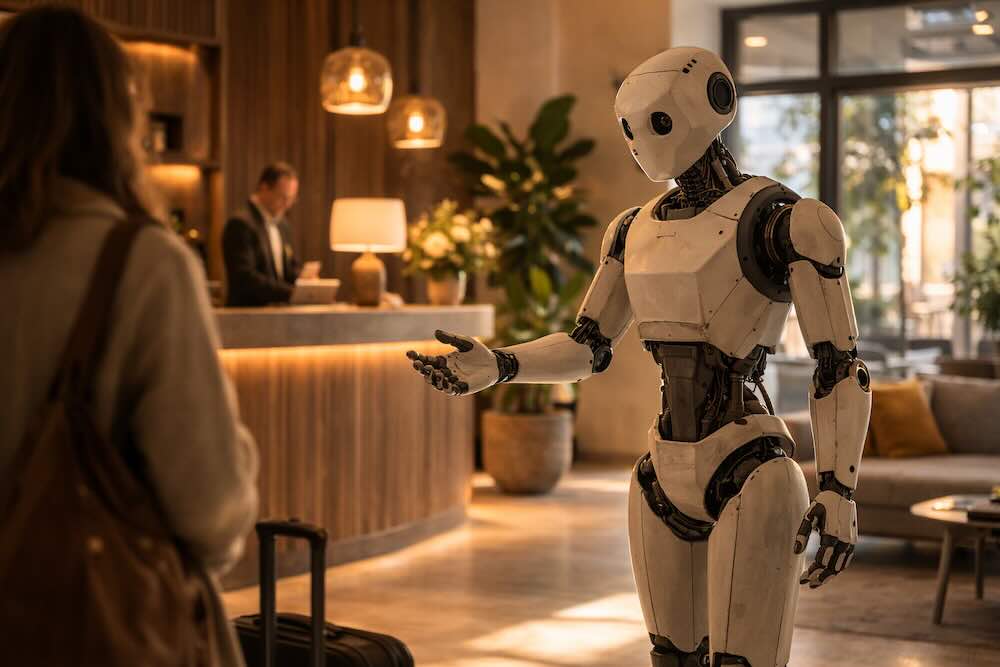
From theme park characters to hotel concierges, humanoid robots are stepping into public-facing roles — with mixed results and enormous potential.
Entertainment and hospitality may seem like an unusual frontier for humanoid robotics. These are industries built on warmth, personality, and human connection. Yet they are also industries plagued by chronic labour shortages, high staff turnover, and a relentless demand for novelty. That combination has made them surprisingly fertile ground for robots that look and move like us.
The results so far have been a fascinating mix of spectacular successes and instructive failures — and together they offer one of the clearest pictures of where humanoid robots genuinely work, and where the technology still falls short.
Theme Parks: Where Robots Have Always Belonged
If you've ever visited a Disney park, you've already spent time with humanoid robots — you just might not have thought of them that way.
Walt Disney Imagineering has been building Audio-Animatronic figures since the early 1960s, beginning with the Enchanted Tiki Room's mechanical birds at Disneyland in 1963 and the landmark "Great Moments with Mr. Lincoln" presentation at the 1964 World's Fair. Over six decades, these figures have evolved from simple pneumatic puppets into extraordinarily lifelike machines. The latest generation — known as A-1000 Animatronics — feature full facial articulation, realistic eye movement, and fluid body motion that can genuinely make audiences forget they're watching a machine.
But the real shift is happening now. Disney's theme park robots are moving from fixed installations to free-roaming, autonomous characters. The company's Project Kiwi developed a small-scale, fully autonomous Groot robot capable of walking around and interacting with guests independently — a dramatic departure from the bolted-down figures of the past. At SXSW in 2025, Disney showcased free-roaming BDX droid robots built by its Imagineering team, designed to wander park environments and interact with visitors. Meanwhile, the "Stuntronics" programme has produced aerial acrobatic robots that can perform flips and twists mid-air while holding heroic poses — essentially robotic stunt doubles for superhero characters.
Universal's Epic Universe, which opened in 2025, introduced its own batches of lifelike animatronic characters, including a lumbering Frankenstein's monster. The competition between the major park operators is driving rapid innovation, with each new attraction raising the bar for what audiences expect from robotic characters.
Theme parks represent something of an ideal environment for humanoid robots. Visitors arrive expecting wonder and spectacle. The setting is controlled and designed. Characters don't need to handle complex, unpredictable requests — they need to perform, emote, and create memorable moments. It's a space where the uncanny valley becomes a feature rather than a bug, where the slight otherness of a robotic character adds to the magic rather than detracting from it.
Hotels: The Cautionary Tale of Henn-na
Any honest account of humanoid robots in hospitality has to begin with Japan's Henn-na Hotel — and the lessons it taught the entire industry.
The Henn-na (meaning "Strange") Hotel opened in 2015 at Nagasaki's Huis Ten Bosch theme park with an audacious premise: a hotel staffed almost entirely by robots. Guests were greeted at the front desk by humanoid receptionists and velociraptor robots wearing bellboy hats. Robotic porters carried luggage. An in-room assistant called Churi managed lights and appliances by voice command. The Guinness Book of World Records certified it as the world's first robot-staffed hotel.
It was a brilliant publicity stunt. It was a less brilliant hotel.
By 2019, the hotel had "fired" more than half of its 243 robots. Guests reported that the in-room assistant repeatedly woke them during the night, mistaking snoring for voice commands. The front desk robots couldn't answer basic questions, requiring human staff to intervene. Luggage-carrying bots moved painfully slowly. Human employees found themselves working overtime to repair and compensate for their robotic colleagues. As one staff member put it, things got easier once the robots were gone.
The Henn-na experience became a widely cited cautionary tale, but it would be a mistake to treat it as the final word. The hotel's problems were largely a product of the technology available in 2015 — limited natural language processing, rigid programming, and unreliable hardware. The underlying concept wasn't wrong; the execution was premature.
Hotels Today: Smarter Deployments, Better Results
A decade on from Henn-na's launch, the picture looks markedly different. Hotels aren't trying to replace their entire workforce with robots anymore. Instead, they're deploying robots in specific, well-defined roles where the technology delivers genuine value.
Delivery robots have become the quiet success story. Machines like the Keenon W3 handle room service deliveries around the clock, with some properties reporting that a single unit can manage hundreds of deliveries per day. These aren't humanoid in the traditional sense — most are wheeled, box-shaped units — but they've proven the economic case for robotics in hospitality settings and paved the way for more sophisticated machines.
The humanoid frontier is now being pushed by a new generation of companies. Fauna, a startup founded by veterans of Meta and Google, launched its Sprout robot in 2025 — a child-sized humanoid priced at around $50,000, specifically designed for hospitality environments. Sprout features mechanical eyebrows that convey interest, surprise, and confusion, reflecting the company's belief that emotional expressiveness matters more in a hotel lobby than raw physical strength. Disney and Boston Dynamics both signed on as early customers.
In Las Vegas, the Otonomus Hotel introduced Oto, a humanoid robot serving as the property's "chief vibes officer." Powered by California-based startup IntBot, Oto greets visitors, answers questions, and responds in more than 50 languages — a practical advantage that few human front-desk staff can match. IntBot also unveiled its Nylo robot at CES 2025, a humanoid designed to take orders and deliver items in restaurants and hotels, running on Nvidia's Cosmos AI platform.
Major hotel brands are experimenting too. Marriott's Aloft hotels have deployed Relay delivery robots across multiple properties. Hilton has tested AI concierge programmes. And across the Asia-Pacific region — which has the highest density of hotel robot deployments globally — thousands of properties now use some form of robotic service.
Restaurants, Retail, and Public-Facing Roles
Beyond hotels and theme parks, humanoid and semi-humanoid robots are appearing in a growing range of customer-facing settings.
Restaurant service robots — primarily wheeled units that deliver food from kitchen to table — have become common across East Asia and are spreading into Western markets. Companies like Bear Robotics produce units that can navigate busy dining rooms, deliver dishes, and return to a docking station autonomously. While most current restaurant robots aren't humanoid in form, they are normalising the idea of robotic service staff and building customer acceptance for more human-shaped machines to come.
In retail, robots have appeared as greeters, information kiosks, and novelty attractions. SoftBank's Pepper robot, one of the most widely recognised humanoid platforms, was deployed in shops, banks, and cruise ships worldwide — though SoftBank scaled back production after mixed commercial results. The lesson, again, was that public enthusiasm for meeting a robot doesn't automatically translate into sustained business value.
Airports represent another growing deployment area. KLM trialled a robot called Spencer to help guide passengers through Schiphol Airport, testing how humanoid navigation assistants could work in crowded, multilingual environments. As airports face the same labour pressures as hotels, robotic wayfinding and customer service assistants are likely to become more common.
The Entertainment Market: By the Numbers
The commercial opportunity is substantial and growing rapidly. The global market for humanoid robots in entertainment was valued at roughly $310 million in 2024, with projections suggesting it could grow to nearly $8 billion by 2034 — a compound annual growth rate of around 38%. Theme parks and amusement parks represent the largest application segment, accounting for more than a third of current market revenue. North America leads the market, driven by heavy investment from the major park operators and a strong culture of early technology adoption.
On the hospitality side, the broader robotics market (including non-humanoid platforms) is projected to exceed $3 billion in 2026, with growth driven by persistent labour shortages — industry surveys consistently show that upwards of 80% of hotels report staffing difficulties — and by the improving economics of robotic deployment.
Why Humanoid Form Matters Here
A wheeled delivery robot can bring a towel to your room. But entertainment and hospitality are fundamentally about human connection and experience, which is precisely why the humanoid form factor matters more in these industries than in almost any other.
In a theme park, a character needs to gesture, emote, and physically embody a personality. A robot that can shrug, tilt its head, or wave excitedly creates an emotional response that no screen or wheeled box can replicate. Disney's research into realistic gaze behaviour — building robots that can make convincing eye contact, track individuals, and react to their presence — reflects a deep understanding that human-like presence is the product in entertainment contexts.
In hospitality, the equation is subtler. A humanoid concierge can communicate warmth and attentiveness through body language in ways that a touchscreen kiosk cannot. It can turn to face you, lean forward to listen, nod in acknowledgement. These are small behaviours, but they are the currency of good service. The next generation of hospitality robots, equipped with emotion recognition and adaptive behaviour — adjusting their energy and manner based on whether a guest appears tired, excited, or frustrated — could bridge a gap that earlier machines couldn't.
The Challenges That Remain
For all the progress, significant obstacles stand between current deployments and the seamless robotic hospitality experience that the industry envisions.
The uncanny valley is real and commercially consequential. Research consistently shows that robots which look almost-but-not-quite human can make people uncomfortable. In a hotel lobby, where guests expect warmth and ease, an unsettling robotic presence is worse than no robot at all. The most successful designs — like Fauna's Sprout with its deliberately non-realistic but expressive face — tend to be those that embrace a clearly robotic aesthetic while investing heavily in emotional expressiveness.
Reliability remains a dealbreaker. A broken robot in a warehouse is a logistics problem. A broken robot in a hotel lobby is a brand problem. Hospitality environments demand near-perfect uptime, which is still difficult to achieve with complex humanoid hardware. The Henn-na Hotel's experience — where malfunctioning robots created more work than they saved — remains a relevant warning.
Expectations management is critical. Guests who interact with a humanoid robot naturally assume it can do roughly what a human can do. When it can't answer a simple question or handle a straightforward request, the disappointment is sharper than it would be with a clearly limited machine. Setting the right expectations through design, signage, and role definition is as important as the technology itself.
The human workforce question is sensitive. Hotels and entertainment venues are major employers. Introducing robotic staff raises legitimate concerns about job displacement, particularly for lower-paid service roles. The emerging industry consensus is a hybrid model: robots handle repetitive, high-volume tasks (deliveries, basic check-ins, routine cleaning), while human staff focus on complex problem-solving, emotional care, and premium service interactions. Getting this balance right — and communicating it well — is essential for both operational success and public acceptance.
What Comes Next
Several converging trends suggest that the next five years will see a significant acceleration in humanoid robot deployment across entertainment and hospitality.
The cost of humanoid hardware is falling. Several companies are targeting sub-$50,000 price points for general-purpose humanoids, which would make them economically viable for a much wider range of hospitality businesses. At that price, a robot roughly equates to one year's salary for a human worker in many hospitality roles — but with no ongoing wage costs, no sick days, and the ability to work around the clock.
AI capabilities are advancing rapidly. Modern large language models give robots the ability to hold natural conversations, understand context, and respond to unexpected questions in ways that were impossible just a few years ago. Combined with computer vision and emotion recognition, these technologies are addressing the core weakness that sank earlier deployments: the inability to handle the unpredictable, messy reality of human interaction.
Robotics-as-a-Service (RaaS) models are lowering the barrier to entry. Rather than purchasing a robot outright, hotels can lease units for as little as $1,000 to $2,000 per month, making it possible to trial robotic service without a major capital commitment.
And perhaps most importantly, public attitudes are shifting. Nearly half of travellers now report being comfortable with robotic service at check-in, and that number is trending upward. A generation raised on smartphones and voice assistants is less fazed by the idea of being greeted by a machine — particularly if that machine is friendly, competent, and doesn't mistake their snoring for a room service order.
The Bottom Line
Entertainment and hospitality sit at a fascinating intersection of technology and human psychology. These are industries where robots need to do more than perform tasks efficiently — they need to make people feel something. A theme park robot needs to inspire wonder. A hotel robot needs to convey care and competence.
The technology is getting there. The early experiments, for all their stumbles, have provided invaluable lessons about what works and what doesn't. The most successful deployments share common traits: they choose the right roles for robots, set appropriate expectations, invest in emotional expressiveness over visual realism, and treat robotic staff as complements to human teams rather than replacements.
The era of the robot concierge and the autonomous theme park character is not a distant fantasy. It's arriving now — carefully, imperfectly, but with accelerating momentum.
Further Reading on Droid Brief