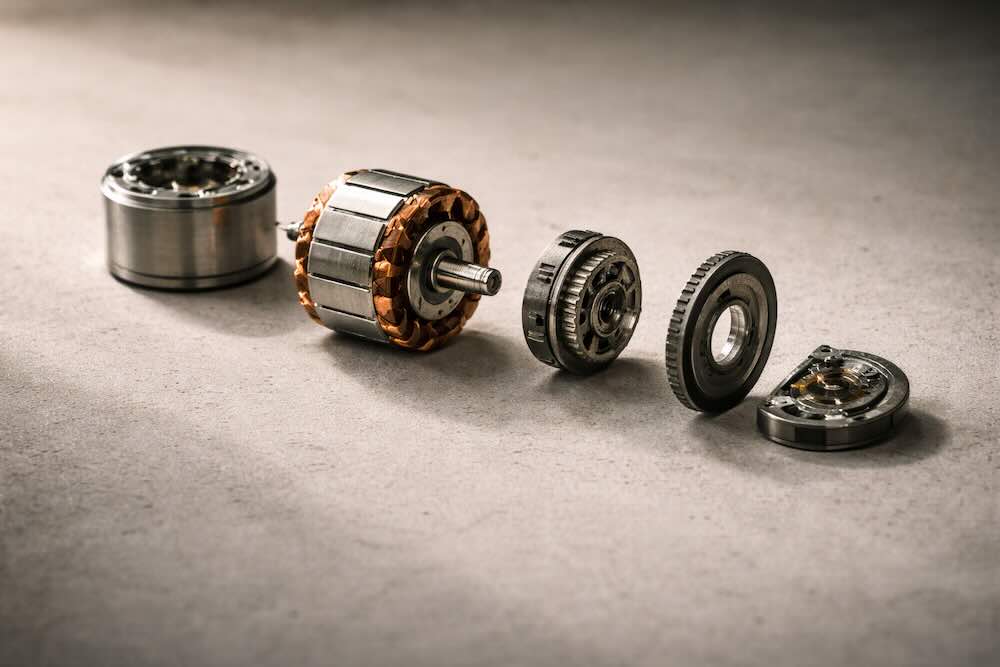
A humanoid robot can have the most sophisticated AI brain ever built, but without the right actuators it's just an expensive statue. Actuators are the muscles of a robot — the components that convert energy into physical movement. Everything a humanoid robot does, from walking across a room to picking up an egg without cracking it, comes down to what its actuators can do and how well they can do it.
What Is an Actuator?
An actuator is any device that converts stored energy into mechanical motion. When a humanoid robot bends its knee, rotates its shoulder, closes its fingers, or turns its head, an actuator is doing the work. If the sensors are the robot's nervous system and the AI is its brain, the actuators are its muscles and tendons — the physical hardware that turns intention into action.
In a humanoid robot, there are actuators at every joint that needs to move. A typical humanoid has between 20 and 56 joints (described as "degrees of freedom"), and each one requires at least one actuator. That means a single humanoid robot might contain dozens of individual actuators, each responsible for a specific movement — the flex of a knee, the rotation of a wrist, the curl of a finger.
The choice of actuator technology is one of the most consequential engineering decisions in the entire design of a humanoid robot. It determines how strong the robot is, how fast it can move, how precisely it can control its motions, how much energy it consumes, how heavy it is, how much noise it makes, how long it can operate on a single charge, and how much it costs to build and maintain. Get the actuators right and everything else becomes easier. Get them wrong and no amount of software brilliance can compensate.
What Makes a Good Humanoid Robot Actuator?
Designing actuators for humanoid robots is one of the most demanding challenges in all of mechanical engineering, because the requirements pull in multiple directions at once. An ideal actuator for a humanoid robot would need to satisfy a demanding list of properties.
- High torque density — It must generate a lot of rotational force (torque) relative to its size and weight. A heavy actuator in the arm makes the whole robot heavier and harder to balance.
- High power density — It must deliver a lot of mechanical power per kilogram. Walking and lifting are energy-intensive activities.
- Precise controllability — It must be able to move to exact positions with exact speeds and hold them steady. Picking up a glass of water requires millimetre-level precision.
- Fast response time — It must react almost instantaneously to commands. When a robot steps into a hole or is pushed, the actuators need to fire corrective movements within milliseconds to prevent a fall.
- High overload capacity — It must be able to briefly produce torque far beyond its normal operating level for sudden, high-demand moments like catching balance or absorbing an impact. The peak torque capability is typically about three times the continuous torque.
- Back-drivability — When an external force is applied (someone pushes the robot, or it bumps into something), the actuator should yield and move rather than resist rigidly. This makes the robot safer and enables force sensing through the actuator itself.
- Energy efficiency — It should consume as little energy as possible. Battery life is one of the most critical constraints in humanoid robotics, and the actuators are the biggest power consumers.
- Low noise — Quiet operation is essential for robots working alongside humans in offices, hospitals, and homes.
- Compact size — It must fit inside a human-scale limb. There isn't room in a robot's forearm for a large industrial motor.
- Durability and reliability — It must operate for thousands of hours without failure. A robot with 40 actuators that each fail 0.1% of the time will spend a lot of time broken.
No actuator technology today perfectly satisfies all of these requirements simultaneously. Every design involves tradeoffs, and understanding those tradeoffs is the key to understanding why different humanoid robots are built the way they are.
The Three Main Actuator Technologies
Actuators used in humanoid robots fall into three broad categories: electric, hydraulic, and pneumatic. Each has a distinct set of strengths and weaknesses that make it suitable for different applications.
Electric Actuators
Electric actuators — motors that convert electrical energy into rotational or linear motion — are now the dominant technology in humanoid robotics. The overwhelming majority of humanoid robots currently in development or deployment use electric actuators, and the trend is strongly in their direction.
A typical electric actuator in a humanoid robot joint consists of several key components working together: a servo motor (usually a frameless torque motor) that generates rotational force; a gearbox or transmission (such as a harmonic drive, planetary reducer, or ball/roller screw) that converts the motor's high-speed, low-torque output into the lower-speed, higher-torque motion needed at the joint; an encoder that tracks the exact position of the joint; and an electronic servo drive that controls the motor's speed, position, and torque based on commands from the robot's central computer.
Why electric dominates. Electric actuators offer a compelling combination of advantages for commercial humanoid robots. They are highly energy-efficient, typically operating at 75–80% efficiency compared to 40–55% for hydraulic systems. They draw power only when actually moving, whereas hydraulic systems must constantly maintain pressure. They are clean — no hydraulic fluid to leak. They are quiet. They offer excellent precision and controllability. And critically, they are compatible with the kind of mass manufacturing that commercial humanoid robots will require. Electric motors are produced in enormous quantities for the automotive and electronics industries, which drives costs down and supply chains up.
The historical limitation. For decades, the knock against electric actuators for humanoid robots was power density. Before the 1990s, hydraulic motors had roughly 100 times the power density of electric motors — meaning a hydraulic actuator could produce far more force per kilogram. This is why Boston Dynamics originally built Atlas with hydraulic actuators: when you need a robot to do backflips and throw heavy objects, raw power matters. However, advances in permanent magnet materials — particularly neodymium magnets (Nd-Fe-B) — have dramatically narrowed this gap. Today, the power density advantage of hydraulics over electric has shrunk to roughly a factor of ten, and for many practical applications, electric is now more than adequate.
Boston Dynamics' switch. The most significant validation of the electric trend came in April 2024, when Boston Dynamics retired its famous hydraulic Atlas and unveiled an all-electric successor. The company that had done more than anyone to demonstrate what hydraulic humanoid robots could achieve concluded that the future of commercial humanoid robots was electric. The reasons were exactly those listed above: lower cost, lower maintenance, quieter operation, better energy efficiency, and a design architecture more suitable for manufacturing at scale.
Hydraulic Actuators
Hydraulic actuators use pressurised fluid (usually oil) to generate mechanical force. A pump pressurises the fluid, and servo valves direct it to pistons or motors at the robot's joints, producing powerful, controlled motion.
The great strength of hydraulics is raw power. Hydraulic actuators can produce enormous forces in a compact package — far more than electric motors of comparable size. This makes them suited to heavy-duty applications where brute strength is the priority: lifting heavy loads, absorbing large impacts, operating in extreme conditions.
The downsides are significant for commercial humanoid robots. Hydraulic systems are mechanically complex, requiring pumps, reservoirs, hoses, valves, filters, and fluid management. They are noisy — the sound of a hydraulic pump is immediately recognisable and incompatible with a quiet office or home. They require regular maintenance, including fluid changes and filter replacements. They can leak, which is messy and potentially hazardous. They are less energy-efficient than electric systems because the pump must maintain constant pressure even when the robot isn't moving. Temperature affects performance — hydraulic fluid degrades above about 82°C and becomes viscous in cold conditions. And they are expensive, both to build and to maintain.
Where hydraulics still matter. Despite the industry-wide shift toward electric, hydraulic technology hasn't disappeared. It remains relevant for extremely heavy-duty applications and for research platforms where maximum dynamic capability outweighs commercial considerations. The engineering advances driven by decades of hydraulic humanoid development — particularly in miniaturised servo valves and compact power units — have also benefited industrial hydraulics more broadly. And hybrid electro-hydraulic systems, which use electric motors to drive compact hydraulic units, offer a middle ground that some designers continue to explore.
Pneumatic Actuators
Pneumatic actuators use compressed air to create motion. They are the least common of the three main types in humanoid robotics, but they occupy an interesting niche because of one distinctive property: compliance.
Because air is compressible (unlike hydraulic fluid or the rigid connections in an electric motor), pneumatic actuators are inherently "springy." When you push against a pneumatic actuator, it gives — absorbing the force rather than resisting it rigidly. This compliance is very similar to how biological muscles behave, which makes pneumatic actuators attractive for researchers studying human-like movement and for applications where safety during physical interaction with humans is critical.
The McKibben muscle is the most well-known pneumatic actuator in humanoid robotics. Invented in the 1950s, it consists of an inflatable rubber bladder surrounded by a braided mesh sleeve. When air is pumped in, the bladder expands, but the mesh constrains the expansion radially, causing the whole structure to shorten — contracting like a biological muscle. McKibben muscles have an excellent power-to-weight ratio and produce very natural-feeling movements.
The limitations are practical. Pneumatic actuators require a compressor and air supply, which adds weight, bulk, and noise. The compressibility of air that gives them their appealing compliance also makes them difficult to control with precision — it's hard to hold an exact position when your actuator is slightly springy. They are less energy-efficient than electric actuators. For these reasons, pneumatic systems are primarily used in research settings and in specific applications like soft robotic grippers, rather than as the main actuation system in commercial humanoid robots.
Electric Actuator Types: The Current Landscape
Since electric actuators now dominate the humanoid robotics industry, it's worth understanding the different approaches within the electric category. The key variations involve how the motor's output is transmitted to the joint, and the tradeoffs involved.
High-Ratio Geared Actuators
Most humanoid robot joints use electric motors paired with high-ratio gear reduction systems. The motor spins fast but with relatively low torque; the gearbox slows the rotation down and multiplies the torque up. The two most common gear types are harmonic drives (also called strain-wave gears) and planetary gearboxes.
Harmonic drives are prized for their compact size, near-zero backlash (meaning no slop or play in the mechanism), and high gear ratios in a single stage. They are widely used in robot arms and wrists. Their main drawbacks are limited shock resistance and higher cost. Planetary gearboxes are more robust, better at handling impacts, and generally cheaper, but they are larger and may have slightly more backlash. Some humanoid robot designs are now shifting from harmonic to planetary reducers for joints that experience frequent impacts, such as legs.
The trade-off with any high-ratio gearbox is that it typically makes the actuator less back-drivable. If someone pushes on the robot, the gearbox resists the motion, which can make the robot feel stiff and makes it harder to sense external forces through the actuator. This is a significant limitation for robots that need to interact safely and responsively with humans and unpredictable environments.
Series Elastic Actuators (SEAs)
A series elastic actuator addresses the back-drivability problem by deliberately placing a spring element between the motor/gearbox and the joint. This spring absorbs shocks, provides inherent compliance (the joint "gives" when pushed), and enables accurate force sensing — the deflection of the spring directly measures the force being applied.
SEAs were pioneered at MIT in the 1990s and have been used in many research humanoid robots. They produce more natural, human-like movement and are inherently safer for human interaction. The downside is that the spring introduces a slight delay and oscillation, which can limit precision and bandwidth at very high speeds. SEAs represent a deliberate choice to prioritise safety and adaptability over raw positional precision.
Quasi-Direct Drive (QDD) Actuators
Quasi-direct drive actuators are one of the most significant recent developments in humanoid robot hardware. They use a low-ratio gearbox (typically 4:1 to 10:1, compared to 100:1 or more in traditional geared systems) paired with a powerful, high-torque motor.
The low gear ratio preserves much of the motor's natural back-drivability — the joint is responsive, compliant, and can sense external forces through the motor's current. At the same time, the small amount of gear reduction provides enough torque multiplication for practical use. QDD actuators offer fast, dynamic movements, good impact resistance, and a natural "feel" during interaction. They are increasingly popular in the latest generation of humanoid robots, particularly for legs and hips where dynamic response and impact handling are critical.
The trade-off is that QDD actuators require larger, more powerful (and therefore heavier and more expensive) motors than high-ratio geared systems, because the motor itself must produce more of the final torque rather than relying on the gearbox to multiply it.
Linear Actuators
Not all humanoid robot joints rotate. Some, particularly in the legs (knees, ankles), use linear actuators — devices that produce motion in a straight line, like a piston. These typically pair an electric motor with a ball screw or planetary roller screw to convert rotary motion into linear push-pull motion.
Planetary roller screws are favoured in humanoid robots over the more common ball screws because they offer longer lifespans, higher load capacity, and greater rigidity. Linear actuators are particularly well-suited to joints that need to produce high forces in a compact, structurally efficient package, such as the knee and ankle joints where the robot must support its entire body weight during walking.
Beyond Conventional Motors: Emerging Technologies
While electric motors dominate today's humanoid robots, a significant body of research is pursuing radically different approaches to actuation — technologies that aim to more closely replicate the remarkable properties of biological muscle.
Artificial Muscles
"Artificial muscle" is a broad umbrella term for any actuator technology that mimics the properties of biological muscle: contracting and expanding, producing force along its length, exhibiting natural compliance, and potentially even self-healing. No artificial muscle technology has yet reached the point of commercial viability in a humanoid robot, but several approaches are making serious progress.
Pneumatic Artificial Muscles (PAMs), including McKibben muscles and their descendants, remain the most mature artificial muscle technology. Recent innovations include vacuum-powered variants, origami-based designs, and hybrid systems that improve contraction range, efficiency, and control. They are used in some research platforms and rehabilitation devices.
Dielectric Elastomer Actuators (DEAs) use electric fields to deform flexible polymer membranes, producing muscle-like contraction and expansion. They offer high energy density, fast response, low noise, and excellent compliance. Recent research has achieved energy densities approaching that of natural muscle, but challenges remain around durability, high voltage requirements, and dielectric breakdown.
Shape Memory Alloys (SMAs), such as nickel-titanium (NiTi) wires, change shape when heated and return to their original shape when cooled. They offer enormous force in a tiny package, but they are slow (limited by heating and cooling cycles), energy-inefficient, and difficult to control precisely.
Electroactive Polymers (EAPs) are materials that change shape in response to electrical stimulation. They come in many varieties and can produce bending, twisting, and linear motions. They are lightweight, flexible, and silent, but generally produce lower forces than conventional actuators.
Twisted and Coiled Polymer (TCP) actuators use fishing-line-like polymer fibres that contract when heated. They are extremely inexpensive, lightweight, and can produce impressive strains, but like SMAs, they are limited by thermal cycling speed.
3D-Printed Soft Actuators represent one of the most exciting recent developments. Researchers at Northwestern University and elsewhere have demonstrated 3D-printed actuators using common rubber materials that can extend and contract like biological muscles, push and pull loads up to 17 times their own weight, and be produced for as little as $3 in materials. These have been assembled into full-scale musculoskeletal robotic legs with artificial muscles, bones, and tendons — pointing toward a future where robots may be built more like bodies than like machines.
When Will Artificial Muscles Be Ready?
Despite impressive lab results, no artificial muscle technology is close to displacing electric motors in commercial humanoid robots. The challenges are durability over thousands of hours of operation, integration with existing control electronics, manufacturing at scale, and achieving the combination of force, speed, precision, and reliability that conventional actuators already deliver. Most experts view artificial muscles as a medium-to-long-term prospect — potentially transformative within five to fifteen years, but not a factor in the current generation of commercial humanoid robots.
The Actuator Map: What Goes Where
A humanoid robot doesn't use the same actuator everywhere. Different joints have different demands, and most robots use a mix of actuator types and sizes matched to the specific requirements of each joint.
- Hips and knees — The most demanding joints. They bear the robot's full weight during walking and must produce high torques with fast, dynamic responses. These joints often use the largest, most powerful actuators in the robot, frequently linear actuators with planetary roller screws or QDD rotary actuators.
- Ankles — Critical for balance and ground adaptation. Ankle actuators need to be strong, fast, and responsive, often using linear actuators for their structural efficiency in compact spaces.
- Shoulders and elbows — Need to support and move the weight of the arms plus whatever the robot is carrying. Moderate torque requirements, with a premium on range of motion. Typically use rotary actuators with harmonic or planetary gears.
- Wrists — Require precision and moderate torque in a compact package. Harmonic drives are common here due to their small size and high accuracy.
- Hands and fingers — The most challenging area for actuators. The extreme space constraints of a human-scale hand mean that actuators must be tiny, yet still produce enough force for useful grasping. Many designs move the actuators into the forearm and transmit force to the fingers via cables (tendons), mirroring how human finger muscles actually work. Some use micro-motors in each finger joint. Dexterous hands remain one of the most active areas of actuator research.
- Torso and neck — Moderate requirements. Torso actuators allow the robot to twist and bend, while neck actuators orient the head and its sensor suite.
Why Actuators Are the Bottleneck
In the current humanoid robotics landscape, an enormous amount of attention is focused on AI — and for good reason. But many engineers argue that actuators are the true bottleneck of the industry. The most advanced AI in the world is useless in a humanoid robot if the actuators can't deliver the speed, precision, force, and reliability needed to execute the AI's commands in the physical world.
Consider what's being asked of these components. A humanoid robot walking across uneven ground needs its leg actuators to make corrective adjustments within milliseconds, coordinating dozens of joints simultaneously. A robot picking up a fragile object needs its finger actuators to apply exactly the right amount of force — too much and it breaks, too little and it drops. A robot that stumbles needs every actuator in its body to fire in a coordinated recovery pattern within a fraction of a second.
Human muscles are, by any engineering standard, extraordinary actuators. They are self-repairing. They can produce both fine, delicate movements and explosive bursts of force. They have intrinsic compliance. They operate for decades. They are powered by chemical energy stored at the cellular level. They are integrated into a control system (the nervous system) that has been refined by hundreds of millions of years of evolution.
Matching even a fraction of these capabilities with engineered components is the fundamental hardware challenge of humanoid robotics. The rapid progress in electric motor technology, the emergence of quasi-direct drive systems, and the promising early results from artificial muscle research all suggest that significant improvements are coming. But the gap between where actuators are now and where they need to be for truly capable, reliable, affordable humanoid robots remains one of the defining challenges of the field.
Every breakthrough you see in humanoid robotics — every smoother walk, every more delicate grasp, every faster recovery from a stumble — is ultimately a story about better actuators. They are the muscles of the machine, and they are where the physical world meets the digital one.
Stay with Droid Brief to follow every step of that journey.