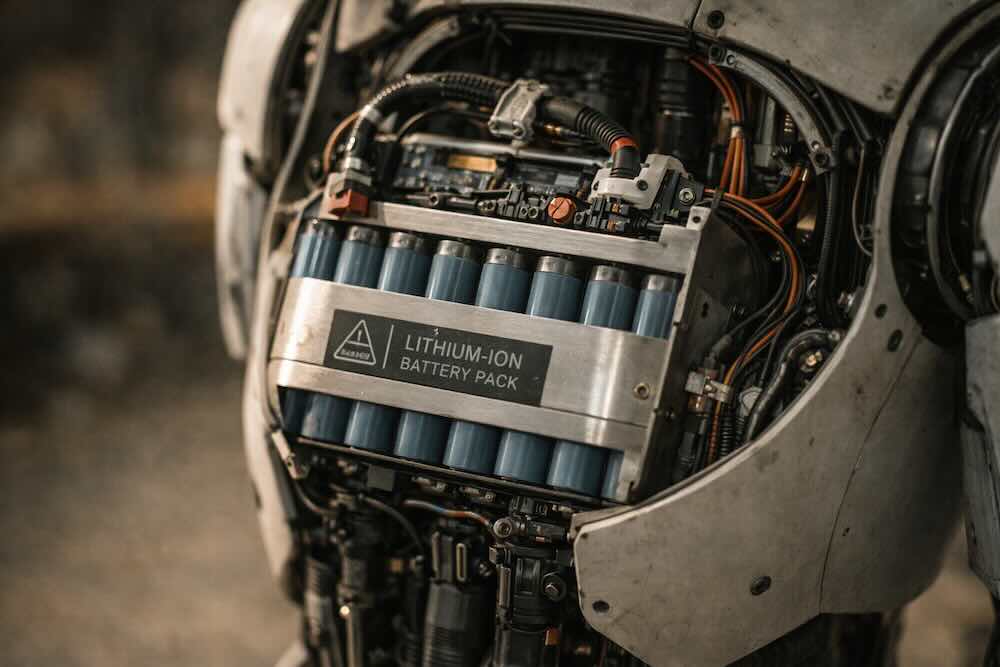
Humanoid robots can walk, grasp tools, and navigate complex environments — but none of it matters if the battery dies after two hours. Power remains the single greatest constraint holding humanoid robots back from widespread real-world deployment. Here's why the energy problem is so hard, what solutions exist today, and what's coming next.
Why Power Is Such a Hard Problem for Humanoids
Every type of mobile robot faces energy challenges, but humanoid robots face them in a uniquely punishing way. The fundamental issue is the collision between high energy demands and severe physical constraints.
Bipedal walking is inherently energy-expensive. Unlike wheeled robots that roll efficiently or quadrupeds that distribute load across four stable points of contact, a humanoid must constantly fight gravity to stay upright on two legs. Every step involves accelerating and decelerating limbs, adjusting balance in real time, and powering dozens of actuators simultaneously. Add in manipulation tasks — lifting, carrying, gripping — and the power demands spike further.
Meanwhile, the humanoid form factor severely limits where you can put a battery. A wheeled warehouse robot can stack cells across a wide, low chassis with no balance concerns. A humanoid has to squeeze its energy storage into a torso-shaped space while keeping the centre of mass positioned precisely over two narrow feet. A bigger battery adds weight, which demands more energy to move, which drains the bigger battery faster — a vicious cycle that engineers call the "mass compounding problem."
On top of locomotion and manipulation, modern humanoid robots run power-hungry onboard computers for perception, AI inference, and real-time control. Cameras, LiDAR, IMUs, force sensors, and the processors interpreting their data all draw continuous power. The result is a machine with the energy appetite of a small electric vehicle but a fraction of the space to store fuel.
Where Things Stand Today: Lithium-Ion Dominance
As of 2025, virtually every humanoid robot on the market or in active development runs on lithium-ion battery packs. The chemistry varies — high-nickel ternary cells (NMC and NCA) are favoured for platforms that prioritise energy density and endurance, while lithium iron phosphate (LFP) appears in some service-oriented robots where cost and safety take priority over maximum range.
Typical pack capacities range from roughly 2 to 5 kWh for most current platforms. Tesla's Optimus carries a 2.3 kWh pack and targets a full working day of light-duty operation. Figure's third-generation robot, the F.03, also uses a 2.3 kWh battery and claims around five hours of runtime at peak performance. Boston Dynamics' new all-electric Atlas specifies approximately four hours of continuous operation. At the other end of the spectrum, smaller research platforms like Unitree's H1 manage under four hours of relatively static operation from a pack under 1 kWh.
These numbers come with heavy caveats. Runtime is profoundly task-dependent. A humanoid standing in place and performing light arm movements will last far longer than one walking briskly, climbing stairs, or lifting heavy objects. Real-world mixed-task operation — the kind of varied activity you'd expect on a factory floor — typically lands somewhere in the two-to-four-hour window for most current platforms.
Battery packs are not commodities
It's worth understanding that humanoid robot battery packs are highly customised subsystems, not off-the-shelf products. Each pack must be co-engineered with the robot's specific chassis geometry, weight distribution, thermal profile, and duty cycle. Figure, for example, designs and manufactures its battery systems in-house, and its F.03 pack is engineered as a structural element of the robot's torso — carrying mechanical loads as well as storing energy. The pack uses die-cast aluminium, stamped steel, and structural adhesives, and is designed to survive a one-metre drop onto concrete from any orientation.
Battery management systems (BMS) are equally critical. A sophisticated BMS monitors individual cell voltages, temperatures, and charge states in real time, balancing loads across the pack and preventing dangerous conditions like thermal runaway. Advanced systems increasingly use AI-driven predictive algorithms to optimise power distribution based on the robot's current and anticipated tasks.
The Tethered Era and the Shift to Electric
It wasn't always this way. The history of humanoid robot power tells a story of progressive liberation from the cable.
When Boston Dynamics unveiled the original Atlas in 2013 for the DARPA Robotics Challenge, the robot was tethered to an external power supply. It was a hydraulically actuated machine — powerful and dynamic, but reliant on an umbilical cord for both electrical power and hydraulic pressure. The tether limited its usefulness to controlled demonstrations and lab environments.
By 2015, Boston Dynamics had produced "Atlas Unplugged" — a version with onboard batteries powering a hydraulic pump. Roughly 75% of the robot's parts were redesigned to make this possible. The untethered hydraulic Atlas could operate for around 30 to 60 minutes on a charge depending on activity level, a dramatic improvement in autonomy despite the short runtime.
The real paradigm shift came in April 2024, when Boston Dynamics retired the hydraulic Atlas entirely and unveiled a fully electric successor. The move from hydraulics to electric actuation wasn't just about performance — it fundamentally changed the power equation. Hydraulic systems are inherently lossy: energy is converted from electrical to mechanical (pump) to fluid pressure to mechanical motion at the joint, with significant heat generated at every stage. Electric actuators convert electrical energy to mechanical motion far more directly, with substantially less waste heat and lower maintenance requirements.
This transition reflected a broader industry consensus. Today, every major humanoid platform in commercial development — Optimus, Figure 02 and F.03, Digit, Apollo, NEO, Phoenix — uses electric actuation. Hydraulics delivered the proof of concept; electric drive is delivering the product.
Extending Runtime: Strategies and Workarounds
Given the current limitations of battery chemistry, humanoid robotics companies are pursuing multiple strategies to get more useful work out of every charge cycle.
Battery swapping
Rather than waiting for a robot to recharge, battery swapping allows a depleted pack to be exchanged for a fresh one in minutes or even seconds. This is the leading near-term strategy for achieving 24/7 operation. Agility Robotics' Digit and Apptronik's Apollo both use hot-swappable battery systems. Boston Dynamics' new electric Atlas is designed with self-swappable batteries — the robot can autonomously navigate to a charging dock, swap its own pack, and return to work without human intervention.
The operational model here borrows from industrial logistics: a facility maintains a pool of battery packs cycling between active use and charging stations, and robots rotate through them continuously. The economics work if the swap time is short enough and the pack pool is large enough to keep every robot productive.
Regenerative braking
Just as electric vehicles recover kinetic energy during deceleration, humanoid robots can recapture energy when slowing limb movements or lowering loads. Estimates suggest regenerative techniques can reduce overall energy consumption by up to 30%. This is particularly valuable during repetitive industrial tasks where arms and legs are constantly accelerating and decelerating.
Efficient actuation design
Actuator efficiency varies enormously depending on design. Quasi-direct-drive (QDD) actuators, which use low-ratio gearing to preserve the motor's natural backdrivability, waste less energy on friction and heat than heavily geared alternatives. Some platforms use series elastic actuators that store and release energy in springs, mimicking the way tendons work in biological legs. These design choices compound: a 10-15% improvement in actuator efficiency across 40 or more joints translates to meaningfully longer runtime.
Intelligent power management
Software plays an increasingly important role. AI-driven power management systems can throttle non-critical processes during low-demand periods, pre-plan energy-efficient movement trajectories, and predict when a battery swap will be needed based on upcoming task schedules. The goal is to extract maximum useful work per watt-hour, not just maximum runtime.
What's Coming Next: Solid-State and Beyond
Solid-state batteries
The technology most likely to transform humanoid robot endurance in the medium term is the solid-state battery. By replacing the liquid electrolyte in conventional lithium-ion cells with a solid material, these batteries promise higher energy density (pushing past 400 Wh/kg, compared to around 250-350 Wh/kg for today's best lithium-ion cells), improved safety (solid electrolytes are far less prone to thermal runaway), faster charging, and longer cycle life.
Industry analysts at TrendForce project that solid-state battery capacity for humanoid robots will grow from approximately 0.05 GWh in 2025 to around 74 GWh by 2035 — a staggering scale-up driven by the expectation that humanoid deployments will reach tens of thousands of units annually. Semi-solid variants (a transitional technology using a partially solid electrolyte) are already entering limited production, with some Chinese manufacturers claiming energy densities of 350 Wh/kg in prototype cells.
The timeline matters. Full solid-state production at scale is widely expected to arrive in the late 2020s, meaning the humanoid robots deployed in factories over the next two to three years will still rely on conventional lithium-ion chemistry. But for the generation of robots targeting mass deployment around 2028-2030, solid-state cells could meaningfully extend shift lengths.
Hydrogen fuel cells
Fuel cells generate electricity from hydrogen and oxygen, producing only water as a byproduct. They offer significantly higher energy density than batteries by weight, and can be refuelled in minutes rather than recharged over hours. A hybrid approach — a fuel cell providing steady baseline power combined with a battery handling peak demands from dynamic movements — is considered particularly promising for robotics applications.
The challenges are practical rather than theoretical. Hydrogen storage requires pressurised tanks that are difficult to integrate into a humanoid torso. Refuelling infrastructure doesn't exist in most facilities. And fuel cell stacks are still more expensive and less robust than battery packs. For now, hydrogen fuel cells remain a credible long-term option rather than a near-term solution for humanoid platforms, though they are already proven in warehouse AGVs and industrial drones.
Other emerging approaches
Several more speculative technologies sit further out on the horizon. Supercapacitors could supplement batteries by handling short, intense power bursts (a jump, a heavy lift) without stressing the main pack. Advances in wireless power transfer might enable robots to top up charge while working in equipped environments. And researchers continue to explore microbial fuel cells, nuclear microbatteries, and other exotic energy sources — though none of these are close to practical deployment in humanoid platforms.
The Bigger Picture: Power Shapes Everything
It's easy to treat power as a dry engineering constraint, but it's worth stepping back to appreciate how profoundly energy limitations shape the entire humanoid robotics industry.
Battery life determines shift length, which determines how many robots a facility needs, which determines the economics of deployment. Charging time determines utilisation rate. Pack weight determines payload capacity. Thermal management determines where a robot can operate. Safety certification for high-energy battery packs — Figure's F.03 is pursuing both UN38.3 and UL2271 standards, the first humanoid robot battery to do so — determines whether a robot can legally work alongside humans.
Every major humanoid robotics company is, to some degree, a battery company. Tesla brings decades of EV battery expertise to Optimus. Figure has built an in-house battery manufacturing line at its BotQ facility. Boston Dynamics' new Atlas was designed around its power system from the ground up. The companies that solve the energy problem most effectively won't just build better robots — they'll build the robots that can actually be deployed at scale.
The current generation of humanoid robots can work a partial shift. The next generation, powered by improved lithium-ion and early solid-state cells, will target a full shift. The generation after that — perhaps arriving in the early 2030s — may finally achieve the all-day endurance that makes humanoid robots genuinely competitive with human workers on raw uptime alone.
Until then, power remains the bottleneck — and the race to solve it is one of the most consequential engineering challenges in robotics today.
Further Reading on Droid Brief:
- Actuators & Motors: The Muscles — How power gets converted into movement
- Locomotion & Balance — Why bipedal walking is so energy-hungry
- Materials & Structural Design — Lightweight materials that reduce power demands
- Comparison Guide: Current Humanoid Robots — Battery specs compared across platforms
- The Business Case for Humanoid Workers — How runtime economics affect deployment