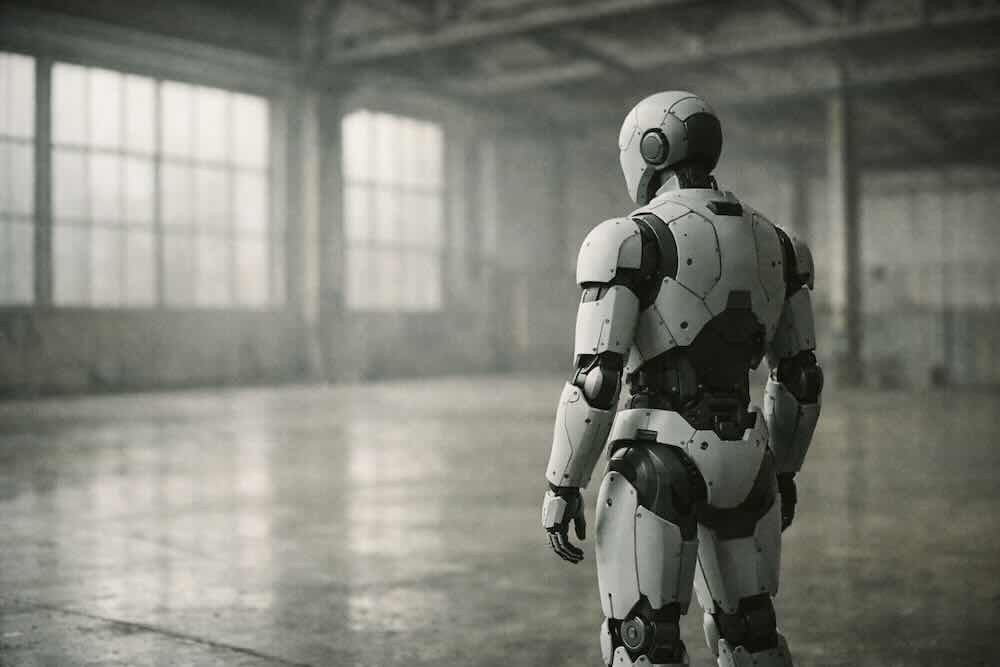
They walk on two legs, reach with two arms, and see with camera eyes. But what exactly makes a robot "humanoid" — and why are some of the world's biggest companies racing to build them?
The Definition
A humanoid robot is a robot designed with a body plan that resembles the human form. At its simplest, that means a torso, two arms, two legs, and a head. The word "humanoid" comes from "human" and the Greek suffix "-oid," meaning "resembling" — so a humanoid robot is, quite literally, a machine that resembles a human.
That's the broad definition, but in practice the term carries specific expectations. When roboticists and the media talk about humanoid robots today, they generally mean a machine that:
- Walks upright on two legs (bipedal locomotion)
- Manipulates objects with hands or grippers at the end of two arms
- Perceives the world through sensors mounted in a head-like structure
- Is capable of some degree of autonomous decision-making
It doesn't need to look convincingly human. Most humanoid robots look unmistakably like machines — and that's fine. The point is the body plan, not the cosmetics.
Quick Definition: A humanoid robot is a machine designed with a human-like body layout — head, torso, two arms, and two legs — enabling it to operate in environments built for people and to interact with the physical world in ways that mirror human movement.
Anatomy of a Humanoid Robot
While every humanoid robot is different, most share a common set of subsystems that map roughly onto the human body. Understanding these components is the first step to understanding how these machines work.
- The "Brain" — One or more onboard computers running AI models that process sensor data, make decisions, and send movement commands.
- Sensors & Perception — Cameras, LiDAR, microphones, and force sensors that let the robot see, hear, and feel the world around it.
- Actuators — Electric motors, hydraulic systems, or artificial muscles that power every joint — the robot's equivalent of muscles.
- Hands & End Effectors — Grippers or multi-fingered hands that allow the robot to grasp, carry, and manipulate objects.
- Skeleton & Structure — A lightweight but strong frame — often aluminium, carbon fibre, or 3D-printed composites — that supports everything.
- Power System — Battery packs (usually lithium-ion) that provide energy for movement, computation, and sensing — typically lasting one to four hours.
The number of joints a humanoid robot has is described by its "degrees of freedom" (DOF). A single degree of freedom represents one axis of movement — a hinge that bends, or a joint that rotates. The human body has over 200 degrees of freedom. Most current humanoid robots have between 20 and 50, focused on the joints that matter most for practical tasks: hips, knees, ankles, shoulders, elbows, wrists, and fingers.
What Isn't a Humanoid Robot
One of the easiest ways to understand what a humanoid robot is, is to understand what it isn't. The word "robot" covers an enormous range of machines, and the vast majority of them are not humanoid.
| Type | Form | Example | Humanoid? |
|---|---|---|---|
| Humanoid Robot | Two legs, two arms, head, torso | Boston Dynamics Atlas, Tesla Optimus | Yes |
| Industrial Robot Arm | Single articulated arm, bolted to floor | KUKA, FANUC, ABB arms | No |
| Quadruped / Legged | Four-legged, animal-inspired | Boston Dynamics Spot, Unitree Go2 | No |
| Wheeled / Mobile | Wheels or tracks, no legs | Amazon warehouse robots, Roomba | No |
| Drone / Aerial | Multi-rotor or fixed wing | DJI Mavic, delivery drones | No |
| Social / Companion Robot | Often humanoid-ish but usually no legs | Pepper, Jibo | Partial* |
| Android | Designed to look convincingly human | Hanson Robotics Sophia, Geminoid | Yes (subset) |
* Social robots like Pepper have a humanoid upper body but wheels instead of legs, placing them in a grey area. Some classify them as humanoid; purists do not.
It's also worth drawing a clear line between humanoid and android. An android is a humanoid robot that is specifically designed to look and move as much like a real human as possible — realistic skin, facial expressions, and natural movement. All androids are humanoid, but most humanoid robots are not androids. The majority look like what they are: machines with a roughly human shape.
Why the Human Form?
This is one of the most frequently asked questions in robotics, and it has a deeply practical answer. The world is built for human bodies. Door handles are at arm height. Stairs are sized for human legs. Tools are shaped for human hands. Factory workstations, kitchens, construction sites, hospitals, offices — all of them are designed around the assumption that the person using them is roughly human-shaped, roughly human-sized, and moves the way humans move.
A wheeled robot can't climb stairs. A robot arm bolted to a workbench can't walk to the next room to fetch a part. A quadruped can navigate rough terrain, but it can't open a door, pick up a box, and carry it upstairs. The humanoid form factor is, in effect, the most general-purpose chassis for operating in human environments without redesigning those environments first.
The argument for humanoid robots is not that the human form is the best possible shape for a robot. It's that it's the best possible shape for a robot that needs to work in a world designed for humans.
There are also psychological reasons. Humans find it more intuitive to interact with, instruct, and work alongside a machine that moves the way they do. If you want to show a humanoid robot how to perform a task, you can demonstrate it yourself — a principle called "learning from demonstration" that is much harder with a robot that has a radically different body plan. The shared form factor creates a natural bridge between human intent and robot action.
Critics rightly point out that the humanoid form has serious engineering penalties. Walking on two legs is fiendishly difficult to engineer and consumes far more energy than wheels. Hands with individual fingers are orders of magnitude more complex than a simple gripper. The vertical, narrow body has a high centre of gravity and is inherently unstable. These are real tradeoffs. The bet the industry is making is that the versatility of the human form outweighs the engineering cost — particularly as AI makes these bodies smarter and more capable.
A Brief History
Humans have been fascinated by the idea of building artificial people for millennia. The history of humanoid robots stretches from ancient mythology to modern venture capital, with a few pivotal moments along the way.
- Antiquity — Ancient Greek myths describe Talos, a giant bronze automaton built by Hephaestus to protect Crete. Real mechanical automata appeared in ancient China, Greece, and the Islamic Golden Age.
- 1495 — Leonardo da Vinci designs a mechanical knight — an armoured humanoid figure operated by pulleys and cables. Modern reconstructions show it actually works.
- 1920 — Czech playwright Karel Čapek coins the word "robot" in his play R.U.R. (Rossum's Universal Robots), from the Czech word robota meaning forced labour.
- 1973 — WABOT-1 at Waseda University in Tokyo becomes the first full-scale humanoid robot, capable of walking, gripping objects, and communicating in basic Japanese.
- 2000 — Honda unveils ASIMO, which becomes the world's most famous humanoid robot. It walks, runs, climbs stairs, and recognises faces — a watershed moment for the field.
- 2013 — Boston Dynamics' Atlas is introduced for the DARPA Robotics Challenge, designed to perform disaster-response tasks. It would go on to become the benchmark for dynamic humanoid movement.
- 2022–Present — The current wave begins. Tesla, Figure, Agility, Apptronik, 1X, Sanctuary AI, Unitree, and others announce or demonstrate humanoid robots aimed at real-world commercial applications, fuelled by advances in AI.
For most of the 20th century, humanoid robots were research projects — impressive demonstrations of engineering but nowhere near practical for real work. What changed was artificial intelligence. The convergence of modern AI (particularly large language models, computer vision, and reinforcement learning) with decades of mechanical engineering progress has made the current generation of humanoid robots fundamentally different from their predecessors. They're not just walking — they're learning.
The Current Generation
As of early 2026, the humanoid robotics industry is in a period of extraordinary activity. Dozens of companies around the world are building humanoid robots, with several already deploying early units in real commercial environments. Here are some of the most significant platforms currently in development or early deployment.
| Robot | Company | Country | Focus |
|---|---|---|---|
| Atlas (Electric) | Boston Dynamics | USA | Commercial / Industrial |
| Optimus (Gen 2+) | Tesla | USA | Manufacturing / General purpose |
| Figure 02 | Figure AI | USA | Warehousing / Commercial labour |
| Digit | Agility Robotics | USA | Logistics / Warehousing |
| Apollo | Apptronik | USA | Manufacturing / Logistics |
| NEO | 1X Technologies | Norway | Home / Security |
| Phoenix | Sanctuary AI | Canada | General purpose / AI-first |
| H1 / G1 | Unitree | China | Research / Commercial |
What unites this generation is an approach that would have seemed radical a decade ago: build the body, then teach it with AI. Rather than programming every motion by hand, these companies are using techniques from artificial intelligence — reinforcement learning, imitation learning, foundation models — to train robots to perform tasks the way humans learn: through practice, observation, and trial and error.
How They Work (In Plain English)
You don't need an engineering degree to understand the basics of how a humanoid robot works. At a high level, the process follows a loop that is remarkably similar to how humans operate: sense, think, act.
Sense
The robot gathers information about its surroundings using an array of sensors. Cameras provide vision. Depth sensors (like LiDAR) build a 3D map of nearby objects. Inertial measurement units (IMUs) track the robot's own orientation and balance — the equivalent of your inner ear. Force and torque sensors in the joints and hands tell the robot how much pressure it's applying. Some robots also have microphones for voice interaction and tactile sensors that mimic a basic sense of touch.
Think
All that sensor data feeds into the robot's onboard computers, where software processes it and decides what to do. This is where AI plays its biggest role. Modern humanoid robots increasingly use neural networks — AI models trained on vast amounts of data — to interpret what they see, plan movements, and decide how to approach tasks. Some decisions happen locally on the robot; others are offloaded to powerful cloud-based computers. The "thinking" layer ranges from low-level balance control (happening hundreds of times per second) to high-level task planning (figuring out the sequence of steps to, say, pick up a box and place it on a shelf).
Act
The robot's decision becomes a set of commands sent to its actuators — the motors and mechanisms that move its joints. Electric motors rotate, hydraulic pistons push, and the robot's limbs move. This happens in a continuous, rapid cycle. Walking, for example, requires the robot to constantly adjust dozens of joints simultaneously, reacting to the feedback from its balance sensors in real time. Every step is a controlled fall, caught just in time.
This sense-think-act loop runs continuously, many times per second. The faster and smarter this loop, the more capable the robot. Much of the current progress in humanoid robotics isn't about building better bodies — it's about making the "think" step dramatically better through AI.
What Are They For?
Humanoid robots are not being built as novelties. The companies developing them are targeting specific, economically significant applications where the humanoid form factor provides genuine advantages over existing automation. The major target sectors include:
- Manufacturing and assembly lines — Humanoid robots can be dropped into existing workstations designed for human workers without retooling the entire facility.
- Warehousing and logistics — They can pick, carry, and sort goods in environments built for people.
- Hazardous environments — Disaster zones, nuclear facilities, and construction sites where sending a human is dangerous.
- Healthcare and elder care — Labour shortages are acute and the tasks — assisting patients, fetching supplies, monitoring wellbeing — require mobility and dexterity in human spaces.
- Domestic assistance — The longer-term vision of a general-purpose robot that can operate in your home.
The common thread across all of these is the concept of a "drop-in replacement" — a robot that can work in spaces and with tools already designed for humans, without requiring the environment to be re-engineered. This is the core commercial proposition of the humanoid form.
The Economic Argument: Proponents argue that the addressable market for a general-purpose humanoid worker is effectively the entire global market for physical labour — a figure measured in the tens of trillions of dollars. Even sceptics acknowledge that if humanoid robots become reliable enough for just one or two of these sectors, the market would be enormous. The question isn't whether the market exists; it's whether the technology can get there, and how soon.
The Hard Problems
For all the recent progress, humanoid robots remain extraordinarily difficult to build and deploy. Several fundamental challenges are still being actively worked on across the industry.
Bipedal Locomotion
Walking on two legs is one of the most computationally and mechanically demanding things a robot can do. Humans learn to walk over the course of about a year, and our brains devote enormous neural resources to balance and movement without us ever being aware of it. For robots, every step requires real-time coordination of dozens of joints, constant adjustment for uneven surfaces, and split-second recovery from perturbations. It works in demos. It needs to work on a construction site, in the rain, for eight hours.
Dexterous Manipulation
Picking up a mug of coffee is trivially easy for a human and astonishingly hard for a robot. The human hand has 27 degrees of freedom and is covered in approximately 17,000 tactile sensors. Building a robotic hand with anything close to this capability — and making it affordable, reliable, and durable — remains one of the field's greatest challenges. Most current humanoid robots use simplified grippers or hands with limited finger dexterity.
Battery Life
Most humanoid robots currently operate for between one and four hours on a single charge. For commercial viability in roles like warehouse work or manufacturing, they'll likely need to operate for full shifts, or the infrastructure for fast automated recharging needs to become seamless. Energy density remains a bottleneck.
Robustness and Reliability
A demonstration that works 95% of the time is impressive. A commercial product needs to work 99.9% of the time. The gap between a successful lab demo and a robot that can operate safely and reliably in an unstructured real-world environment for months on end is enormous. This is where much of the current engineering effort is focused.
Cost
Current humanoid robots cost anywhere from tens of thousands to hundreds of thousands of dollars per unit. For widespread commercial adoption, particularly in roles that replace minimum-wage labour, prices will need to fall dramatically. Many companies are betting that scale manufacturing, simpler designs, and cheaper components will bring costs down to the range of a car over the next five to ten years.
Intelligence and Generalisation
Perhaps the biggest challenge of all. Today's humanoid robots can be trained to perform specific tasks very well. But a truly useful humanoid worker needs to generalise — to handle novel situations, adapt to unexpected problems, and learn new tasks quickly. This is the frontier where AI research meets robotics, and where progress is both the most exciting and the most uncertain.
What's Next
The humanoid robotics industry is at an inflection point. After decades as a research curiosity, humanoid robots are entering the early stages of commercial reality.
In the near term — the next two to five years — expect to see small fleets of humanoid robots working in controlled commercial environments like warehouses and factories, performing specific, well-defined tasks. You'll see rapid improvements in AI-driven capability, where robots learn new tasks in hours rather than months. You'll see costs begin to fall as companies move from hand-built prototypes to manufactured products.
The medium-term horizon — five to fifteen years — is where the more transformative predictions live: humanoid robots in hospitals, on construction sites, in homes. Whether and how quickly this happens depends not just on engineering progress, but on regulatory frameworks, public acceptance, economic conditions, and breakthroughs in AI that are difficult to predict.
What's clear is that the convergence of advanced AI, better hardware, and serious commercial investment has made humanoid robots a technology to pay attention to — not as science fiction, but as an emerging industrial reality. This is not a question of whether humanoid robots will become part of the economy. It's a question of when, where, and how.
The age of humanoid robots is not arriving with a single breakthrough moment. It's arriving gradually, one task, one factory, and one deployment at a time.
Stay with Droid Brief to follow every step of that journey.