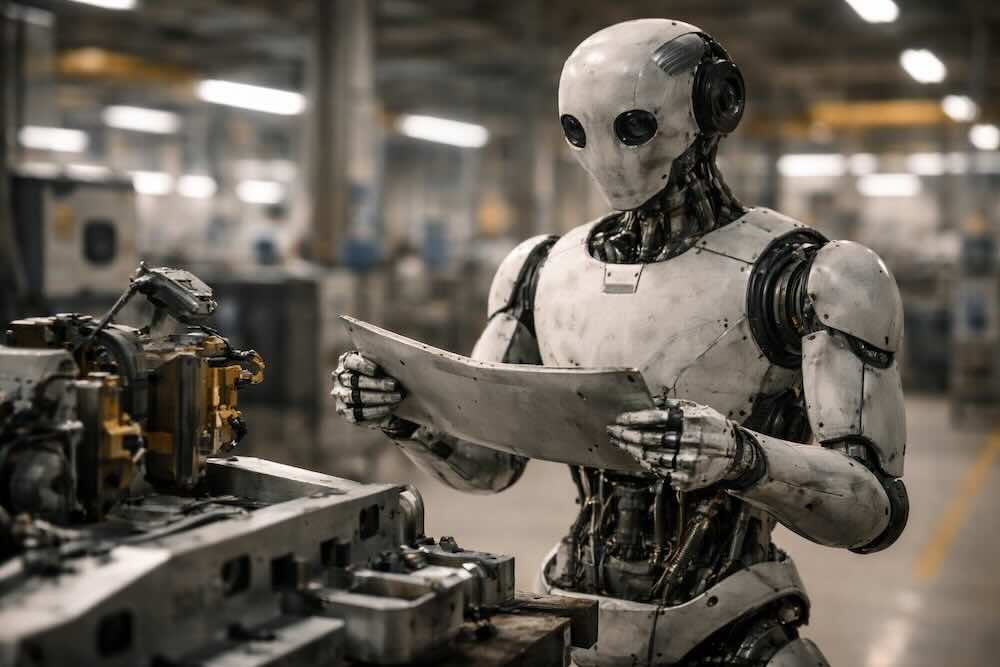
Of all the places humanoid robots could end up, the factory floor and the warehouse are where they're arriving first. Not the home. Not the hospital. The production line.
That might seem counterintuitive — factories already have robots, after all. Industrial arms have been welding, painting, and assembling products for decades. But those machines are bolted in place, designed for a single task, and surrounded by safety cages. The new generation of humanoid robots promises something different: machines that can walk into an existing facility, work alongside people, and switch between tasks — all without tearing up the floor plan.
We're still in the very early innings. Most deployments remain pilot programmes with a handful of units. But the results so far are real, the investment is enormous, and the trajectory is clear. Here's where things stand.
Why Humanoids? Why Not Just More Arms and AGVs?
The global manufacturing and logistics sectors already use millions of robots. Autonomous mobile robots (AMRs) shuttle goods across warehouse floors. Six-axis industrial arms weld car bodies with sub-millimetre precision. Automated guided vehicles (AGVs) follow magnetic strips between loading docks. So why introduce a humanoid?
The answer comes down to three things: flexibility, infrastructure, and the limits of single-purpose automation.
Traditional automation requires you to redesign your facility around the robot. That means new conveyor layouts, safety barriers, dedicated pathways, and months of downtime during installation. This "greenfield" approach works brilliantly for high-volume, low-mix production — think automotive welding lines that run the same operation millions of times. But vast areas of manufacturing and logistics remain stubbornly manual, precisely because the tasks are too varied, too unpredictable, or too deeply embedded in human-scale spaces to justify a bespoke automation solution.
Humanoid robots are designed for "brownfield" deployment — they can, in theory, walk into an existing facility and start working with minimal modification. They can navigate aisles built for people, reach shelves at human height, use human-scale tools, and transition between different tasks in a single shift. A legged humanoid can handle stairs, ramps, and uneven surfaces that would stop a wheeled robot dead. An upper body with dexterous hands can pick, place, inspect, and carry — tasks that currently require separate machines or, more often, a human worker.
The pitch isn't that humanoids will replace the industrial arm or the AMR. It's that they'll fill the enormous gap between what today's automation can do and what still requires a person.
Who's Deploying, and Where?
The automotive industry is leading the way, which makes sense — it has the deepest history with industrial automation and some of the most pressing labour challenges. But logistics and warehousing are close behind. Here are the most significant real-world deployments as of early 2026.
BMW and Figure AI: The Spartanburg Milestone
The most documented humanoid deployment in manufacturing to date took place at BMW's plant in Spartanburg, South Carolina, in partnership with California-based Figure AI. Over an eleven-month pilot, two Figure 02 robots worked ten-hour shifts, Monday to Friday, on an active assembly line. Their job was a classic pick-and-place task: retrieving sheet metal parts from racks and positioning them on welding fixtures with millimetre precision, after which conventional industrial robots performed the welds.
The numbers are notable. The robots supported the production of more than 30,000 BMW X3 vehicles, handled over 90,000 individual components, logged approximately 1,250 operating hours, and covered around 1.2 million steps. The task demanded both speed — parts had to be loaded within a 37-second cycle time — and accuracy, with placement tolerances of just 5 millimetres.
Figure AI hasn't published detailed performance metrics against those targets, but the pilot generated enough confidence for BMW to take the next step. In December 2025, the automaker began a new pilot at its Leipzig plant in Germany — its first European humanoid deployment — this time using the AEON robot from Hexagon Robotics. That programme focuses on high-voltage battery assembly and component manufacturing, with a full-scale pilot expected by summer 2026. BMW has also established a dedicated Centre of Competence for Physical AI in Production to consolidate what it's learning across its global network.
Meanwhile, Figure AI has retired the Figure 02, rolling its learnings into the next-generation Figure 03, which is being evaluated for additional BMW use cases.
Mercedes-Benz and Apptronik: Teaching Robots Through Teleoperation
Mercedes-Benz entered a commercial agreement with Austin-based Apptronik in early 2024 to pilot the Apollo humanoid robot in its manufacturing facilities. The initial focus has been on intralogistics — transporting components and assembly kits to the production line, and conducting initial quality inspections along the way.
Much of the testing has taken place at Mercedes-Benz's Digital Factory Campus in Berlin-Marienfelde, the company's global innovation hub for production technology. The approach is distinctive: Mercedes production workers have been transferring their knowledge to Apollo through teleoperation and augmented reality, effectively teaching the robots by demonstration before they transition to autonomous operation. By early 2025, Mercedes announced a low double-digit-million-euro investment in Apptronik and confirmed that Apollo was being trained to perform tasks autonomously within its MO360 digital production ecosystem.
Mercedes has framed the project as complementing its workforce rather than replacing it, targeting repetitive, physically demanding tasks where labour shortages are most acute.
Agility Robotics and GXO: The Warehouse Workhorse
If BMW's deployment is the headline manufacturing story, the equivalent in warehousing belongs to Agility Robotics and GXO Logistics. In June 2024, GXO — the world's largest pure-play contract logistics provider — signed what was described as the industry's first formal commercial deployment of humanoid robots, and the first robotics-as-a-service (RaaS) agreement for humanoids.
The deployment at GXO's facility in Flowery Branch, Georgia, put Agility's bipedal Digit robot to work alongside existing autonomous mobile robots. Digit's role is what the industry calls "last-metre" work: picking totes on and off AMRs, loading items onto conveyors, and stacking containers at floor locations — tasks that require the kind of mobility and dexterity that wheeled robots and fixed arms struggle with.
By November 2025, Agility announced that Digit had moved more than 100,000 totes in commercial operation at the GXO facility — a milestone designed to demonstrate sustained, reliable throughput rather than one-off demonstrations. Agility has since signed an agreement with Mercado Libre, Latin America's largest e-commerce company, to deploy Digit in a fulfilment centre in San Antonio, Texas, with an eye toward expansion across the Americas.
Other Notable Activity
The BMW, Mercedes, and GXO deployments are the best-documented, but activity is spreading rapidly across the sector:
- Tesla is developing Optimus for internal use in its own manufacturing plants, with broader commercial availability planned for later.
- Hyundai has announced plans to purchase thousands of Atlas robots from Boston Dynamics (which Hyundai owns) for deployment in its facilities.
- 1X Technologies struck a deal in late 2025 to ship up to 10,000 Neo humanoid robots to EQT's portfolio companies — concentrated in manufacturing, warehousing, and logistics — between 2026 and 2030.
- Amazon has tested Digit for tote-recycling tasks in its fulfilment centres, though the current status and scale of that programme is unclear.
- Toyota is testing Digit at facilities in Canada.
- GXO is also piloting robots from Apptronik and other manufacturers alongside Digit, deliberately avoiding a single-vendor strategy.
What Are They Actually Doing?
It's worth being clear-eyed about the scope of current tasks. Despite the "general-purpose" branding that most humanoid companies use, the robots deployed in manufacturing and warehousing today are performing narrow, well-defined task sets in controlled environments. The most common include:
- Tote and bin handling: Moving containers between AMRs, conveyors, shelves, and floor locations.
- Parts loading: Picking components from racks or bins and placing them on fixtures or workstations.
- Material transport: Delivering kitted parts and assembly components to production line workers.
- Basic inspection: Visual quality checks on components during handling.
- Palletising: Stacking and organising goods for shipping or storage.
These are important, real tasks — and they're precisely the kind of repetitive, physically demanding work that's hardest to staff in today's labour market. But they're a long way from the sci-fi vision of a robot that can do anything a human can. High-precision assembly, work in crowded human-dense spaces, and tasks requiring creative problem-solving remain beyond current capabilities.
The Business Case: Cost, Speed, and the Labour Equation
The economic argument for humanoid robots in manufacturing and warehousing rests on several pillars, not all of which are straightforward.
Labour Shortages
This is the most commonly cited driver, and it's genuine. Manufacturing and logistics face chronic difficulty filling physically demanding, repetitive roles — particularly on second and third shifts. High turnover rates compound the problem, with the cost of constant recruiting and retraining eating into margins. Humanoid robots don't call in sick, don't quit after three months, and can theoretically operate multiple shifts (battery permitting).
Cost Per Hour
Current humanoid robots are expensive. Prices range from roughly $30,000 for entry-level research platforms to $250,000 or more for commercially deployed models like Digit. At the higher end, the economics only work at scale through RaaS models, where companies pay a usage fee rather than buying the robot outright. Most manufacturers project that humanoid robot ROI will become compelling within 12–24 months of deployment as the technology matures and production volumes bring costs down.
Speed vs. Endurance
Here's an important nuance: current humanoid robots are generally slower than human workers. GXO's early testing showed humanoids performing at roughly 70–85% of human picking speed. The productivity argument isn't about speed — it's about endurance and consistency. A robot that works at 80% human speed but operates for 20 hours a day with no breaks, no injuries, and no variance in quality can outproduce a human worker over a full week. The gap between robot and human speed is also closing as AI models improve.
Battery Life
This remains a significant constraint. Most humanoid robots today operate for only around two to four hours on a single battery charge. Achieving a full eight-hour shift without intervention could take years, as battery energy density improves incrementally. In the meantime, operators rely on hot-swappable battery packs and fast charging to keep robots on the floor. Some hybrid designs use wheeled bases to extend operational time by reducing the energy cost of bipedal locomotion.
The Brownfield Advantage
One of the most compelling practical arguments for humanoid robots is that they can be deployed in existing facilities without major infrastructure changes. Traditional automation often requires a complete rethink of floor layout, new safety infrastructure, specialised power and data connections, and months of commissioning time. For many companies — particularly in logistics, where margins are thin and facilities turn over frequently — that level of investment simply isn't viable.
A humanoid robot, in principle, can be delivered, powered on, and put to work in a space that was designed for humans. It fits through standard doorways, navigates standard aisles, and operates at standard shelf heights. The BMW Spartanburg deployment did require some physical adaptations — additional barriers, enhanced 5G network coverage, and integration with BMW's existing Smart Robotics ecosystem — but these were modest compared to installing a new fixed-automation line.
This "drop-in" capability is especially attractive for third-party logistics (3PL) providers like GXO, who operate hundreds of facilities for different clients and can't justify customised automation for every site.
Safety and Standards
Deploying a walking, two-armed robot in a space full of human workers raises obvious safety questions. Unlike a fixed industrial arm behind a cage, a humanoid robot moves through shared space with people, carrying loads and making autonomous decisions about where to go and what to do.
The industry is beginning to address this. In May 2025, a working group including representatives from the Association for Advancing Automation (A3), Agility Robotics, and Boston Dynamics published the draft ISO 25785-1 standard — the first international safety standard specifically addressing humanoid robots in workplaces. The standard notably avoids the word "humanoid," instead using the technical descriptor "industrial mobile robots with actively controlled stability." Companies deploying humanoid robots must also comply with existing ISO 10218 (industrial robot safety) and ISO/TS 15066 (collaborative robot) standards.
At BMW's Spartanburg plant, integrating Figure 02 required coordination between production IT, occupational safety teams, process management, and logistics — with early communication to workers cited as essential for building acceptance. BMW reported that after an initial period of curiosity, the humanoid became a natural part of the daily workflow.
What's Coming Next
The humanoid robot industry is transitioning from demonstration to early commercialisation, but it's important to maintain perspective on the timeline. As of early 2026, deployment in warehouses remains below 5%, according to research from IDTechEx. Analyst firm Interact Analysis projects around 40,000 humanoid robots shipped globally by 2032 — meaningful growth, but far from mass adoption.
Several developments will shape the near-term trajectory:
- Next-generation hardware: Figure 03, Atlas (now electric), and updated versions of Digit, Apollo, and others promise improved dexterity, battery life, and reliability, informed by real-world deployment data.
- AI-driven learning: Foundation models for robotics — including partnerships between Apptronik and Google DeepMind — are enabling robots to learn new tasks from demonstration, simulation, and natural language instruction rather than explicit programming.
- Scaling through RaaS: The robotics-as-a-service model is expected to be the primary route to market, lowering the barrier to adoption for companies that can't justify six-figure capital expenditure on unproven technology.
- Expanding task range: Early deployments focus on tote handling and parts loading, but companies are actively exploring quality inspection, machine tending, line feeding, and logistics coordination as next-step applications.
- New safety frameworks: As ISO 25785-1 moves from draft to adoption, a clearer regulatory environment will give cautious adopters more confidence to pilot humanoids.
IDTechEx projects the global humanoid robot market will reach approximately $29.5 billion by 2036, with automotive manufacturing and logistics expected to be the first sectors where deployment reaches meaningful scale. The path from hundreds of robots today to tens of thousands by the end of the decade is plausible — but it depends on continued progress in battery technology, dexterity, and the economics of production at scale.
The Bottom Line
Humanoid robots in manufacturing and warehousing are real, they're generating real output, and the major automotive and logistics companies are investing seriously. But the gap between a successful pilot and widespread deployment remains substantial. The technology works for narrow tasks in controlled settings. The question now is how quickly it can expand — in capability, reliability, and economic viability — to justify the enormous expectations and investment the sector is attracting.
For manufacturers and logistics operators, the practical advice is straightforward: watch the pilots, understand the limitations, and start thinking about which of your most repetitive, physically demanding, hard-to-staff tasks might be candidates for humanoid automation in the next two to five years. The robots aren't coming for every job on the factory floor — but they are coming for the tasks nobody wants to do.
This article is part of Droid Brief's Resources section — an evergreen reference library covering humanoid robotics from foundations to frontiers. Last reviewed: March 2026.