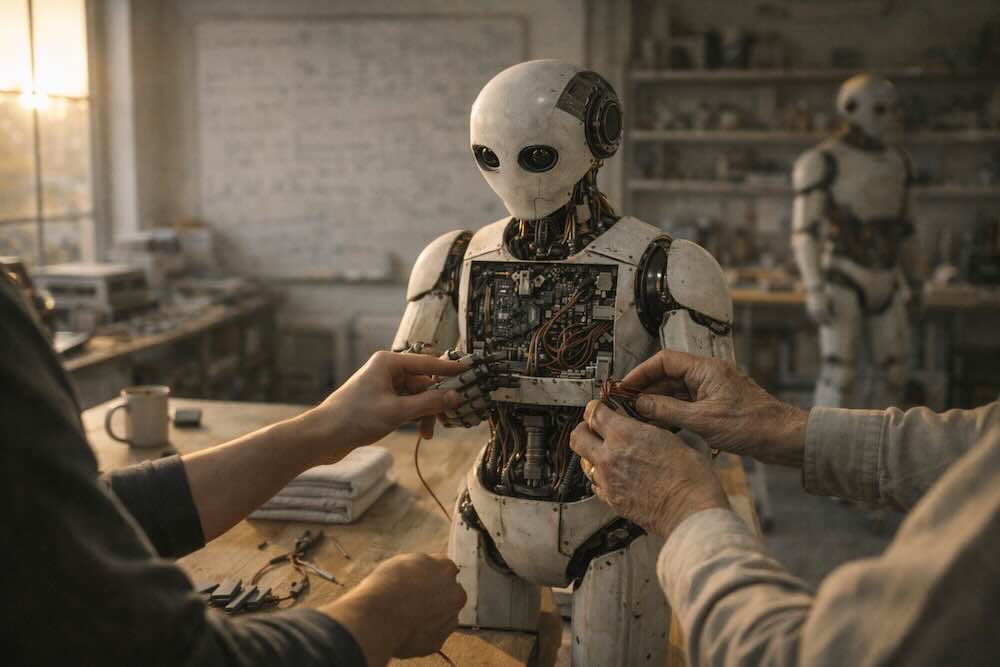
Long before humanoid robots started turning up on factory floors and in warehouse aisles, they lived almost exclusively in one place: the lab. Universities and research institutions have been the proving ground for nearly every breakthrough in bipedal locomotion, dexterous manipulation, and embodied AI that now underpins the commercial humanoid industry. And increasingly, humanoid platforms are becoming teaching tools in their own right — giving students hands-on experience with the technologies shaping the future of work, healthcare, and everyday life.
This article explores how humanoid robots are used as research platforms, what role they play in education from primary school through to postgraduate study, and why the research pipeline matters for the entire industry.
The University Lab: Where Humanoids Are Born
Most of the humanoid robots now attracting billions in venture capital trace their lineage back to academic research. Honda's ASIMO emerged from decades of internal R&D, but its walking algorithms drew heavily on academic work in zero moment point (ZMP) control. Boston Dynamics' Atlas — arguably the most recognisable humanoid on the planet — grew out of projects funded by DARPA and developed in close collaboration with MIT, Carnegie Mellon, and other university teams. The relationship between academia and industry in humanoid robotics is not just historical — it remains the primary engine of fundamental progress.
The reason is straightforward. Commercial companies optimise for deployable products on tight timelines. Universities can afford to spend years on the kinds of open-ended problems that humanoid robotics demands: how to make a bipedal robot recover from an unexpected shove, how to teach a robot hand to manipulate objects it has never seen before, or how to give a machine the spatial awareness to navigate a cluttered kitchen.
Key Research Institutions
A handful of universities and labs have shaped the field disproportionately, though the research community is broadening rapidly.
MIT — The Computer Science and Artificial Intelligence Laboratory (CSAIL) and the Robot Locomotion Group have been central to humanoid development for decades, contributing algorithms for dynamic walking, whole-body control, and manipulation planning. MIT fielded one of the strongest teams in the DARPA Robotics Challenge.
Carnegie Mellon University — Home to the Robotics Institute and the National Robotics Engineering Center (NREC), CMU has been a powerhouse in perception, navigation, and human-robot interaction research. Its CHIMP robot competed in the DARPA Robotics Challenge, and the university continues to be a pipeline for talent entering the humanoid industry.
Stanford University — Stanford's AI Lab and its work in reinforcement learning, computer vision, and sim-to-real transfer have been foundational to modern approaches to robot control. Much of the work on foundation models for robotics — a key enabler for the current wave of humanoid development — has roots here.
UC Berkeley — Berkeley's robotics research spans manipulation, locomotion, and AI policy. The university is known for influential work in deep reinforcement learning applied to physical robots and for producing researchers who have gone on to lead major humanoid programmes.
ETH Zurich — Europe's leading robotics research institution, ETH Zurich's Autonomous Systems Lab and Robotic Systems Lab have produced groundbreaking work in legged locomotion and robotic perception, with strong emphasis on real-world deployment.
University of Tokyo — Japan has one of the longest traditions in humanoid robotics research, and the University of Tokyo has been at its centre. Work here on humanoid control, sensor integration, and human-robot coexistence has influenced global research directions for decades.
KAIST (Korea Advanced Institute of Science and Technology) — KAIST's DRC-HUBO won the 2015 DARPA Robotics Challenge Finals, completing all eight tasks in under 45 minutes. The team's innovative approach — a hybrid humanoid that could switch between bipedal walking and wheeled locomotion — demonstrated how creative engineering could overcome the instability problems that plagued other competitors.
Beyond these well-known names, humanoid-related research now takes place at hundreds of institutions worldwide, from Waseda University in Japan (home to some of the earliest humanoid projects) to newer programmes at Iowa State University, where researchers are working on safety testing methodologies for humanoid systems.
Competitions That Push the Field Forward
Robotics competitions have played an outsized role in driving humanoid research. They create deadlines, attract funding, generate public attention, and force teams to solve integrated problems rather than isolated technical challenges.
The DARPA Robotics Challenge (2012–2015)
The DARPA Robotics Challenge remains the most significant humanoid robotics competition ever held. Motivated by the 2011 Fukushima nuclear disaster — where radiation prevented human responders from accessing critical areas — DARPA challenged teams to develop robots capable of performing disaster-response tasks in degraded human environments. The tasks included driving a vehicle, opening doors, cutting through walls, turning valves, and navigating rubble.
The competition ran across three stages: a virtual challenge in 2013, live trials in late 2013, and finals in June 2015. Twenty-three teams competed in the finals, with South Korea's Team KAIST taking the $2 million grand prize. The event provided ATLAS robots to several university teams, democratising access to advanced humanoid hardware and producing a generation of researchers who now lead programmes across the industry.
Perhaps the most lasting contribution of the DRC was what it revealed about the state of the art. Robots fell over constantly. Tasks that a human could complete in minutes took robots close to an hour. The gap between science fiction and engineering reality was made publicly, sometimes comically, visible — and that honest reckoning helped direct research priorities for the following decade.
RoboCup
RoboCup, the international robot football (soccer) competition, has been running since 1997 with the ambitious long-term goal of fielding a team of autonomous humanoid robots capable of beating the human FIFA World Cup champions by 2050. While that target remains distant, RoboCup has been enormously valuable as a research platform. The competition's humanoid league requires bipedal robots to perceive a ball, navigate a pitch, coordinate with teammates, and physically kick — integrating locomotion, perception, planning, and real-time control in a dynamic environment.
Virginia Tech, the University of Bonn, and several other institutions have used RoboCup as a vehicle for developing humanoid platforms that later influenced broader research. The DARwIn-OP robot, originally developed at Virginia Tech and commercialised by ROBOTIS, became one of the most widely used humanoid research platforms in the world, with over 400 units deployed in labs and classrooms globally.
Emerging Competitions and Benchmarks
As the field matures, new competitions and benchmarking efforts are emerging. NVIDIA's Isaac platform and tools like MuJoCo and Isaac Sim are enabling virtual competitions and standardised benchmarks for humanoid capabilities. These simulation-based approaches allow far more teams to participate and iterate rapidly, lowering the barrier to entry for humanoid research.
Humanoid Robots as Teaching Tools
Beyond their role as research subjects, humanoid robots are increasingly used as educational tools at every level — from primary schools to postgraduate programmes.
In the Classroom: K–12 Education
Humanoid robots have found a growing role in schools, primarily as tools for teaching coding, STEM concepts, and computational thinking. The most widely used platforms in K–12 settings include SoftBank's NAO and Pepper, UBTECH's Alpha Mini, LuxAI's QTrobot, and Robotical's Marty. These range from affordable entry-level devices costing a few hundred pounds to more capable platforms priced at several thousand.
The evidence on learning outcomes is encouraging but nuanced. Studies consistently show that students are more engaged and motivated when working with physical humanoid robots compared to screen-based coding exercises. The strongest results appear in STEM education, language learning, and special education — particularly autism support, where robots like QTrobot and NAO have been used to help children practice social interactions in a controlled, repeatable, and non-judgmental setting.
However, researchers caution that measurable academic gains from robot-assisted teaching remain small to moderate. The robots work best as supplements to human teaching, not replacements. The most effective deployments use a blended model where robots handle repetitive practice and structured exercises while teachers provide complex instruction, emotional support, and creative guidance.
In Higher Education: Learning by Building
At the undergraduate and postgraduate level, humanoid robots serve a different purpose — they are platforms for learning by doing. Students studying robotics, mechanical engineering, computer science, and AI can work directly with humanoid hardware and software, gaining experience in areas including:
- Programming robot behaviours using ROS 2 and Python
- Developing perception systems using cameras, LiDAR, and force sensors
- Implementing control algorithms for bipedal locomotion and balance
- Training reinforcement learning policies in simulation and transferring them to physical hardware
- Designing and fabricating mechanical components including actuators and end effectors
- Exploring human-robot interaction, including speech, gesture, and social behaviour
Platforms commonly used in university settings include the ROBOTIS OP3 (around $13,000, fully programmable with ROS support), Unitree's G1 and H1 humanoids, and various custom-built platforms. Some institutions, like William Paterson University in New Jersey, have acquired Unitree G1 Edu humanoids through federal grants, giving students direct experience programming AI-powered humanoid systems — including natural language interaction, locomotion training, and sensor integration.
Open-Source Platforms: Lowering the Barrier
Open-source projects have been critical in making humanoid robotics accessible to students and smaller research groups who cannot afford six-figure commercial platforms.
The Poppy Project, developed in France, offers a fully open-source humanoid platform built using 3D-printed components. Poppy robots are modular and highly customisable, making them suitable for both research and education at a fraction of the cost of commercial systems.
K-Scale Labs, founded by a former Meta robotics researcher, is pursuing an open-source approach to full-scale humanoid robotics, arguing that making hardware and software freely available is the fastest path to widespread adoption. Their philosophy echoes the open-source ethos that accelerated software development and, more recently, AI research.
OpenMind AGI released OM1, described as an open-source operating system for intelligent robots — a universal platform intended to allow any robot to perceive, reason, and act in real-world environments. Projects like these are gradually building an open ecosystem that could do for humanoid robotics what Linux and ROS did for software and robot middleware.
The Research-to-Industry Pipeline
One of the most important — and often overlooked — functions of university humanoid robotics programmes is talent development. The humanoid industry is growing at extraordinary speed, with companies like Figure AI, Apptronik, Agility Robotics, and Tesla competing aggressively for engineers who understand locomotion, manipulation, perception, and embodied AI. Nearly all of these specialists come through academic research pipelines.
The career paths emerging in humanoid robotics span a wide range of disciplines:
- Mechanical engineers designing actuators, structural components, and dexterous hands
- Control systems engineers developing algorithms for balance, locomotion, and whole-body coordination
- AI and machine learning researchers working on reinforcement learning, foundation models, and sim-to-real transfer
- Computer vision specialists building perception systems for navigation and manipulation
- Human-robot interaction researchers studying how people respond to, communicate with, and trust humanoid systems
- Ethics and policy researchers examining the societal implications of deploying human-shaped machines
University spin-outs are also a significant source of new companies entering the space. Many of today's humanoid startups were founded by researchers who developed core technologies in academic settings before seeking commercial applications.
What Research Is Focused on Now
The current wave of humanoid research is shaped by the convergence of robotics and AI — particularly the application of large language models, vision-language models, and reinforcement learning to physical robot control.
Foundation models for robotics — Researchers are exploring how models trained on vast amounts of internet data can be adapted to help robots understand instructions, reason about tasks, and generalise to new situations. NVIDIA's GR00T models, purpose-built for humanoid control, represent one strand of this work.
Sim-to-real transfer — Training robots in simulation and then deploying learned behaviours on physical hardware remains one of the most active research areas. Tools like NVIDIA Isaac Sim and DeepMind's MuJoCo are central to this work, and bridging the gap between simulated and real-world performance is a major focus.
Dexterous manipulation — Teaching humanoid hands to handle diverse objects with human-like skill is widely considered one of the hardest unsolved problems in robotics. University labs are at the forefront of this research, developing new sensor technologies, grasp planning algorithms, and learning approaches.
Safety and robustness — As humanoid robots move toward deployment alongside humans, research into safety testing, verification, and robust control is becoming increasingly critical. Work at institutions like Iowa State University is developing new testing methodologies to evaluate how humanoid robots behave in unpredictable situations.
Human-robot interaction — Understanding how people perceive, trust, and collaborate with humanoid robots is essential for successful deployment. This interdisciplinary research draws on psychology, cognitive science, design, and engineering.
Why This Matters
It is tempting, in the current hype cycle, to focus entirely on the companies raising billions and the robots appearing on stage at product launches. But the research and education ecosystem is the foundation on which the entire humanoid industry is built. The algorithms that make a Figure 03 or an Atlas move were developed in university labs. The engineers building the next generation of humanoid platforms were trained on academic research robots. And the fundamental questions that will determine whether humanoid robots become genuinely useful — questions about safety, intelligence, dexterity, and human coexistence — are still being answered, in large part, by researchers and students.
For anyone entering the field, whether as a student, a career changer, or an investor trying to understand the technology, the research and education layer is where the real foundations are laid.
Key Takeaways
- Universities remain the primary source of fundamental breakthroughs in humanoid locomotion, manipulation, perception, and AI — and the primary training ground for industry talent.
- Competitions like the DARPA Robotics Challenge and RoboCup have been powerful catalysts for progress, forcing teams to solve integrated, real-world problems.
- Humanoid robots are increasingly used as teaching tools from primary school to postgraduate level, with the strongest evidence for impact in STEM education, coding, and special education support.
- Open-source platforms like Poppy, K-Scale, and OM1 are lowering barriers to entry and building a shared ecosystem for humanoid development.
- Current research priorities include foundation models for robotics, sim-to-real transfer, dexterous manipulation, safety testing, and human-robot interaction.