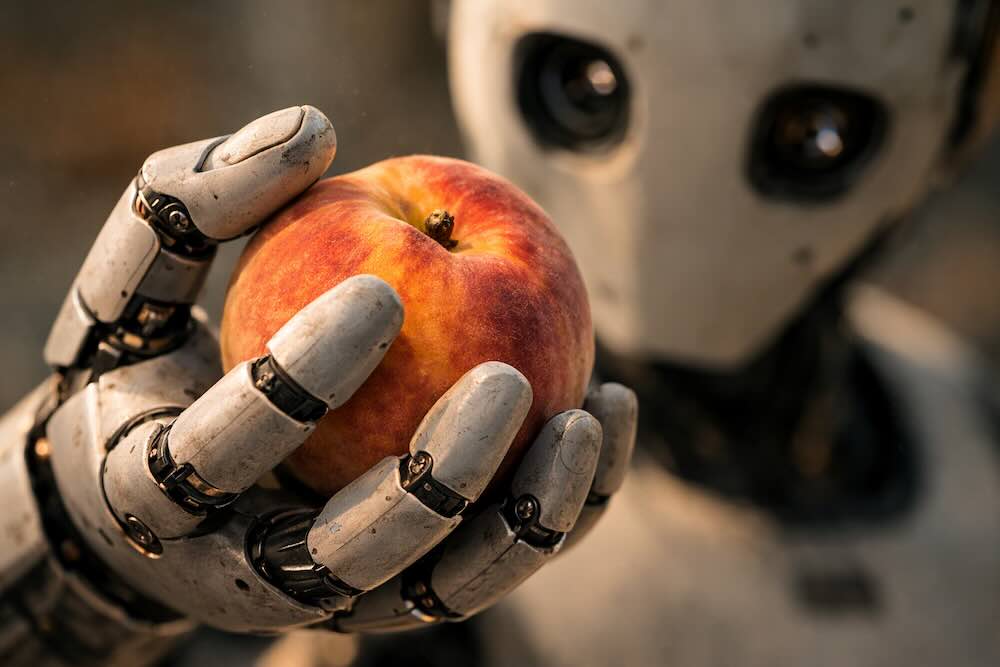
A humanoid robot can have the most powerful AI brain ever built, but without sensors, it's blind, deaf, and numb. Perception is the bridge between intelligence and action — and it remains one of the hardest problems in robotics.
Every time you catch a falling mug, step over a kerb, or feel the difference between a ripe peach and a hard avocado, you're relying on an extraordinary sensory system refined over millions of years of evolution. Humanoid robots need to replicate enough of that capability to operate safely and usefully in our world. This article breaks down the major sensor systems that give humanoid robots their senses — what each technology does, why it matters, and where the field is heading.
Why Perception Is So Hard for Robots
Humans process sensory information almost effortlessly. We fuse inputs from our eyes, ears, skin, muscles, and inner ear into a seamless, real-time model of the world without consciously thinking about it. For robots, every piece of this must be engineered from scratch.
The core challenges include:
- Speed: A robot catching an object or recovering from a stumble needs sensor data processed in milliseconds, not seconds.
- Noise: Real-world sensor data is messy. Lighting changes, reflections, vibrations, and electromagnetic interference all corrupt signals.
- Fusion: No single sensor tells the whole story. Robots must combine data from many sources — a discipline known as sensor fusion — to build a reliable picture of reality.
- Interpretation: Raw data is meaningless without context. A camera image is just a grid of pixel values until software recognises it as a doorway, a person, or an obstacle.
Getting perception right is a prerequisite for everything else a humanoid robot does. Without it, locomotion, manipulation, navigation, and human interaction all fail.
Vision: Cameras and Depth Sensing
Vision is typically the primary sense for a humanoid robot, just as it is for most humans. But robot vision goes well beyond simple cameras.
RGB Cameras
Standard colour cameras capture rich visual information and form the backbone of most robot perception systems. Modern humanoid robots typically use multiple cameras — often mounted in the head to mimic human eye placement — to provide overlapping fields of view.
What cameras are good at: recognising objects, reading text and signs, detecting people and gestures, understanding scenes at a distance.
What cameras struggle with: determining precise distance, operating in low light or direct glare, and distinguishing objects of similar colour from their background.
Stereo Vision
By using two cameras separated by a known distance — much like human eyes — a robot can calculate depth through triangulation. Stereo vision gives humanoid robots a sense of how far away objects are, which is critical for reaching, grasping, and navigation. Most current-generation humanoids, including Figure 02 and Tesla Optimus, rely heavily on stereo camera systems.
Depth Cameras (RGB-D)
Depth cameras like Intel's RealSense or Microsoft's Azure Kinect project infrared patterns or use time-of-flight measurement to produce a 3D depth map alongside a standard colour image. They give robots a direct, per-pixel measurement of distance — no computation-heavy stereo matching required.
Trade-offs: depth cameras work well indoors at short to medium range, but most struggle in direct sunlight, which overwhelms the infrared signal.
Event Cameras
A newer technology gaining traction in robotics research. Unlike conventional cameras that capture full frames at a fixed rate, event cameras detect changes in brightness at each pixel independently, with microsecond latency. This makes them exceptionally fast and efficient — ideal for high-speed motion tracking and operating in challenging lighting conditions. They're not yet standard on commercial humanoids, but they're an active area of development.
LiDAR: Mapping the World in 3D
LiDAR (Light Detection and Ranging) fires thousands of laser pulses per second and measures how long each takes to bounce back, building a precise 3D point cloud of the surrounding environment.
LiDAR excels at:
- Centimetre-accurate distance measurement at ranges of up to hundreds of metres.
- Working in any lighting condition — total darkness, bright sunlight, it doesn't matter.
- Creating detailed 3D maps for navigation and obstacle avoidance (a process called SLAM — Simultaneous Localisation and Mapping).
LiDAR's limitations include cost (though prices have dropped dramatically thanks to the autonomous vehicle industry), difficulty detecting transparent or highly reflective surfaces, and the fact that it provides geometric data without colour or texture information.
Some humanoid platforms use LiDAR as a primary navigation sensor, while others — particularly those betting on vision-first approaches like Tesla — have moved away from it, arguing that camera-based systems can achieve comparable results at lower cost.
Inertial Measurement Units (IMUs)
If cameras and LiDAR are a robot's eyes, the IMU is its inner ear. An inertial measurement unit typically combines accelerometers, gyroscopes, and sometimes magnetometers to measure acceleration, rotational velocity, and orientation.
For a humanoid robot, the IMU is absolutely critical for balance. It tells the robot's control system how its body is oriented relative to gravity, how fast it's rotating, and whether it's about to fall — all at update rates of hundreds or thousands of times per second.
IMUs are small, cheap, fast, and reliable, which is why virtually every humanoid robot carries at least one in its torso. Many carry several — in the torso, head, and limbs — to track the motion of different body segments.
The main weakness of IMUs is drift: small errors in gyroscope readings accumulate over time, causing the estimated orientation to slowly diverge from reality. This is why IMU data is almost always fused with other sensors — particularly cameras and encoders — to correct for drift.
Force and Torque Sensors
When a humanoid robot picks up a cup, pushes open a door, or shakes someone's hand, it needs to know how much force it's applying and how much force the world is pushing back with. That's the job of force/torque (F/T) sensors.
These sensors are typically placed at key interaction points:
- Wrists: Between the forearm and the hand, to measure forces during manipulation.
- Ankles/feet: To measure ground reaction forces during walking — essential for balance control.
- Joints: Some robots embed force sensing directly into actuators for compliant, safe movement.
Force/torque sensing enables impedance control and force control — strategies that allow robots to interact gently with fragile objects and safely with people, rather than rigidly following position commands regardless of what's in the way. This is a fundamental requirement for any humanoid that will work alongside humans.
Tactile Sensing: The Frontier of Robot Touch
Human fingertips contain around 2,000 mechanoreceptors per square centimetre. We can detect textures, slip, temperature, and pressure with remarkable precision. Robotic tactile sensing is still far behind human capability, but it's advancing rapidly and is widely regarded as one of the most important unsolved challenges in humanoid robotics.
Current Approaches
- Resistive and capacitive sensor arrays: Grids of pressure-sensitive elements embedded in fingertips or skin. They measure where contact is occurring and how hard, but typically at much lower resolution than human skin.
- Vision-based tactile sensors (e.g., GelSight, DIGIT): A camera behind a soft, deformable membrane captures detailed images of how the membrane deforms on contact. These sensors can detect fine textures, object shape, and slip with impressive resolution. They've become a major focus of manipulation research.
- Piezoelectric and MEMS sensors: Small sensors that detect dynamic contact events — vibrations, taps, and slip onset — at high speed.
- Electronic skin (e-skin): Large-area flexible sensor sheets that can cover entire robot limbs or the torso, giving whole-body contact awareness. Still mostly in the research phase, but critical for safe human-robot contact.
Why Tactile Sensing Matters So Much
Without touch, a robot hand is essentially operating blind once it makes contact with an object. Vision can guide a hand to an object, but once fingers close around it, cameras often can't see what's happening. Tactile feedback tells the robot whether it has a secure grip, whether the object is slipping, how heavy it is, and whether it's fragile. Advancing tactile sensing is considered by many researchers to be the single biggest lever for improving humanoid manipulation capability.
Joint Encoders and Proprioception
Proprioception — the sense of where your body parts are and how they're moving without looking at them — is something humans take for granted. Close your eyes and touch your nose. That's proprioception.
Robots achieve proprioception primarily through joint encoders: sensors embedded in each joint that measure the angle and rotational speed of the joint. These come in several types — optical encoders, magnetic encoders, and resolvers — but the function is the same: they tell the robot exactly where every limb, joint, and segment is at any moment.
This information is essential for:
- Knowing the robot's current posture and configuration.
- Closing the loop on motion commands — confirming that a joint actually moved to where it was told to go.
- Feeding into balance and locomotion controllers.
- Detecting collisions or unexpected resistance (when a joint encounters more force than expected).
Combined with IMU data and force sensors, encoders give the robot a complete internal model of its own body state — which is just as important as sensing the external world.
Audio and Speech
Many humanoid robots carry microphone arrays for voice command recognition, speaker identification, and sound source localisation — determining the direction a sound is coming from. This is particularly important for robots intended to interact naturally with people in noisy, real-world environments like homes, hospitals, and factory floors.
Audio sensing also has practical applications beyond speech: detecting the sound of machinery malfunctions, alarms, or a person calling for help.
Sensor Fusion: Making Sense of It All
No single sensor provides a complete, reliable picture of reality. Every sensor has blind spots, noise characteristics, and failure modes. The discipline of sensor fusion combines data from multiple sensor types to produce a unified, more robust understanding of the world.
For example, a humanoid robot navigating a warehouse might fuse:
- Camera data for object recognition and scene understanding.
- LiDAR data for precise distance measurement and mapping.
- IMU data for tracking its own motion and orientation.
- Encoder data for knowing its current body configuration.
- Force sensor data from its feet for balance.
Classical approaches use mathematical frameworks like Kalman filters and particle filters to combine these streams probabilistically. Increasingly, deep learning approaches are being used to learn fusion strategies directly from data, which can capture complex relationships between sensor inputs that hand-designed algorithms miss.
Effective sensor fusion is arguably the unsung hero of humanoid robotics. A robot with average sensors but excellent fusion will outperform one with premium sensors and poor fusion almost every time.
Where the Field Is Heading
Sensor technology for humanoid robots is evolving on several fronts:
- Whole-body tactile skins that give robots continuous contact awareness across their entire surface, not just their fingertips. This is essential for safe operation in close proximity to people.
- Neuromorphic sensors — including event cameras and spiking tactile sensors — inspired by the way biological nervous systems process information. These promise dramatically lower latency and power consumption.
- AI-native perception — instead of hand-engineering perception pipelines, using large pretrained vision and multimodal models to understand scenes, objects, and context directly from raw sensor data.
- Miniaturisation and cost reduction — driven by the automotive (autonomous driving) and consumer electronics (AR/VR) industries, many of the sensors humanoids need are getting smaller, cheaper, and more capable every year.
- Self-calibrating systems that can detect and compensate for sensor degradation or drift without manual intervention — a requirement for robots expected to operate for years in the field.
The Bottom Line
Sensors are the interface between a humanoid robot and reality. Without fast, accurate, diverse sensory input — and the software to interpret it — even the most advanced AI and the most powerful actuators are useless. The current generation of humanoid robots is pushing sensor technology forward across the board, from computer vision to tactile sensing to proprioception. But replicating even a fraction of human sensory capability remains a profound engineering challenge, and breakthroughs in perception will continue to be one of the key drivers — and constraints — of progress in humanoid robotics.
Further Reading on Droid Brief: