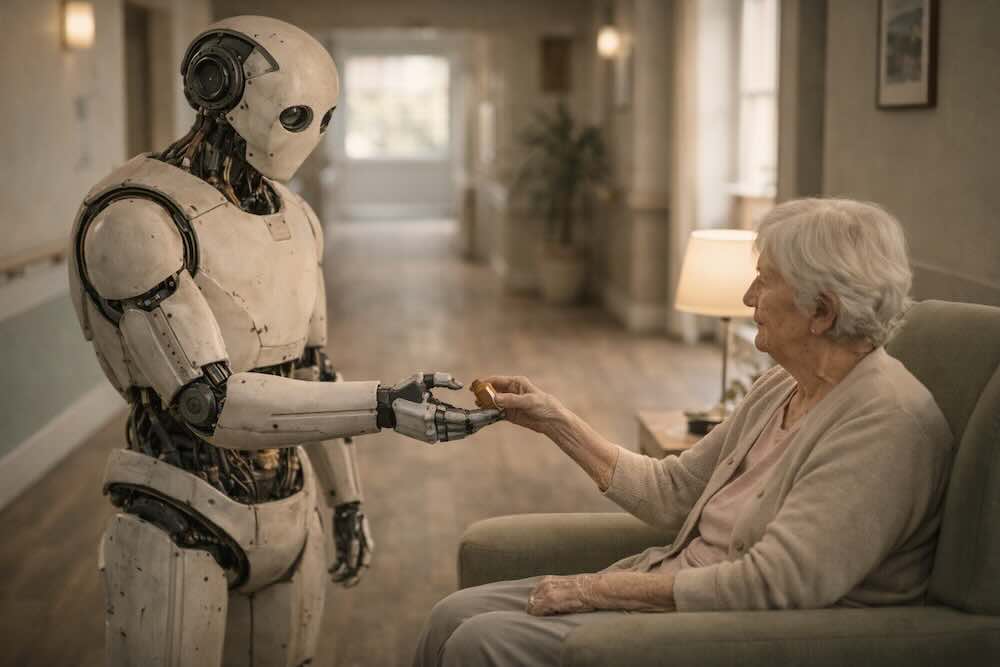
Where human-shaped machines are already making a difference — and where the real potential lies.
Healthcare is facing a crisis of supply and demand. Populations are ageing, chronic conditions are rising, and there simply aren't enough trained workers to meet the need. Japan alone faces a projected shortfall of hundreds of thousands of care workers. In the United States and across Europe, nursing burnout and staff shortages have reached critical levels, accelerated by the lasting impact of the COVID-19 pandemic.
Into this gap, humanoid robots are beginning to step — not as replacements for human caregivers, but as tireless assistants that can take on the repetitive, physically demanding, and logistically complex tasks that pull clinical staff away from the bedside.
This isn't science fiction. Robots are already working in hospitals, rehabilitation centres, and care homes around the world. But the picture is more nuanced than the headlines suggest. Here's where things actually stand.
Hospital Logistics: The Quiet Revolution
The most successful deployment of humanoid-style robots in healthcare isn't glamorous — it's logistics. Hospitals are sprawling, complex environments where an enormous amount of time is spent simply moving things from one place to another: medications, lab samples, clean linen, equipment, supplies.
The leading example is Moxi, built by Austin-based Diligent Robotics. Moxi is a mobile manipulation robot that autonomously navigates hospital corridors, rides elevators, opens doors, and delivers items between departments. As of late 2025, Moxi operates in over 25 US hospitals and has completed more than 1.25 million deliveries. The company reports that its fleet has saved clinical staff nearly 600,000 hours — time that nurses and pharmacy workers can redirect toward patient care.
The impact is significant. Studies show that nurses can spend up to 30% of their shifts on non-clinical tasks like fetching supplies and transporting specimens. By automating these errands, robots like Moxi allow healthcare workers to stay closer to their patients and focus on the skilled work they trained to do.
Diligent has announced Moxi 2.0, a next-generation platform with substantially more computing power and an AI foundation model trained on its vast real-world dataset. The company is also expanding into senior living facilities, signalling that the hospital logistics model could extend into residential care.
China's Fourier Intelligence has taken a different approach with its GR-1 humanoid, which has been deployed in testing for physically assisting patients — including helping to transfer people between beds and wheelchairs. Over 100 units have been sent to various organisations for evaluation.
Elder Care and Companionship
The elder care sector is where the need is most acute and the emotional stakes are highest. The global elder care assistive robots market was valued at approximately $2.9 billion in 2024 and is projected to reach nearly $10 billion by 2033, driven by demographic pressure and caregiver shortages.
Several types of robots are already in use. Smaller humanoid platforms like SoftBank's Pepper and Aldebaran's NAO have been deployed in Japanese and European care homes for years, providing companionship, leading group exercises, delivering medication reminders, running cognitive stimulation activities, and offering fall detection alerts. Research published in the International Journal of Social Robotics has found that elderly residents interacting regularly with humanoid robots report reduced feelings of loneliness and improved mood.
More ambitious projects aim to create robots that can provide more substantive care. Hanson Robotics developed Grace, a humanoid nurse assistant with an expressive face, designed to interact with isolated seniors. Grace can speak multiple languages, take temperature readings through a built-in thermal camera, and engage in basic conversational therapy. The idea is to provide regular check-ins and health monitoring for homebound patients, leveraging the fact that humans are naturally wired for face-to-face interaction — even when one of those faces is artificial.
In China, the development of emotionally responsive care robots is being pursued aggressively. Researchers at Shanghai's Fudan University are developing the Guanghua No. 1 humanoid specifically for elderly care scenarios, with a goal of delivering not just functional task completion but emotional warmth and a sense of companionship. Their lead researcher, Liu Lizheng, believes these capabilities are technically achievable within three to five years.
UBTech Robotics launched a consumer-grade humanoid home robot in 2025 priced at $20,000, designed to assist with everyday domestic tasks like loading dishwashers and folding laundry — part of a broader strategy to address the growing shortage of caregivers.
Despite these advances, significant barriers remain. Current home-care humanoids are expensive, and safety concerns are real — a full-sized robot operating in a home with frail elderly residents must be extraordinarily reliable. For now, most home-based care robots remain simpler devices: therapeutic robotic pets like PARO the seal, medication dispensers, and monitoring systems. The fully capable humanoid home carer remains a near-term aspiration rather than a present reality.
Rehabilitation and Physical Therapy
Rehabilitation is one of the most promising areas for humanoid robots in healthcare, particularly for stroke recovery — the leading cause of long-term disability worldwide. Rehabilitation is effective but enormously resource-intensive, requiring repeated, consistent sessions that can stretch over months or years. This is exactly the kind of work where robots' tireless consistency offers a genuine advantage.
Researchers have used humanoid robots like Baxter and NAO as therapy assistants, first learning movements from a human therapist and then guiding patients through exercise routines. The robot provides verbal instruction, visual demonstration, real-time feedback on form, and motivational encouragement — delivering a consistent experience across every session without fatigue or variation.
A key area of progress is upper-limb rehabilitation. Systems like the E-BRAiN digital therapy platform use a humanoid robot to provide therapeutic interaction during arm rehabilitation sessions, offering information, feedback, and supportive social engagement. Studies have shown that the robot's therapeutic interaction is largely comparable to that of a human therapist for certain structured exercise routines.
The Pepper robot has been used in a gamified rehabilitation platform for long-term post-stroke recovery, incorporating functional exercises drawn from patients' daily lives. The system tracks performance over time and adjusts difficulty, addressing one of the key challenges in rehabilitation: maintaining patient engagement and motivation over weeks and months of repetitive exercise.
The UK's National Robotarium partnered with the Austrian Institute of Technology on a pilot using socially assistive robots to support stroke and brain injury survivors through upper-limb rehabilitation — addressing the fact that only around 31% of patients currently complete their prescribed exercise routines.
Beyond humanoid-form robots, exoskeletons represent another rapidly advancing category. ULS Robotics in China produces wearable exoskeleton devices that help elderly people walk, climb stairs, and maintain mobility. Their devices also serve caregivers — a worker wearing an exoskeleton can receive up to 30 kg of lifting assistance, reducing their physical burden by more than 60%. These devices have already been deployed in nursing homes and are being tested in community settings.
Rehabilitation clinicians who have been consulted on the use of humanoid robots express enthusiasm about the potential to address workforce shortages, particularly noting the value of robots that can track patients' motor dynamics, monitor progress across sessions, and eventually operate with minimal supervision. However, they also raise legitimate concerns about the current biomechanical limitations of humanoid platforms and their ability to work with patients who have cognitive as well as physical impairments.
Mental Health and Social Interaction
An emerging and perhaps surprising application is in mental health support. Humanoid robots are being explored as tools for active listening counselling, anxiety reduction through guided breathing exercises, and social stimulation for isolated individuals.
A 2025 study published in JMIR Human Factors evaluated a socially assistive robot integrated with a large language model in a geriatric care institution, looking at how enhanced conversational ability affects acceptability and usability with older adults. The integration of LLMs represents a significant step forward — earlier generations of social robots were limited to scripted interactions, but modern AI allows for more natural, responsive conversation.
In autism therapy, humanoid robots like NAO have been used for years as social interaction partners for children on the spectrum. The robot's predictable behaviour, patience, and lack of complex social cues can make it a less overwhelming interaction partner than a human therapist, providing a bridge to developing social skills.
These applications highlight an important nuance: in mental health and social care, the humanoid form isn't just a convenience for navigating human spaces — it's a therapeutic tool in itself. People are wired to respond to faces, voices, and human-like movement. A robot that can maintain eye contact, use appropriate gestures, and respond conversationally can facilitate trust and engagement in ways that a screen or a speaker cannot.
Medical Training and Triage
Humanoid robots are also finding a role in medical education. The University of California, San Diego has developed RIA, a humanoid robot that allows nursing and medical students to practise patient interactions through role-play. RIA can be programmed to present a wide range of conditions and symptoms, giving students a realistic but low-stakes environment to develop their clinical skills.
In triage, the University of York is developing DAISY (Diagnostic AI System for Robot-Assisted A&E Triage), a prototype that would collect patient data including symptoms and vital signs, producing a report for a senior doctor to guide the next stages of assessment. The researchers acknowledge that patient acceptance is the first hurdle — people need to be willing to interact with a robot before the clinical benefit can be realised.
The COVID-19 Catalyst
The pandemic dramatically accelerated interest in healthcare robots. The need to reduce human contact in clinical settings created an immediate use case for robots that could perform tasks without infection risk. Humanoid robots were deployed in hospitals worldwide to screen patients, take temperatures, deliver supplies to isolation wards, and spray disinfectants. In Rwanda, human-sized robots were used in COVID-19 clinics for temperature checks and supply delivery.
The pandemic's lasting impact on healthcare staffing — driving many workers out of the profession entirely — has only strengthened the economic argument for robotic assistance. What began as an emergency measure has become a strategic investment.
The Investment Landscape
Capital is flowing into healthcare robotics. CMR Surgical, a UK-based surgical robotics company, recently raised an additional $200 million and has facilitated over 30,000 procedures across more than 30 countries. Mendaera, which combines robotics with real-time imaging for interventional procedures, closed a $73 million Series B round. Neura Robotics secured €120 million in early 2025. Diligent Robotics continues to expand its hospital footprint and expects to deploy thousands of robots by 2030.
The global medical robotics market is projected to grow from around $16.6 billion in 2023 to nearly $64 billion by 2032 — a reflection of both the scale of the healthcare challenge and the growing confidence that robotic solutions can deliver real operational value.
Challenges and Limitations
For all the progress, significant challenges remain before humanoid robots become commonplace in healthcare settings.
Cost. Current humanoid platforms remain expensive. Early prototypes of care-focused humanoids can cost as much as a luxury car, putting them beyond the reach of most care facilities and families. Robot-as-a-Service (RaaS) leasing models are beginning to lower the barrier, but affordability remains the single biggest obstacle to widespread adoption.
Safety. A robot operating around vulnerable patients — elderly people, children, individuals with limited mobility — must meet extraordinarily high safety standards. A fall, a collision, or a malfunction in a care setting could have serious consequences. Current safety standards for collaborative robots exist but humanoid-specific regulations are still catching up.
Trust and acceptance. Both patients and healthcare workers need to trust robotic systems. Research consistently shows that perceived usefulness and ease of use are critical factors in clinician acceptance. Early scepticism often gives way to enthusiasm once staff experience the practical benefits, but the onboarding process matters enormously.
Technical limitations. Today's humanoid robots are not general-purpose caregivers. They excel at specific, structured tasks — deliveries, guided exercises, scripted interactions — but struggle with the unpredictable, nuanced, and physically demanding work that human caregivers do intuitively. Fine motor control, safe physical contact with patients, and genuine contextual understanding remain significant engineering challenges.
Ethical considerations. Questions about emotional attachment, data privacy, and the dignity of care delivered by a machine are real and important. When a robot provides companionship to an isolated elderly person, is that genuine support or a simulacrum of human connection? These questions don't have simple answers, and the healthcare sector is rightly cautious about navigating them.
Where Things Are Heading
The trajectory is clear, even if the timeline remains uncertain. Several converging trends are accelerating the adoption of humanoid robots in healthcare:
AI capabilities are advancing rapidly. The integration of large language models, computer vision, and reinforcement learning is making robots dramatically more capable in unstructured environments. A robot that can hold a meaningful conversation, interpret a patient's body language, and adapt its behaviour in real time is fundamentally more useful than one following a fixed script.
Real-world data is accumulating. Companies like Diligent Robotics are building enormous datasets from actual hospital deployments, creating a learning flywheel where every interaction makes the next robot smarter. This is a critical advantage that simulation alone cannot replicate.
Demographics are unforgiving. The maths of ageing populations and shrinking workforces doesn't change. The need for care will continue to outstrip the supply of human caregivers, creating a structural demand for assistive technology that only grows stronger over time.
Costs will come down. As manufacturing scales and components become commoditised, the economics will shift. The question is not whether humanoid care robots will become affordable, but when.
The most realistic near-term picture is not a humanoid robot replacing a nurse or a care worker, but a robotic assistant that handles the logistical, repetitive, and physically draining tasks — freeing human professionals to do what they do best: provide the empathy, clinical judgement, and human connection that no machine can replicate.
That's not a small thing. It might be transformative.
Further Reading
- What Is a Humanoid Robot? — Start here if you're new to humanoid robotics.
- Why Build Robots That Look Like Us? — The case for the humanoid form factor, including in care settings.
- AI and the Robot Brain — How machine learning and large language models are powering the next generation of care robots.
- Manipulation and Dexterous Hands — Why safe, precise physical interaction remains one of the hardest problems in robotics.
- Will Humanoid Robots Take Our Jobs? — A balanced look at labour displacement and augmentation in healthcare and beyond.
- Company Profiles — Deep dives on Diligent Robotics, Fourier Intelligence, Hanson Robotics, and other key players in healthcare robotics.