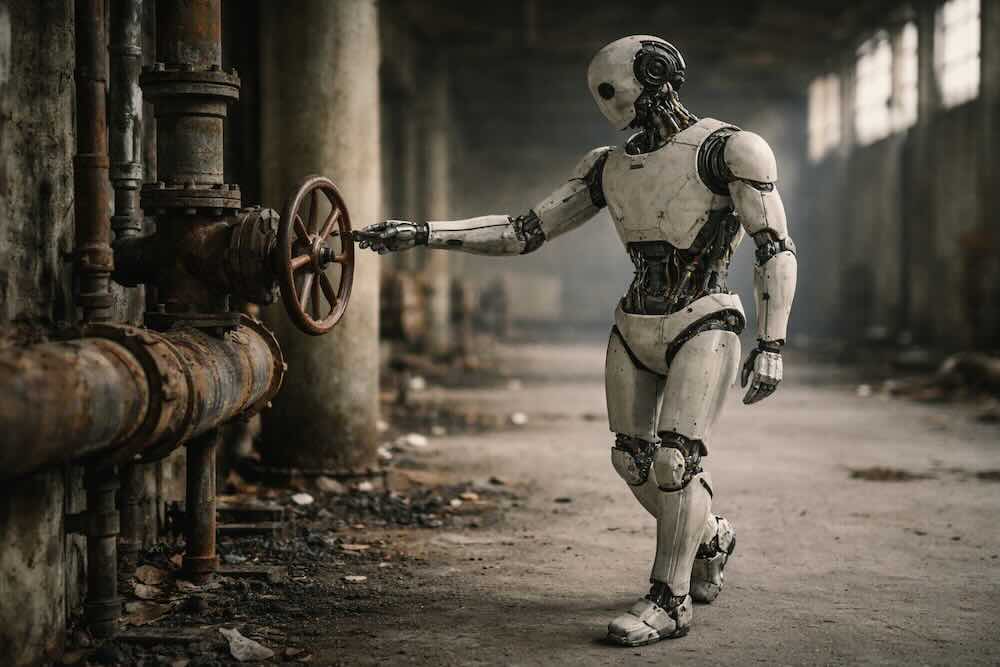
From irradiated reactor buildings to the surface of Mars, humanoid robots are being developed to go where humans simply cannot — or should not — venture. This is the application area where the case for human-shaped machines is at its most compelling.
Why Hazardous Environments Need Humanoid Robots
Some of the most dangerous places on Earth — and beyond it — were built for people. Nuclear power plants have doors, valves, stairs, and control panels designed for human hands and human bodies. Disaster zones are littered with the infrastructure of everyday life: corridors, vehicles, ladders, light switches. When these environments become too toxic, too radioactive, or too structurally unstable for people to enter, the robots sent in their place face a fundamental design problem: the space was made for a human form.
This is the core argument for humanoid robots in hazardous settings. Wheeled robots get stuck on stairs. Tracked robots struggle with doors. Aerial drones can survey but cannot manipulate. A robot built roughly like a person — with legs to climb, arms to reach, and hands to grasp — can theoretically navigate any space a human worker once occupied, using the same tools and interfaces that are already in place.
The practical reality, as we will see, is still catching up with the theory. But progress over the past decade has been significant, and the stakes could not be higher.
Nuclear Facilities: The Defining Use Case
If any single event defined the urgency of developing robots for hazardous environments, it was the Fukushima Daiichi nuclear disaster of March 2011. When a magnitude 9.0 earthquake and subsequent tsunami triggered three reactor meltdowns at the Japanese coastal plant, the resulting radioactive contamination made large sections of the facility lethal for human workers. Engineers desperately needed to survey damage, measure radiation levels, and begin stabilisation work — but the environment was simply too dangerous for people.
Japan, despite its world-leading robotics industry, found itself painfully unprepared. Earlier nuclear disaster robots had been mothballed after funding dried up, and Honda's celebrated ASIMO — the most famous humanoid in the world at the time — lacked the robustness for real-world deployment. In the immediate aftermath, TEPCO (Tokyo Electric Power Company) had to rely on imported military robots like iRobot's PackBot, originally designed for bomb disposal, to make initial surveys of the reactor buildings.
In the years since, Fukushima has become a proving ground for robotic technology. Dozens of specialised machines have been deployed, from swimming robots like "Little Sunfish" — designed to navigate the flooded reactor interiors and search for melted fuel — to Boston Dynamics' Spot quadruped, which has been collecting radiation data and debris samples since 2022. Most recently, TEPCO has deployed a 22-metre, 4.6-tonne snake-like robotic arm to navigate narrow passages within the reactor buildings and begin retrieving samples of the estimated 880 tonnes of melted fuel debris that must eventually be removed.
The decommissioning of Fukushima Daiichi is expected to take 30 to 40 years and cost an estimated $188 billion. The United States faces a parallel challenge: cleanup of its own nuclear legacy sites, including the Savannah River Site, has already consumed over $250 billion since 1989 and is less than half complete. In both cases, the consensus is clear — robotics, including humanoid systems with dexterous manipulation capabilities, will be essential to accelerating timelines and reducing costs.
The nuclear industry also presents ongoing operational needs beyond disaster cleanup. Routine inspection and maintenance of active plants, decommissioning of aging facilities, and handling of radioactive waste all involve environments where minimising human exposure is a priority. Humanoid robots capable of operating standard tools, turning valves, and navigating the corridors and stairwells of these facilities could significantly reduce risk to workers.
The DARPA Robotics Challenge: A Turning Point
The Fukushima disaster had a direct and measurable impact on humanoid robotics research. In 2012, the US Defense Advanced Research Projects Agency (DARPA) launched the DARPA Robotics Challenge (DRC) — an $80 million programme explicitly motivated by the Fukushima scenario. The goal was to accelerate the development of semi-autonomous humanoid robots capable of performing useful tasks in disaster environments.
The challenge ran for 33 months and culminated in the DRC Finals in Pomona, California in June 2015, where 23 teams from five countries competed. Robots were required to complete eight tasks representative of a real disaster response: driving a vehicle, walking across rubble, opening doors, turning valves, cutting through walls, and climbing stairs — all with degraded communications to simulate realistic field conditions.
Team KAIST from South Korea won the $2 million grand prize with DRC-HUBO, a humanoid that could switch between bipedal walking and wheeled locomotion — a pragmatic design choice that allowed it to complete all tasks quickly and, crucially, without falling over. This was no small achievement: many competing robots, including several using Boston Dynamics' powerful Atlas platform, suffered dramatic falls during the competition.
The DRC revealed both the promise and the limitations of humanoid robots in disaster scenarios. The robots proved they could, in principle, perform complex manipulation tasks in human-designed environments. But they were also slow, fragile, and prone to failure. As one competing team from Worcester Polytechnic Institute and Carnegie Mellon University summarised bluntly: in uncontrolled conditions, even well-tested humanoid designs performed poorly and frequently fell.
Perhaps the most striking observation was that none of the competing robots used the environment to help stabilise themselves — no robot grabbed a stair railing, leaned against a wall, or braced against a door frame. Behaviours that would be instinctive for even an unsteady human remained beyond the robots' capabilities. The DRC made clear that while the hardware was approaching viability, the software intelligence and robust autonomy needed for real disaster deployment still had a long way to go.
Disaster Response and Search and Rescue
Beyond nuclear scenarios, the broader disaster response field represents one of the most actively researched applications for advanced robotics. Earthquakes, building collapses, floods, chemical spills, and industrial accidents all create environments that are acutely dangerous for human first responders.
The search and rescue robotics sector has grown significantly, driven both by increasing natural disaster frequency and by advances in AI and autonomy. While the majority of currently deployed search and rescue robots are not humanoid — snake robots, tracked crawlers, aerial drones, and quadrupeds dominate operational use — the humanoid form factor offers distinct advantages for certain tasks.
Specifically, humanoid robots are best suited to scenarios that require interaction with human infrastructure: opening doors, operating machinery controls, using tools, climbing stairs, and moving through corridors. Purpose-built disaster humanoids like the Italian Institute of Technology's WALK-MAN (1.85 metres tall, 102 kilograms, 33 degrees of freedom) and the hybrid Centauro platform have been designed specifically for these scenarios.
The realistic near-term picture, however, is one of mixed robotic teams rather than humanoids working alone. An effective disaster response deployment might use aerial drones for initial survey and mapping, snake robots to penetrate rubble and locate survivors, quadrupeds like Spot for terrain traversal and data collection, and humanoid robots for manipulation tasks that require human-like dexterity. Each form factor has its strengths, and the humanoid's advantage is specifically in environments and tasks designed around the human body.
Space Exploration: The Ultimate Hazardous Environment
Space is, by definition, the most hostile environment humans seek to work in. The vacuum, radiation, extreme temperatures, and remoteness of space make it a natural application for robotic surrogates — and NASA has been exploring humanoid designs for decades.
The Robonaut programme, which began at NASA's Johnson Space Center in 1997, set out to build a humanoid robot with the dexterity to perform tasks normally requiring a suited astronaut. The core insight was simple: if the robot's hands can use the same tools as the crew, it does not need specialised equipment for every task. Robonaut 2 (R2), developed in partnership with General Motors, became the first humanoid robot in space when it was delivered to the International Space Station aboard the Space Shuttle Discovery in February 2011. Initially a torso-only system mounted on a fixed base, R2 received a pair of climbing legs in 2014 to allow it to move around the station interior.
NASA's more ambitious humanoid project is Valkyrie (officially R5), a fully bipedal, entirely electric humanoid standing 1.9 metres tall and weighing approximately 130 kilograms. Originally built for the 2013 DARPA Robotics Challenge, Valkyrie was designed as a rugged platform capable of operating in degraded environments. Its hands were specifically engineered for the kind of valve manipulation and tool use required in scenarios like Fukushima.
NASA's long-term vision for humanoid robots in space centres on pre-deployment: sending robots ahead of human crews to prepare habitats on the Moon or Mars. These robots would assemble equipment, perform construction tasks, and maintain systems in the period before astronauts arrive. Once crews are on-site, robots would work alongside them, handling dangerous extravehicular tasks or operating in areas with high radiation exposure. When human missions end, the robots would remain behind to continue maintenance.
This vision has also driven collaboration with the emerging commercial humanoid robotics industry. NASA has worked closely with Apptronik — whose founders helped build Valkyrie — and has indicated strong interest in commercially produced humanoid robots that could eventually serve as robotic crewmembers requiring no food, water, or air.
Other Hazardous Applications
Nuclear facilities, disaster zones, and space are the most prominent use cases, but the potential applications of humanoid robots in hazardous environments extend further.
Chemical and Biological Hazards
Chemical spills, biological contamination events, and hazardous material storage facilities all present environments where human exposure must be minimised. A humanoid robot capable of operating decontamination equipment, handling containment vessels, and navigating standard facility layouts could significantly reduce risk to emergency response personnel.
Deep-Sea and Underwater Operations
Offshore oil and gas platforms, subsea infrastructure, and deep-ocean research all involve extreme environments. NASA's deployment of Valkyrie with Woodside Energy in Australia specifically targeted this use case — testing whether a humanoid robot could handle remote operations on uncrewed offshore facilities where the infrastructure was designed for human operators.
Mining and Tunnelling
Underground mining environments involve risks from collapse, toxic gases, and extreme heat. Robotic systems that can operate standard mining equipment and navigate mine infrastructure designed for human workers offer the potential to remove people from the most dangerous underground operations.
Firefighting
Structural firefighting in extreme conditions — high-rise buildings, industrial facilities, chemical plants — presents scenarios where humanoid robots could enter spaces too dangerous for firefighters, operating door handles, hose connections, and building systems designed for human use.
The Challenges Ahead
Despite compelling use cases and steady progress, significant technical hurdles remain before humanoid robots can be reliably deployed in hazardous environments.
Robustness and reliability remain the most fundamental challenges. A robot that falls and cannot get back up, or that suffers a hardware failure after a few hours of operation, is of limited use in an emergency. The DARPA Robotics Challenge demonstrated that even the most advanced humanoids are prone to catastrophic failure under real-world conditions. Environments with high radiation pose additional problems, as radiation can damage electronic circuits and scramble data in logic systems.
Autonomy and decision-making are critical in disaster scenarios where communications may be degraded or nonexistent. Current humanoid robots still rely heavily on human teleoperation for complex tasks, but real emergencies are — as one Fukushima researcher noted — fast-moving and difficult to predict, with narrow windows for effective intervention.
Dexterous manipulation in unstructured environments remains extraordinarily difficult. Turning a valve in a laboratory is one thing; turning a valve in a debris-strewn, flooded reactor building with poor visibility is quite another. The gap between controlled demonstrations and real-world performance continues to narrow, but it has not closed.
Power and endurance limit operational duration. Most current humanoid robots operate on battery power for periods measured in minutes to a few hours — far short of what extended disaster response or nuclear decommissioning operations require.
Speed of deployment is a practical concern highlighted by Fukushima. Disasters do not wait for robots to be customised and tested. The field needs robust, general-purpose humanoid platforms that can be rapidly deployed without extensive adaptation — a capability that does not yet exist.
Where Things Stand
The use of humanoid robots in hazardous environments sits at an interesting inflection point. The motivating scenarios are clear and urgent. The underlying technologies — in AI, perception, actuation, and materials — are advancing rapidly. Major government programmes, from DARPA to NASA to Japan's nuclear decommissioning effort, continue to invest heavily. And the growing commercial humanoid robotics industry is producing platforms that may eventually be adapted for hazardous applications.
But we are not yet at the point where a humanoid robot can be dropped into a disaster zone and trusted to operate effectively with minimal human oversight. The gap between demonstration and deployment remains real.
What has changed decisively is the recognition — reinforced by Fukushima, validated by the DARPA Robotics Challenge, and underscored by the scale of nuclear decommissioning ahead — that developing robots capable of operating in environments built for humans is not a speculative ambition. It is an operational necessity. The question is no longer whether humanoid robots will be needed in hazardous environments. It is how quickly the technology can be made reliable enough to meet the need.
This article is part of Droid Brief's Resources section — an evergreen reference library covering the technology, business, and societal impact of humanoid robotics. For real-world deployment updates, see our latest news coverage.
Related reading: