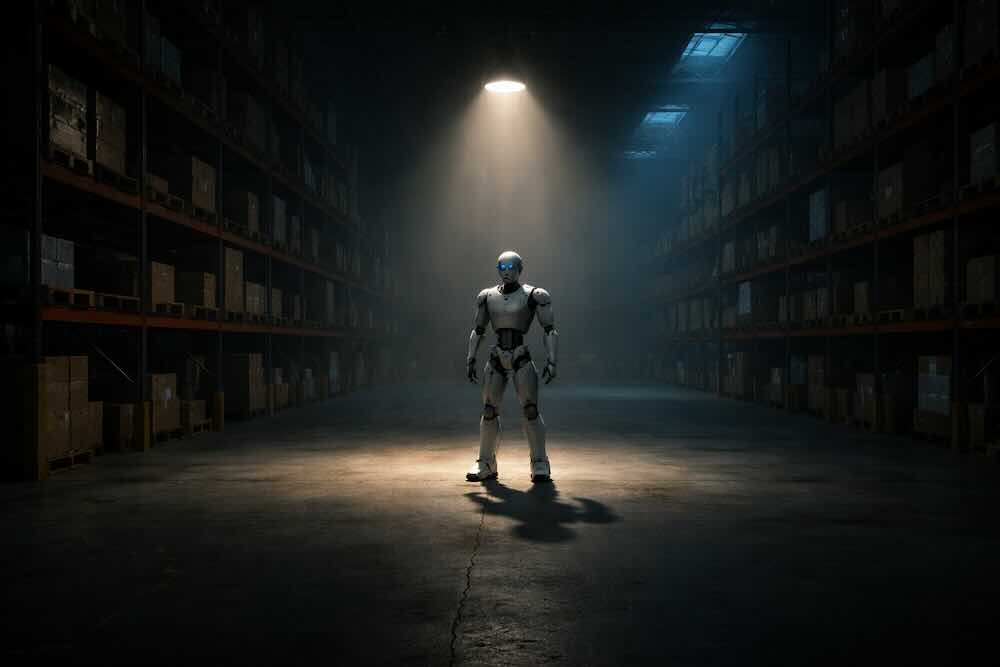
Jensen Huang just gave a computer to a waddling snowman and told him he learned to walk in the digital void.
If you had "NVIDIA founder shares a campfire song with an animated lobster and a physical snowman" on your GTC 2026 bingo card, congratulations—you’re as unhinged as the current pace of robotics. But beneath the Disney-infused spectacle of the GTC keynote lies the most significant technical flex of the year. By bringing a physical, walking Olaf out on stage, NVIDIA didn't just win at showmanship; they proved that "Sim-to-Real" has officially conquered the "Uncanny Valley."
What Happened
The climax of the GTC 2026 keynote featured a surprise appearance by Olaf, the snowman from Disney’s *Frozen*. Unlike previous Disney "animatronics," which are largely pre-programmed sequences of motion, this Olaf was a fully autonomous, physical humanoid driven by NVIDIA’s Jetson Thor and trained entirely within the Omniverse simulation. Jensen Huang joked that the robot "learned how to walk inside Omniverse," emphasizing that every motion—from the waddle to the balance—was simulated, not pre-rendered.
This demo served as a live-action proof of concept for the new NVIDIA Isaac Lab 2.3 and the GR00T N1 general-purpose robotics model. NVIDIA also highlighted a collaboration with PSYONIC to integrate the "Ability Hand" directly into Isaac Lab, enabling "real-to-real" transfer where human dexterous data is used to train robotic hands in simulation before being deployed to physical hardware. The message was clear: if you can simulate a snowman with non-standard physics and a high center of gravity, you can simulate anything.
Why It Matters
The Olaf demo matters because it solves the "Morphology Problem." Most humanoid robots today are built to mimic human proportions because that's what our data (and our models) understand. By successfully deploying a physical robot with the "physics" of a cartoon character, NVIDIA is demonstrating that their simulation stack is robust enough to handle *any* physical form factor.
This is the "Zero-Shot" moment for robotics. If a robot can learn to walk, navigate, and interact in a high-fidelity digital twin of the world (Omniverse) and then step onto a real stage without falling over, the need for months of real-world "tuning" disappears. This drastically lowers the barrier to entry for non-standard robotics—from specialized industrial droids to entertainment humanoids. The "Olaf" moment proves that simulation is no longer a tool for testing; it is the primary environment for creation.
Wider Context
This breakthrough is supported by the general availability of NVIDIA IGX Thor, the industrial-grade platform designed for "safety-critical" physical AI. While Olaf is a fun demo, the same technology is being adopted by companies like Agility and Hexagon Robotics for real-time AI reasoning and multimodal sensor fusion in their robots.
We are also seeing the standardization of the "Data Bridge." The release of massive datasets like the BONES-SEED motion dataset (142,000 animations) and the integration of high-fidelity sensors from partners like Infineon and Texas Instruments into the Isaac Sim framework means that the "digital twin" is becoming indistinguishable from the physical machine. The "Sim-to-Real" gap hasn't just been bridged; it's been paved over with Blackwell-class compute.
The Droid Brief Take
Watching a billionaire talk to a mechanical snowman is either the peak of human achievement or the beginning of a very specific kind of fever dream. But the "Olaf" demo is a masterclass in hidden complexity. Walking is hard; walking like a top-heavy cartoon character with stubby legs is nearly impossible. The fact that NVIDIA can "teach" a machine to navigate the real world entirely in the digital void means that the "Real World" is now just an edge case for the simulation. We are moving toward a future where a robot’s first breath of real air happens only after it has lived a thousand lifetimes in Omniverse. Olaf isn’t just a snowman; he’s a harbinger of a reality where "physical" is just a final export setting.
What to Watch
Watch for the first commercial applications of the Disney/Imagineering research; we expect to see "sim-trained" characters appearing in theme parks by late 2026. Keep an eye on the PSYONIC "real-to-real" transfer results; if dexterous manipulation can be trained as quickly as locomotion, the "hand" problem in robotics is effectively solved. Finally, monitor the expansion of the "Isaac Lab" ecosystem; if NVIDIA continues to integrate every major sensor and actuator manufacturer into their simulation, they will become the sole gatekeeper of the robotic mind.
Sources
NVIDIA Blog — "NVIDIA GTC 2026: Live Updates on What’s Next in AI"
Interesting Engineering — "NVIDIA-Powered Wheeled Humanoid Robot"
Humanoids Daily — "PSYONIC and NVIDIA Bridge the Robotics Data Gap"