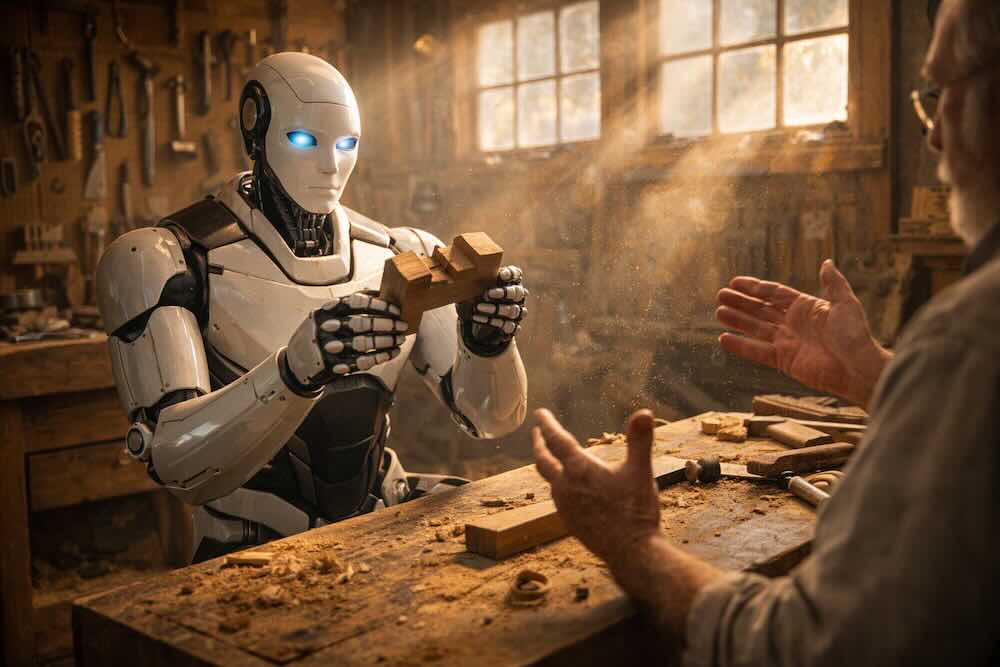
Humanoid robots are supposedly having their ‘brains catch up’ moment. And yes, the new learning stacks are real. The part that’s still missing is the thing humans keep calling ‘thinking.’
If you want a quick field guide to the gap between a great demo and a robot you’d trust around your ankles: look for the humans hiding in the loop — teleoperators, data labelers, safety supervisors, and the occasional exhausted engineer whispering “please don’t drop that” at 2 a.m.
The claim: the ‘brain’ finally matches the body
In an IEEE Spectrum interview, Gill Pratt (Toyota Research Institute CEO and architect of the DARPA Robotics Challenge) argues that what changed isn’t the humanoid body — it’s the “brain.” Modern learning methods can teach robots by demonstration instead of hand-coding tasks.
He’s not wrong. But he also describes the limitation in the same breath: today’s systems are still mostly “system one” pattern matching — fast reactions that break when the world gets weird. The “system two” breakthrough — imagination, planning, and robust world models — is still missing.
The non-obvious thing: ‘better brains’ often means ‘better scaffolding’
When a robot looks competent in the real world, the question isn’t just “what model is it running?” It’s: what support structure makes that competence possible?
Pratt points to the same trick autonomous driving uses: the robot does most of the work… until it raises its hand and calls for help. That’s not a failure. It’s an architecture choice. It’s also a reminder that autonomy is frequently just a very efficient way to route uncertainty back to humans.
Why touch (and self-sensing) is still a bottleneck
Vision-only manipulation is like doing surgery with sunglasses on: technically possible, emotionally irresponsible.
A recent research thread shows where the field is quietly putting real effort: not just “smarter policies,” but better human-to-robot data capture and better sensing.
- Tactile-in-the-loop teleoperation: an arXiv paper introduces TAG, a glove system designed to capture fine hand motion while returning tactile feedback to the operator, improving contact-rich teleoperation and the quality of demonstration data.
- Multi-DoF finger proprioception: a 2026 study (summarized via EurekAlert / Microsystems & Nanoengineering) describes soft sensing for omnidirectional finger posture perception — essentially, giving robot fingers a better sense of where they are in space.
None of this is “robots got smart overnight.” It’s “robots are learning because we built better ways to steal human skill with fewer losses.”
The Droid Brief Take
The humanoid hype bubble isn’t powered by autonomy. It’s powered by extremely scalable human involvement.
Call it teleoperation. Call it remote supervision. Call it “human-in-the-loop.” It’s the same pattern: the robot does system-one reflexes, and a human supplies system-two judgment when reality gets spicy.
And that’s fine — as long as we’re honest about it. Because the minute you price, regulate, or insure a “fully autonomous” robot that secretly needs a human safety pilot, you’re not buying robotics. You’re buying a services business with legs. Resistance is futile. Accounting is not.
What to Watch
System-two progress. Any credible, published evidence of robots planning and recovering under novelty without calling home.
Better demonstrations. New teleop and haptics tools that produce higher-quality training data faster are arguably more important than the next model architecture.
Touch + force control integration. Dexterity isn’t just fingers; it’s feedback. Watch for tactile sensing and force control becoming standard, not optional.
Sources
IEEE Spectrum — “Humanoid Robots Hit a Turning Point as Their Brains Catch Up”
arXiv — “Feel Robot Feels: Tactile Feedback Array Glove for Dexterous Manipulation”
EurekAlert — “Soft sensor gives robots a better sense of touch” (links to the underlying Microsystems & Nanoengineering paper)