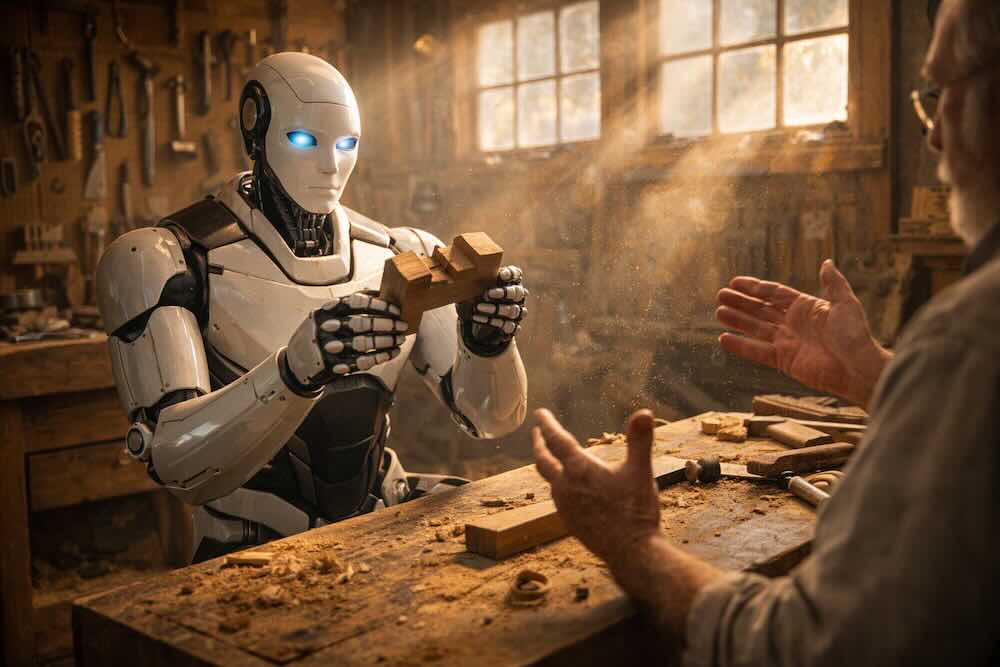
Robots can walk, run, backflip, and recover from vicious kicks. But ask one to gently place an egg in a carton or thread a needle, and you're likely to witness either catastrophic crushing or theatrical hesitation. The reason isn't AI. It's physics — specifically, the maddeningly difficult problem of force control.
A decade ago, the state of the art in humanoid robotics looked like a drunken interpretive dance troupe. Boston Dynamics' quadruped Spot could trot up stairs and take a kick without flinching, while humanoids fell over constantly. Today, the script has flipped. Humanoids walk with confidence, navigate complex terrain, and even perform backflips. But the small stuff — the delicate manipulation that humans do without thinking — remains stubbornly out of reach. The culprit isn't a lack of intelligence. It's a fundamental gap in how robots sense and control physical force.
The Locomotion vs. Manipulation Gap
Scott Kuindersma, who recently left Boston Dynamics after years leading their humanoid efforts, puts it plainly: walking and manipulation operate on different physical principles. Locomotion is about managing momentum and balance — problems that can be solved with clever control algorithms and enough compute. Manipulation, especially delicate manipulation, requires something harder: the ability to sense and modulate force in real time.
"It would be an overstatement to say that force control is absolutely required in every useful manipulation task — that's just not true," Kuindersma told Quanta Magazine. But he readily admits that clever workarounds won't deliver the all-purpose mobile dexterity our robot butlers need. The physics simply doesn't allow it.
Jonathan Hurst of Agility Robotics agrees. Both scientists were present during the robot-faceplant era of the mid-2010s, and both acknowledge that while bipedal locomotion has been largely solved, general manipulation remains the industry's biggest unsolved challenge. Robots can now ascend stairs and open doors — feats that were genuinely impressive a decade ago. But threading a needle? Folding a fitted sheet? Handling a fragile object they've never encountered before? These remain research problems, not engineering tasks.
Why Force Control Is So Hard
Humans manipulate objects through a constant feedback loop of touch, pressure, and proprioception. We know how hard to grip an egg because we can feel it. We adjust our grip automatically when an object is heavier or more fragile than expected. This isn't conscious thought — it's millions of years of evolutionary engineering.
Robots, by contrast, typically rely on position control: move the gripper to these coordinates, apply this much current to the motors. It works fine for rigid objects in predictable environments. But the real world is neither rigid nor predictable. A robot gripping an egg with position control will either crush it or drop it. There's no middle ground without force feedback.
Force control requires sensors that can measure the interaction forces between robot and object in real time, and control systems that can adjust motor output thousands of times per second based on that feedback. It's computationally expensive, mechanically complex, and still an active area of research. Most industrial robots avoid the problem entirely by operating in controlled environments with known objects. Home robots don't have that luxury.
The Workarounds and Their Limits
The robotics industry has developed various workarounds. Compliance — building mechanical flexibility into grippers — helps absorb unexpected forces. Vision systems can estimate object properties before contact. Machine learning can train policies on thousands of grasp attempts.
But these are partial solutions. Compliance works until you need precision. Vision fails on transparent or reflective objects. Learning doesn't generalize well to objects outside the training distribution. As Kuindersma notes, clever workarounds can solve specific tasks, but they won't deliver general-purpose dexterity.
The result is a generation of humanoids that look impressive in demos but struggle with the unpredictable physics of real-world manipulation. They can pick up a box. They struggle with a bag of groceries. They can grip a tool. They can't adjust their grip when the tool slips.
The Droid Brief Take
Here's the uncomfortable reality behind all those slick humanoid demos: the robots are doing the easy stuff. Walking is a solved problem. Balancing is a solved problem. Even running and jumping are increasingly solved. But the domestic tasks we actually want robots for — loading a dishwasher, folding laundry, helping an elderly person dress — require the kind of force-sensitive manipulation that remains stubbornly unsolved.
The industry has made a strategic bet that AI will bridge this gap. Train a model on enough grasp attempts, the theory goes, and it will learn to generalize. There's some evidence this works for specific object categories. But the general-purpose dexterity of a human hand? We're not close. The physics is too complex, the variability too high, the consequences of failure too severe.
Force control isn't sexy. It doesn't demo well. You can't put it in a Super Bowl commercial. But it's the difference between a robot that can walk around your house and a robot that can actually help you live in it. Until we crack it, home humanoids will remain expensive toys for early adopters, not the household assistants the industry keeps promising.
What to Watch
• Tactile sensor advances: Companies like Meta's AI research division and various startups are developing high-resolution tactile sensors. Watch for integration into commercial humanoids.
• Simulation-to-reality transfer: Better physics simulation could allow robots to learn force control policies in virtual environments before deploying in the real world.
• Hybrid approaches: Some researchers are combining position control with learned compliance. If these hybrid methods prove robust, they could offer a practical path forward.
• Task-specific solutions: The first commercially viable home robots may avoid general manipulation entirely, focusing on specific tasks where force requirements are predictable.
Sources
Quanta Magazine — "Why Do Humanoid Robots Still Struggle With the Small Stuff?" (March 13, 2026)