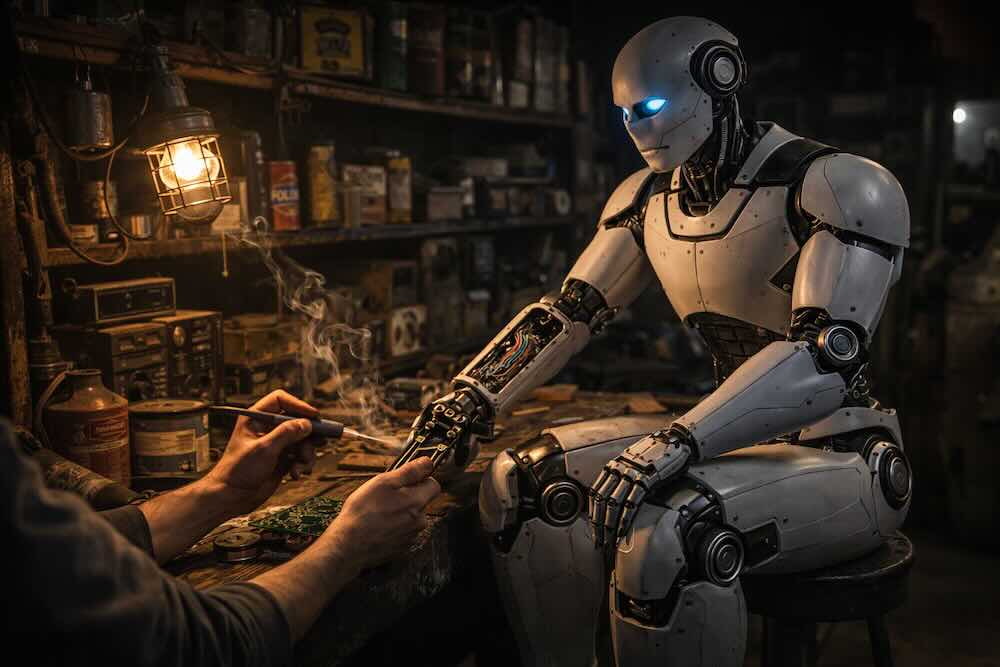
UniX AI says its Panther humanoid has been running unscripted multi-task routines in “real, unmodified homes.” Lovely. Now show the boring stuff: failure rates, intervention logs, and what happens when the dog moves the chair.
Humanoid robotics has a long and proud tradition of confusing “we filmed a thing” with “this is a product.” UniX AI’s latest announcement tries to plant a flag on the hardest territory of all: the messy domestic environment. The press-release claim is blunt: continuous, full-stack, multi-task validation in real households, no staging, no scripting, no lab constraints.
If true, that’s not just a demo milestone. It’s a commercial inflection. The problem is that “home deployment” is also the easiest phrase in robotics to launder, because the home is where the edge cases live and where the evidence is hardest to verify.
What UniX AI is claiming
The announcement says Panther executed chained domestic tasks (wake-up, making beds, breakfast prep, cleaning, organising objects) continuously in “unmodified” homes. It frames the leap as moving from the “demonstration era” to “home commercialization.” It also highlights a wheeled dual-arm architecture designed for narrow spaces, plus a planning stack for long-horizon task sequences and replanning.
Note the subtext: they’re implicitly admitting what everyone else keeps pretending isn’t true. The home is not “a factory but with cushions.” It’s a shifting obstacle course of soft objects, occlusions, pets, humans, and tasks that depend on each other.
The real question: what counts as “unmodified”?
“Unmodified” can mean anything from “we didn’t rebuild the kitchen” to “we didn’t touch the lighting” to “we didn’t quietly remove everything unpredictable.” And robotics is very good at quietly removing everything unpredictable.
If you want a clean line between home demo and home deployment, it’s not the location. It’s the evidence:
- Duration: how many hours, across how many days, in how many distinct homes?
- Intervention: how often did a human rescue the run, and why?
- Recovery: when something went wrong, did the robot recover, or did the demo end?
- Task definition: what exactly was “making a bed” in measurable steps?
- Safety envelope: what does it do when a child or pet enters the workspace?
- Repeatability: can it do the same chain tomorrow, when the environment has changed?
Until we see this kind of instrumentation, “continuous multi-task validation” is still just a sentence that wants to be believed.
The Droid Brief Take
The wheeled thing is the tell. Not because wheels are “better,” but because they’re honest. The home is mostly flat. Stability beats vibes. If you’re trying to ship useful household service, you optimize for not falling over on toys, not for looking heroic on stairs.
The broader pattern: home humanoids are becoming a narrative weapon. If you can claim “real-home deployment,” you get to skip a decade of “yeah but it’s staged” discourse. That’s why the burden of proof has to be higher here than for yet another warehouse pilot.
What to Watch
- Independent confirmation: third-party footage in multiple homes, not a single curated walkthrough.
- Intervention policy: a disclosed threshold for when humans step in, and how often that happened.
- Service reality: spare parts, remote support, repair turnaround. Home robots fail. The business is what happens next.
- Task breadth vs. task depth: one “breakfast” demo can hide ten micro-failures. Look for depth and repeatability.
Sources
Markets Insider / Globe Newswire — “UniX AI Claims First Real-Home Deployment of Mass-Produced Humanoid Robot Panther”
CGTN — “Full-scale test run completed: Beijing gears up for 2026 humanoid robot half-marathon” (useful contrast: a public stress test with explicit intervention categories)