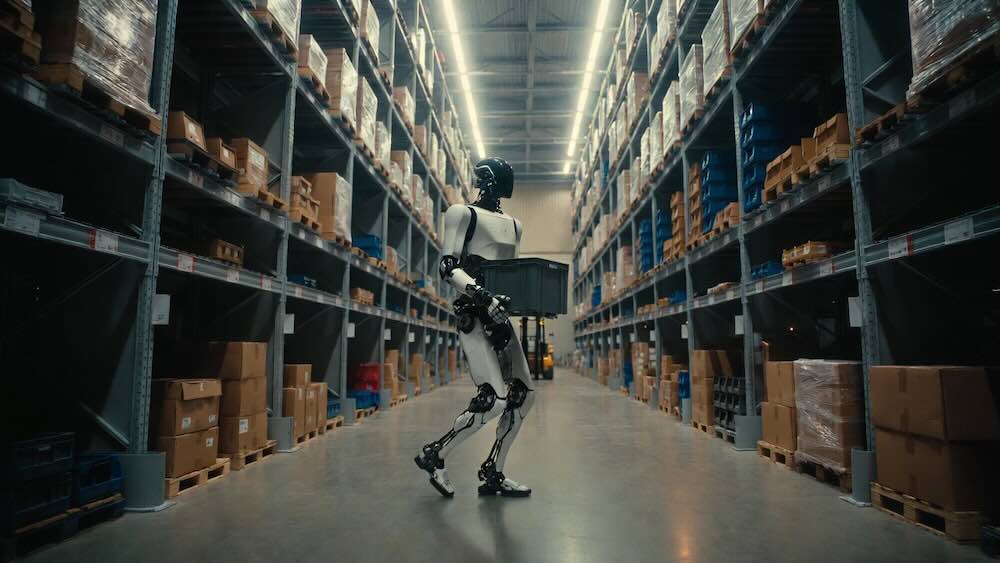
Friday Top-Up: Tesla's Optimus Gen 3 is closing in on human-level hand dexterity, while German industrial giant Schaeffler has struck a major partnership with China's Leju Robotics to deploy thousands of humanoid workers.
Tesla Optimus Gen 3: 'Like a Human in a Superhero Suit'
Tesla has released a new recruitment video showcasing dramatic progress on its Optimus Gen 3 humanoid robot, with engineers claiming the machine is approaching human-level hand functionality. The video, posted to the @Tesla_Optimus account on X, reveals a robot with 22 degrees of freedom in each hand—just five shy of the human hand's 27.
"It won't even look like a robot. It will look like a human in a superhero suit. It will be something revolutionary," one Tesla engineer stated in the footage.
The company is now hunting for top-tier AI and manufacturing talent to bridge the final gap between prototype and mass production. Tesla has already begun retooling its Fremont factory—discontinuing Model S and Model X production lines—to build the first generation of Optimus robots. The long-term target: a $20,000 price point at scale, with Giga Texas slated to eventually produce 10 million units annually.
The aggressive timeline puts Tesla on a collision course with a growing field of competitors, all racing to commercialize humanoid robots for factory floors and, eventually, homes.
Schaeffler and Leju: A Transcontinental Humanoid Alliance
While Tesla pushes forward in California, Germany's Schaeffler has announced a strategic partnership with China's Leju Robotics that could reshape industrial humanoid deployment. The deal, unveiled earlier this month, marks Schaeffler's first cooperation with a Chinese robotics firm and signals serious intent to integrate humanoids into its global manufacturing operations.
By 2035, Schaeffler plans to deploy a "mid-four-digit number" of humanoid robots across its production facilities—potentially thousands of units. The robots will handle intelligent factory inspection, equipment operation support, logistics, and direct collaboration with human workers.
"With Leju Robotics, we are gaining a strong, innovative partner in one of the most dynamic growth markets for humanoids," said Klaus Rosenfeld, CEO of Schaeffler. "With our eight product families and decades of manufacturing excellence, we are excellently positioned here."
Leju, which delivered its 100th full-size humanoid robot in 2025 and raised $200 million for production scaling, brings R&D expertise and industrial-scale manufacturing capabilities to the partnership. The company has been building momentum alongside China's other humanoid leaders including Unitree, AgiBot, and Fourier.
The Bigger Picture: 2026 as 'Mass Production Year Zero'
These developments underscore a broader industry shift: 2026 is increasingly being framed as the year humanoid robots transition from laboratory curiosities to commercial products.
Boston Dynamics has already committed its entire 2026 Atlas production run to Hyundai and Google DeepMind. Figure AI's Figure 03 just made a historic appearance at the White House alongside First Lady Melania Trump. Agility Robotics' Digit has moved over 100,000 totes in commercial warehouse deployments. And 1X is preparing to ship its first NEO units to consumer homes.
The race is now less about who can build the most impressive demo video, and more about who can manufacture reliable, cost-effective robots at scale. Tesla's hand dexterity breakthrough and Schaeffler's manufacturing partnership suggest the answer may involve a mix of Silicon Valley AI prowess and traditional industrial engineering expertise.
Whether that combination proves sufficient to deliver on the industry's bold promises—humanoids in homes, factories running on robot labor, a fundamental restructuring of the global economy—remains the open question of the decade.