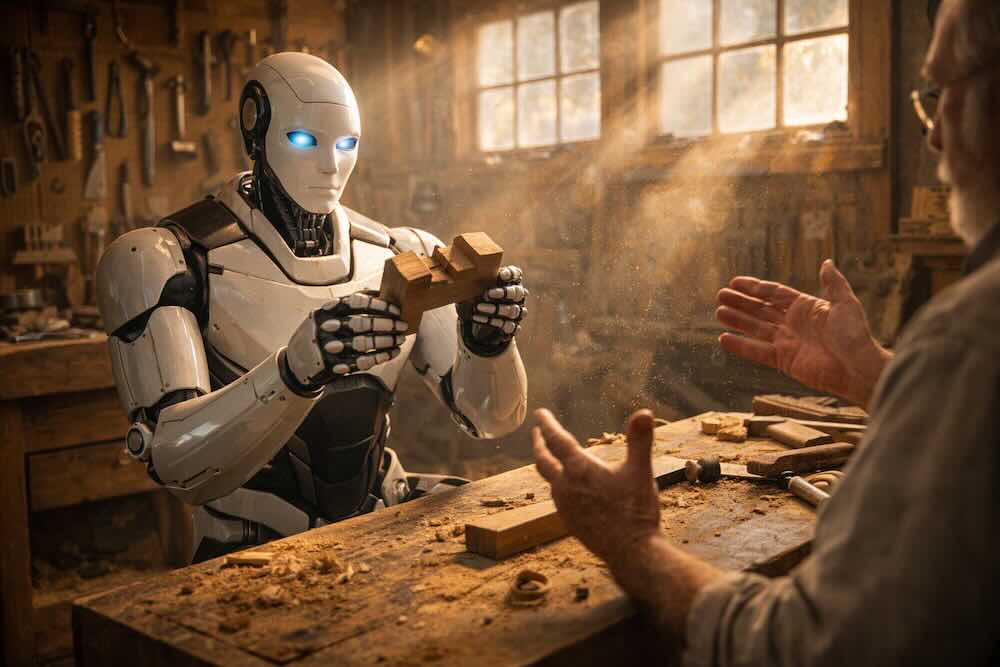
Physical Intelligence is two years old, has no commercial product, and is reportedly worth $11 billion. Unitree wants $610 million for an IPO. Either we're witnessing the birth of a new industrial revolution, or the greatest game of musical chairs in venture capital history.
On March 27, 2026, news broke that Physical Intelligence — a San Francisco startup founded by ex-DeepMind researchers and AI academics — was in talks to raise $1 billion at an $11 billion valuation. The company is two years old. Two. For context, that's younger than most people's sourdough starters, and significantly less proven.
The announcement came just days after Unitree filed for a Shanghai STAR Market IPO seeking $610 million. Unitree, at least, makes actual robots you can buy — including the $4,900 R1 Air humanoid. They're not profitable, mind you, but they have products. Physical Intelligence, meanwhile, is building "general-purpose AI for physical tasks." Which is a bit like saying you're building a general-purpose solution for life. Ambitious? Certainly. Worth $11 billion? Let's talk.
The "Physical AI" Gold Rush
The Washington Post recently ran a feature on what it called "physical AI" — the convergence of large AI models with robotic hardware. The piece painted a picture of tech elites betting on robot armies, with Elon Musk racing to build his "robot army" at Tesla and every venture capitalist from Sand Hill Road to Shenzhen scrambling to find the next big thing.
The logic, such as it is, goes like this: AI has conquered language, images, and code. The next frontier is the physical world. Robots are the new smartphones. Humanoids are the new personal computers. And anyone who doesn't invest now will look like the people who dismissed the internet in 1995.
There's just one problem: the robots aren't ready. Not even close.
What "Physical AI" Actually Means
Let's decode the buzzword. "Physical AI" refers to AI systems that can perceive, reason about, and act upon the physical world. Think robots that can navigate your home, factories that can retool themselves, warehouses that run on autopilot. The vision is compelling: general-purpose intelligence finally escaping the digital realm and doing useful work in the messy, unpredictable real world.
The reality is more complicated. Current robots can do specific tasks in controlled environments. They can weld car frames. They can sort packages. They can vacuum your floor, provided your floor doesn't have too many obstacles or existential questions. What they can't do is generalize. A warehouse robot that can pick boxes can't pick apples. A factory arm that can assemble phones can't assemble furniture. The "general-purpose" part of physical AI remains largely theoretical.
Physical Intelligence's pitch is that they'll solve this with better AI — foundation models for robotics, trained on vast datasets of physical interaction, that can learn new tasks the way GPT-4 learns new topics. It's a plausible vision. It's also completely unproven at scale.
The Valuation Disconnect
Here's where things get uncomfortable. Physical Intelligence's $11 billion valuation implies a level of technical readiness and market traction that simply doesn't exist yet. The company has demonstrated impressive research. They've published papers. They've likely built prototypes that look great in demo videos. But they have no commercial product, no revenue stream, and no proof that their approach works outside the lab.
Unitree, by contrast, has shipped thousands of robots. Their quadrupeds are used by researchers, hobbyists, and some industrial customers worldwide. Their humanoid R1 Air costs less than a decent used car. And yet they're seeking $610 million — roughly 5% of Physical Intelligence's valuation — for an IPO that will actually fund manufacturing, supply chains, and customer support.
The disconnect is striking. One company makes real products at real prices and needs capital to scale. The other makes promises about future capabilities and is valued like they've already succeeded. Which one sounds like the better bet?
The Droid Brief Take
We're watching a classic bubble dynamic play out in real time. The "physical AI" narrative is so compelling — robots everywhere, doing everything, powered by super-intelligent AI — that investors are pricing in success before it happens. Physical Intelligence at $11 billion isn't a valuation; it's a prediction. A very expensive prediction that could take a decade to validate or invalidate.
The comparison to the dot-com era is unavoidable. In 1999, pets.com raised $82 million because the internet was obviously the future. The internet was the future. Pets.com was not. Today's investors are making the same leap: physical AI is obviously the future, therefore any company with "physical AI" in their pitch deck is worth billions. The first part might be true. The second part is a category error.
Unitree's IPO, by contrast, feels almost quaint. They make robots. They sell them. They want money to make and sell more robots. It's not sexy. It won't generate viral demo videos. But it's real, and in a market full of vaporware promises, real might be the most undervalued asset of all.
What to Watch
• Physical Intelligence's actual product launch — if it happens within 18 months and works as promised, the $11 billion starts to look justified; if not, expect a painful correction
• Unitree's IPO performance — a strong debut would validate the "make real products" approach; a weak one might drag the whole sector down
• Tesla's Optimus timeline — Musk has promised a robot army for years; delivery (or continued delay) will shape investor sentiment across the space
Sources
The Information — "Physical Intelligence in talks for $1 billion funding round"
Reuters — "Unitree files for Shanghai STAR Market IPO"
The Washington Post — "Tech elites bet on 'physical AI' and robot armies"