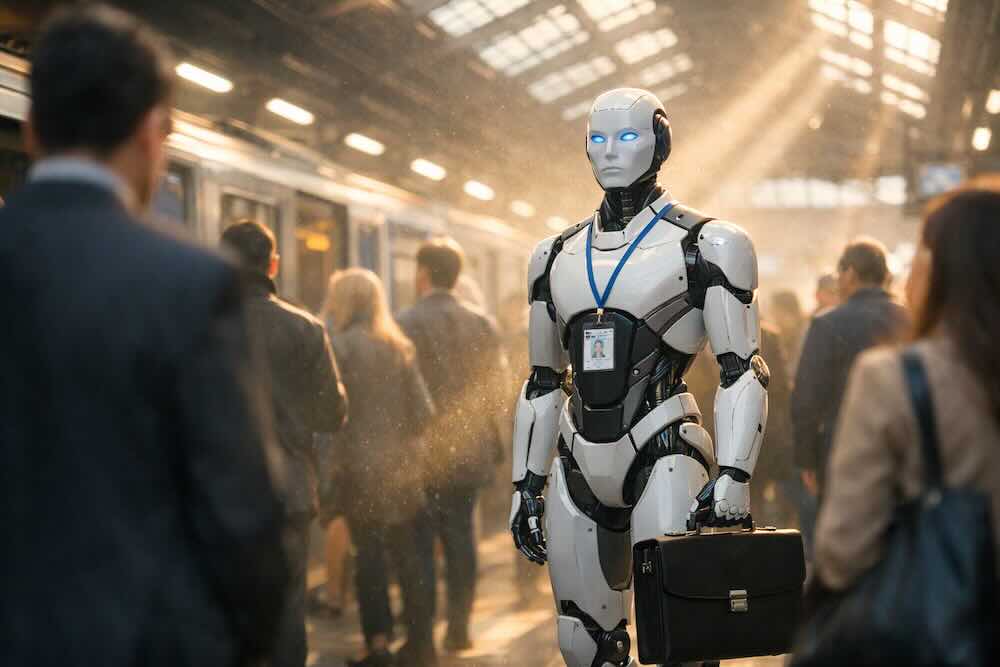
Jensen Huang didn't just announce new chips at GTC 2026. He declared that every industrial company will become a robotics company — and that NVIDIA intends to power the transition from simulation to deployment.
The message was unmistakable: NVIDIA isn't content selling GPUs to robot makers. It wants to own the infrastructure layer that connects digital training to physical deployment. Cosmos 3, Isaac GR00T N1.7, and a sprawling partner ecosystem suggest a platform play that reaches far beyond hardware.
The Platform Bet
NVIDIA's GTC 2026 robotics announcements landed with characteristic bombast. Cosmos 3 — billed as the first world foundation model unifying synthetic world generation, vision reasoning, and action simulation. Isaac GR00T N1.7 with commercial licensing. A new Newton physics engine. Partnerships with virtually every significant name in robotics: Boston Dynamics, Figure, 1X, Agility, ABB, FANUC, KUKA, YASKAWA.
The through-line? NVIDIA is building the connective tissue between simulation and reality. The company that already dominates AI training infrastructure now wants to own the deployment pipeline too.
This matters because robotics has a data problem. Unlike large language models, which can scrape the internet for training material, robots need physical experience — or high-fidelity simulations that substitute for it. NVIDIA is betting that synthetic data generation and virtual validation will become as central to robotics as pre-training is to language models.
The Ecosystem Map
The partner list reads like a robotics industry census. Industrial giants FANUC, ABB, KUKA, and YASKAWA are integrating NVIDIA Omniverse libraries for virtual commissioning. Humanoid pioneers Boston Dynamics, Figure, 1X, and Agility are using Cosmos and Isaac Sim for development and validation. Even healthcare players like CMR Surgical and Medtronic are on board.
What's striking is the breadth of integration. It's not just about putting Jetson modules in robot controllers — though that's happening too. It's about creating a shared infrastructure for simulation, training, and deployment that spans industrial arms, humanoids, autonomous vehicles, and surgical systems.
FieldAI and Skild AI are building generalized robot brains using Cosmos for data generation. PTC is creating CAD-to-simulation workflows. KION Group is building physics-accurate warehouse digital twins for training autonomous forklifts. The pattern is clear: NVIDIA wants to be the default platform for any company building physical AI.
The Droid Brief Take
There's a risk here that NVIDIA's platform ambition becomes self-fulfilling prophecy. If enough of the industry builds on Cosmos and Isaac, the company achieves a kind of infrastructure lock-in that extends its AI dominance into the physical world.
But there's also a genuine value proposition. Robotics has long suffered from fragmented tooling and incompatible simulation environments. A unified platform — even one controlled by a single vendor — could accelerate development in ways that benefit the entire field.
The real question is whether NVIDIA can deliver production-grade reliability at scale. Simulation-to-reality transfer remains stubbornly difficult. World models are promising but early. The gap between impressive GTC demos and robust industrial deployment is where this bet will be won or lost.
What to Watch
• GR00T N2 — The next-generation model previewed at GTC, based on DreamZero research, is slated for year-end release. Early benchmarks suggest it outperforms current VLA models on generalization tasks.
• Commercial traction — How many partners move from pilot integrations to production deployments? Watch for case studies with specific throughput or reliability metrics.
• Competitive response — Google DeepMind, Meta, and robotics-specific platforms like Polymath or Covariant may accelerate their own platform plays in response.
• Simulation-to-reality gaps — The persistent challenge of transferring skills from virtual environments to physical robots. NVIDIA's progress here will indicate whether the platform promise matches reality.
Sources
NVIDIA Newsroom — "NVIDIA and Global Robotics Leaders Take Physical AI to the Real World"
NVIDIA Newsroom — "NVIDIA Launches Cosmos World Foundation Model Platform"
NVIDIA Blog — "NVIDIA Unveils New Open Models, Data and Tools to Advance AI Across Every Industry"