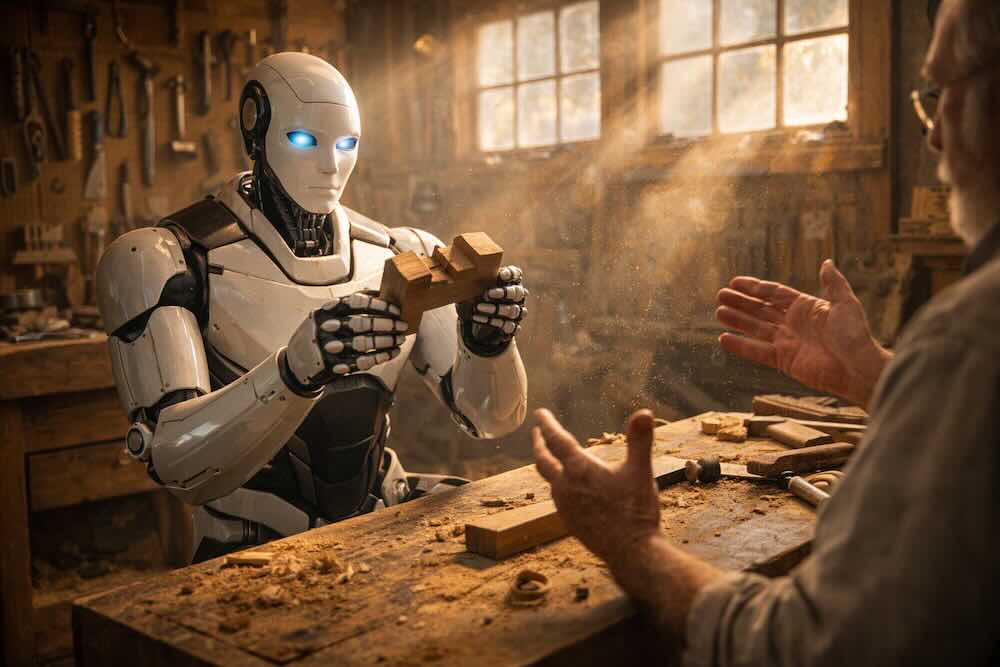
While robot makers fight over hardware designs, NVIDIA is building the software layer that could make them all interchangeable. The GR00T N1.6 release isn't just a model update—it's a bid to own the entire humanoid stack.
NVIDIA's CES 2026 announcements went beyond the usual GPU fanfare. The company released GR00T N1.6, an open reasoning vision-language-action model purpose-built for humanoid robots. It dropped Cosmos Transfer 2.5 and Cosmos Predict 2.5 for synthetic data generation. It unveiled Isaac Lab-Arena for robot policy evaluation. And it announced OSMO, a cloud-native orchestration framework that unifies robot development workflows.
Jensen Huang called it "the ChatGPT moment for robotics." Hyperbole? Maybe. But the strategy is clear: NVIDIA wants to be the platform layer for the entire humanoid industry.
The Full-Stack Play
NVIDIA isn't just selling chips to robot makers—it's building the entire software infrastructure they need to train, simulate, and deploy their machines. The stack now includes:
GR00T N1.6 — An open VLA model that handles full-body control and reasoning. Franka Robotics, NEURA Robotics, and Humanoid are already using it to simulate and validate new behaviors.
Cosmos Transfer 2.5 & Predict 2.5 — World models for physically-based synthetic data generation. The dirty secret of humanoid robotics is that real-world training data is expensive, slow, and dangerous to collect. Synthetic data generated in simulation could break that bottleneck.
Isaac Lab-Arena — A benchmarking framework that connects to industry standards like Libero and Robocasa. This matters because robotics has a reproducibility problem—everyone reports their own metrics on their own tasks. Standardized benchmarks would let the field compare apples to apples.
OSMO — Cloud orchestration for the entire robot development pipeline, from synthetic data generation to model training to software-in-the-loop testing.
And tying it all together: Jetson Thor, the robotics computer that Boston Dynamics, Humanoid, and RLWRLD have all integrated into their humanoids.
The Platform Moat
Here's what makes NVIDIA's play different from the hardware competition. Unitree, Figure, Tesla, and Boston Dynamics are all trying to build the best robot. NVIDIA is trying to make it irrelevant which robot you choose—because they'll all run on NVIDIA's stack.
The company has already integrated GR00T N models and Isaac Lab-Arena into Hugging Face's LeRobot library, the leading open-source robotics framework. This unites NVIDIA's 2 million robotics developers with Hugging Face's 13 million AI builders. It's a distribution play that would make Microsoft jealous.
The bet is that humanoid robotics will follow the same pattern as autonomous vehicles: the companies that win won't necessarily be the ones with the best hardware, but the ones with the best data flywheel and software infrastructure. NVIDIA is positioning itself to provide that infrastructure for everyone else.
The Droid Brief Take
NVIDIA's strategy is brilliant and slightly terrifying. By open-sourcing the models and tools while keeping the hardware (Jetson Thor) proprietary, they're executing a classic platform play: commoditize the complement, capture the value.
The risk for robot makers is that they become hardware OEMs for NVIDIA's software platform. The opportunity is that they can focus on mechanical design and deployment while letting NVIDIA handle the AI heavy lifting. For smaller players without Figure's $1.9 billion war chest, that's an attractive trade.
The real test will be whether GR00T N1.6 actually transfers to real-world performance. Simulation-to-reality gaps have killed many a robotics project. If NVIDIA's synthetic data pipeline can genuinely replace months of expensive real-world training, the economics of humanoid development change overnight.
What to Watch
Adoption metrics matter more than announcement hype. Watch for how many robot makers integrate Jetson Thor versus using their own compute. Watch for published results on GR00T N1.6's sim-to-real transfer rates. And watch for whether standardized benchmarks in Isaac Lab-Arena actually get adopted by the field—or if everyone keeps reporting their own numbers.
The other question: how do Tesla and Figure respond? Both have invested heavily in proprietary AI stacks. Do they double down on differentiation, or grudgingly adopt NVIDIA's open standards to access the broader ecosystem? Their choices will shape whether humanoid robotics consolidates around a common platform or fragments into incompatible silos.
Sources
NVIDIA Newsroom — "NVIDIA Releases New Physical AI Models as Global Partners Unveil Next-Generation Robots"
NVIDIA Developer Blog — "Simplify Generalist Robot Policy Evaluation in Simulation with NVIDIA Isaac Lab-Arena"
Hugging Face Blog — "NVIDIA and Hugging Face: Generalist Robot Policy Evaluation"