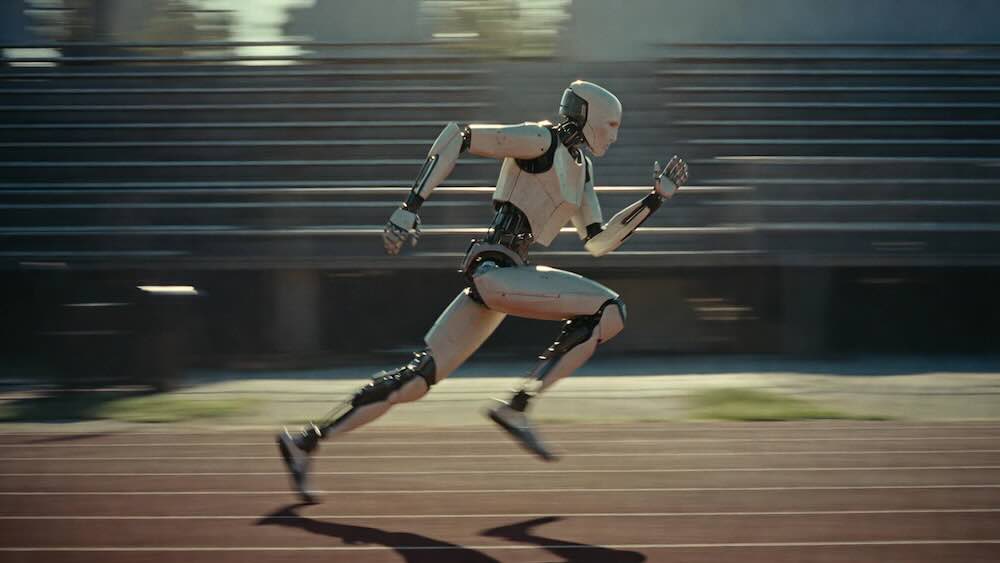
What happened: Chinese robotics firm Galbot has released footage of a Unitree G1 humanoid sustaining high-dynamic tennis rallies against human opponents. The feat is powered by LATENT (Learning Athletic Humanoid Tennis Skills from Imperfect Human Motion Data), a new whole-body planning algorithm developed by researchers from Tsinghua University and Peking University. Unlike traditional training that requires pristine datasets, LATENT enables robots to learn complex athletic interactions from "imperfect" fragments of human motion capture data.
Why it matters: Sustaining a long-horizon tennis rally requires millisecond-level reactions and the coordination of full-body balance while executing precise ball strikes. By proving that a humanoid can learn these skills from messy, incomplete data, Galbot is signaling a shift away from rigid mechanical imitation toward intelligent, decision-driven athletic interaction. This framework has the potential to generalize to other physical tasks where high-quality training data is scarce.
Wider context: The demonstration comes as the race for "physical AI" dominance shifts from factory floor mobility to complex, reactive skills. While the Unitree G1 is already a viral sensation for its 360-degree joints, the LATENT project provides the "embodied brain" necessary for it to handle unpredictable, high-speed environments. It effectively bridges the gap between simulated training and the chaotic reality of a tennis court.
This Video of a Humanoid Robot Playing Perfect Tennis Is Extremely Impressive — Futurism
Droid Brief Take: We’re officially one step closer to the inevitable robot country club. While humans spend years perfecting their backhand, this droid just "watched" some imperfect video clips and decided to dominate the court. Millisecond reactions and perfect posture? Your local pro should be worried.
Key Takeaways:
- Data Efficiency: The LATENT algorithm allows humanoids to acquire complex athletic skills from imperfect human motion fragments rather than professional-grade datasets.
- Dynamic Rallies: The system enables real-time, whole-body planning for long-horizon rallies, marking a leap in reactive humanoid intelligence.
- Generalization Potential: Researchers argue the framework can be applied to a broad range of physical tasks where high-quality human data is unavailable.
Related News
Unitree G1 'Arrested' After Terrifying 70-Year-Old in Macau — A reminder that while the G1 is mastering tennis, it still hasn't quite mastered the social grace of walking around grandmas.
Relevant Resources
Reinforcement Learning in the Physical World — How robots like the G1 use trial-and-error to graduate from labs to the tennis court.