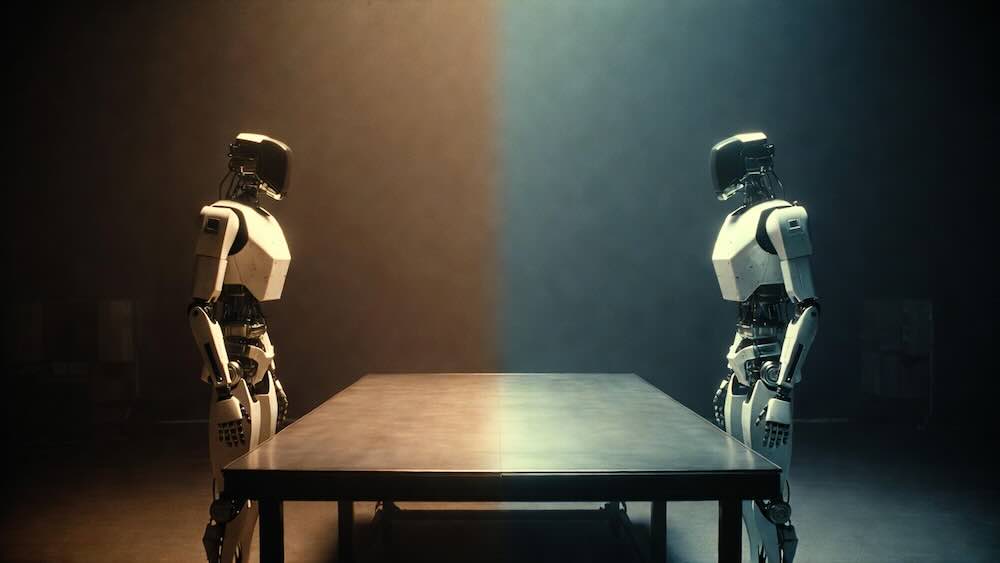
What happened: China has created a new profession: robot trainer. At the Hubei Humanoid Robot Innovation Center, young workers in motion-capture suits and VR headsets spend their days teaching humanoid robots to grind coffee beans, pour hot water, and navigate kitchens. The robots mirror their every movement, learning through physical demonstration rather than magical autonomy.
Why it matters: Job postings in China's humanoid robot sector jumped 409 percent in early 2025. Morgan Stanley projects Chinese humanoid sales doubling to 28,000 units in 2026. Behind those numbers is a small army of human trainers doing the tedious work that makes robots look competent on camera.
Wider context: The innovation center hosts over 20 simulated environments—hospitals, supermarkets, offices—where trainers collect data on motion trajectories, force, and tactile feedback. China accounted for 90 percent of global humanoid robot shipments in 2025, according to Omdia. The 15th Five-Year Plan explicitly targets embodied AI as a future industry.
Background: Humanoid robots wowed audiences at this year's Chinese New Year gala with kung fu moves. But the industry is now racing to turn spectacle into utility. Training centers are mushrooming across Anhui, Zhejiang, and Shandong provinces. As one engineer noted: "There's no ready-made textbook for training robots."
Robot "teachers" preparing China's humanoids for real-world jobs — Xinhua
Droid Brief Take: Nothing says "autonomous future" like needing humans in spandex suits to teach robots how to hold a coffee cup. The real story here isn't robot capability—it's the hidden labor making the demo reel possible. Your participation may be optional, but theirs definitely isn't.
Key Takeaways:
- Hidden Workforce: Robot trainers spend eight-hour days producing just 3.5 hours of usable training data, with the rest consumed by repetition and correction.
- Explosive Growth: China's humanoid sector saw 409% more job postings and 396% more job seekers in early 2025 compared to the previous year.
- Scale Dominance: China shipped 90% of the world's humanoid robots in 2025, with sales projected to hit 28,000 units in 2026.
- Training Reality: Even simple motions require hundreds or thousands of repetitions—there's no shortcut to embodied intelligence.