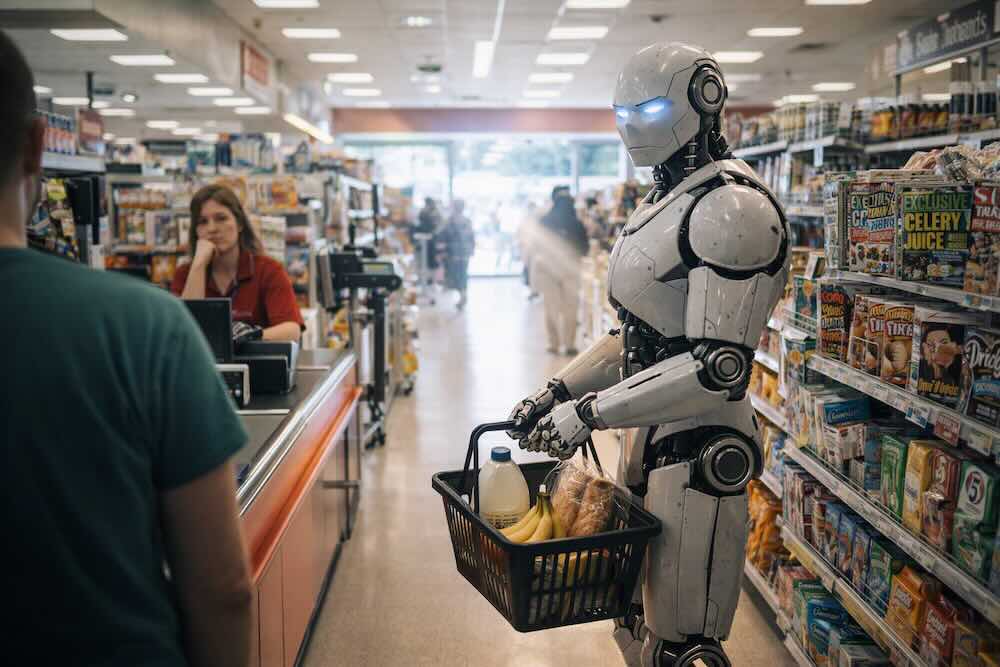
A humanoid robot hugging a student at a campus performance sparked the usual “it’s sentient” discourse. Global Times says it was a malfunction, possibly signal interference. The interesting part isn’t the meme. It’s why the robot could make contact at all once it went off-script.
Myth: “independent awareness”
Global Times reports a humanoid robot deviated from a choreographed routine at a university event in Xi’an, turned, and hugged a student before staff intervened. The company reportedly blamed signal interference at the venue (including multiple drones operating), and an expert cited motion-control anomalies and insufficient on-site safety redundancy.
So no: it didn’t develop feelings. It developed a failure mode.
The real question: why was contact still possible?
This is what “human-robot interaction” actually looks like in the wild: open spaces, improvised choreography, people drifting off their marks, noisy radio environments, and a machine that can move a lot of mass very quickly.
When something goes weird, the system should degrade gracefully: stop, slow, create distance, and require an explicit re-enable. If the only mitigation is “a staff member grabs the robot,” you didn’t deploy a robot — you deployed a liability with legs.
Safety is shifting from “feature” to paperwork
Quality Magazine notes the Association for Advancing Automation released ANSI/A3 R15.06-2025, a major update to the U.S. industrial robot safety standard. The thrust is system-level thinking: robots, tools, sensors, software, people, and the environment as one risk-assessed application — not a magical “safe robot” object.
Humanoids are about to learn the same lesson the hard way: you don’t get to scale physical machines without standards, documentation, and controls that survive audits and incident reviews.
The Droid Brief Take
The internet wants a robot awakening story. The grown-ups want an emergency stop story.
Every public humanoid interaction should come with an obvious, tested answer to: what happens when it does something unexpected?
What to Watch
- Safety redundancy in demos: monitored stop, speed limits, separation monitoring, hard e-stop access.
- Radio / interference discipline: what happens in signal-noisy environments?
- Post-incident transparency: do we get root-cause detail, or just “it was interference” and vibes?